Guides · For job seekers
Warehouse Worker Resume: Your Rate, Your Accuracy, and the Equipment You Run
Warehouse worker resumes are read for three numbers and a short equipment list. Here's how to write yours with your real pick or pack rate, your accuracy, the systems and equipment you used, and the safety record a warehouse manager checks.
Published 10/11/2026 · Updated 10/30/2026
A warehouse worker resume is read by a hiring manager or a staffing recruiter who fills shifts for a living. They are looking for three numbers and a short list: how fast you work, how accurate you are, how reliably you show up, and which equipment and systems you can run on day one. A resume that says “hard-working team player responsible for picking and packing orders” gives them none of it, and it looks like many other applications in the pile.
The good news is that warehouse work is measured closely, and in many buildings your rate, your accuracy, and your attendance were tracked every shift. Put those numbers on the page.
Lead with your rate, your accuracy, and your equipment
Before: “Warehouse associate responsible for picking, packing, and shipping orders in a fast-paced environment.”
After: “Warehouse associate at a [regional fulfillment center], [night] shift: picked about [140] units an hour on an RF scanner at [99.8]% accuracy; trained on the electric pallet jack and the pick-to-light line; [12] months with no safety incidents and no missed shifts.”
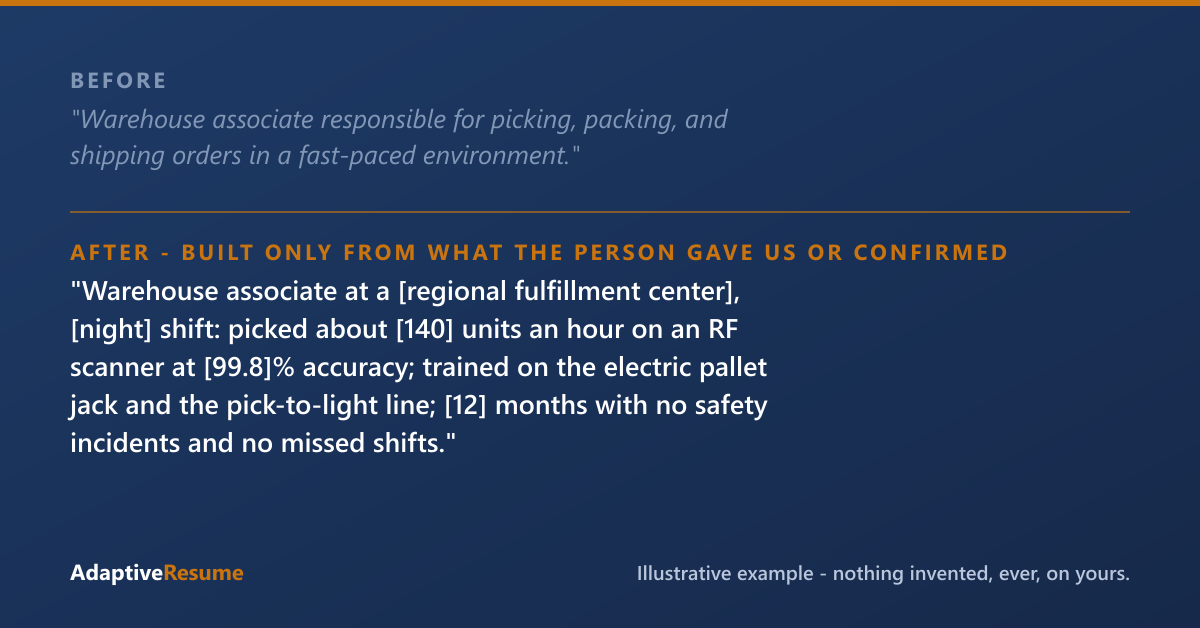
Illustrative example. Everything on your resume is yours: the experience you listed, plus the systems, equipment, and safety training your work already involved, each added only after you confirm it’s true.
The second version tells the manager the setting, the speed, the accuracy, the equipment, and the reliability in two lines. Use the numbers you know from your own shifts, such as your usual pick rate, and leave off any figure you could not explain in an interview.
The numbers a warehouse manager reads
Rate. Give your rate in units per hour, lines per hour, cases per hour, or orders per shift, depending on how your building counted it. Write the unit your warehouse used, because “140 units an hour” and “140 lines an hour” are very different jobs. If you met or beat the standard, say so: “about 110% of the standard rate across peak season.”
Accuracy. Give your pick accuracy, pack accuracy, or the error rate on your counts. Accuracy matters as much as speed, because a wrong item can cost the warehouse a return and a customer.
Attendance and reliability. Count your months without a missed shift, the overtime and peak-season shifts you worked, and any attendance or performance recognition. In a business that runs on full shifts, this is a selling point, not a filler line.
Safety. Write your months or years without a recordable incident, the safety training you completed, and any safety-team role.
Where your numbers come from
Many warehouses show your rate on the scanner or a daily screen, and some states now require it in writing. California’s warehouse quota law, for example, requires covered employers to give each worker a written description of each quota they are subject to, including the number of tasks or items expected in a set time. New York, Washington, Minnesota, and Oregon have passed similar notice laws for large warehouse employers. If you received one of those notices, it tells you exactly how your work was measured, and your own results against it are honest resume numbers.
If no one ever gave you a number, estimate from a normal shift, round it down, and mark it as approximate. A manager would rather see “about 100 units an hour” than a precise figure you cannot explain in the interview.
Warehouse worker resume skills that carry weight
Scanners and systems. Name the RF handheld scanners, voice picking headsets, pick-to-light and put-to-light systems you used, and the warehouse management system (WMS) by name if you know it, such as Manhattan, Blue Yonder, SAP, Oracle, or the company’s own system. Knowing the system shortens your training, and recruiters often search for those names.
Equipment. List the equipment you ran, such as manual pallet jacks, electric pallet jacks, order pickers, reach trucks, sit-down forklifts, carts, and conveyors. An electric pallet jack counts as a powered industrial truck under OSHA’s rule, so the training and evaluation your employer gave you are worth naming, along with the truck type.
Receiving and inventory. Describe receiving work such as unloading trucks, checking shipments against the paperwork, putaway, cycle counts, and inventory adjustments in the system. Cycle-count accuracy is a number worth writing.
Packing and shipping. Describe packing to standard, choosing box sizes, labeling, building pallets, wrapping loads, loading trailers, and working with bills of lading and carrier pickups.
Stocking and replenishment. Show that you kept pick locations full, rotated stock first in, first out, and handled temperature-controlled or hazardous products if your building carried them.
Moving up from the floor
The lines that point upward matter even for an entry-level job: training new hires, covering a lead’s duties, running a cycle-count team, getting trained on a second piece of equipment, or moving from picking into receiving or inventory control. Each one shows the manager that you can be trusted with more. If you are aiming at a lead or supervisor job next, our warehouse supervisor resume guide covers what that role is read for, and our forklift operator guide covers moving into a driving role.
Format notes
Length follows your history. A warehouse worker with one or two jobs usually fits on one page, and that is fine. Two pages is normal and expected once you have more than one substantive job to describe, such as several warehouses plus a military or retail history. Keep the numbers, the equipment, the systems, and the safety record; cut the duties every warehouse job shares.
Use reverse chronological order and a single column, and leave out graphics and photos. Large warehouse employers and staffing agencies run applications through hiring software, and a two-column template can scramble the read. List staffing-agency jobs under the agency’s name with the warehouse you worked at, for example “[Staffing agency], assigned to [warehouse],” so the dates make sense.
Gaps get one plain dated line. Seasonal and peak-season work is normal in this industry, and listing it honestly with its dates reads well.
Warehouse worker resume examples: a bullet bank you can adapt — keep only what’s true
- “Picked about [N] [units/lines] an hour on an RF scanner at [N]% accuracy; met or beat the standard rate [N] weeks in a row”
- “Packed [N] orders a shift to standard; [N]% pack accuracy across [peak season/the year]”
- “Unloaded and received [N] trucks a shift; checked shipments against the paperwork and put away product in [WMS]”
- “Ran cycle counts on [N] locations a week at [N]% count accuracy”
- “Trained and evaluated on the [electric pallet jack/order picker/reach truck] by [employer], [year]”
- “Built and wrapped [N] pallets a shift and loaded [N] trailers for carrier pickup”
- “[N] months with no missed shifts; worked every peak-season overtime shift offered”
- “Trained [N] new hires on the pick line and covered the lead’s duties on [N] shifts”
What screening software looks for on a warehouse worker resume
Filters commonly read for: warehouse associate, warehouse worker, picker, packer, material handler, order picking, packing, shipping, receiving, putaway, inventory, cycle count, RF scanner, voice picking, pick-to-light, WMS, pallet jack, electric pallet jack, forklift, order picker, reach truck, loading, unloading, pallet building, FIFO, accuracy, units per hour, safety, OSHA, and peak season. O*NET’s profile for stockers and order fillers has the full task list, and hand material movers have their own profile.
The highest-risk lines are the ones a warehouse can check in a phone call: a rate your last building will not confirm, equipment you were never evaluated on, or a job title changed to match the posting. Write what you actually did and how you were measured.
The Role Skills Checklist below helps you inventory what your warehouse history actually proves, which is usually more than the resume currently says. Our build does it with you: we work backwards from your real jobs, shifts, and equipment, and we ask you about the systems, certifications, and safety training that work like yours normally involves. Nothing goes on your resume that you didn’t give us or confirm, so a rate, a piece of equipment, or a system you never told us about stays off the page.
Common questions
How do I find my pick rate if I never wrote it down?
Start with what your warehouse told you. Many fulfillment operations show workers their rate on the scanner, a screen, or a daily report, and in several states large warehouse employers must give workers a written description of the quotas they are held to. If you never saw a number, estimate honestly from a typical shift, such as orders picked divided by hours worked, and write it as approximate.
I have no warehouse experience. What goes on the resume?
List the work that carries over. Retail stocking and receiving, restaurant prep and dish work, landscaping, moving jobs, and military supply work all show that you can do physical work on a schedule, count accurately, and follow safety rules. Write those jobs with their numbers, add any equipment you have used, and list forklift or electric pallet jack training only if an employer trained and evaluated you on that truck.
Should I list my forklift experience on a warehouse worker resume?
List it if you were trained and evaluated on that truck by an employer. Name the truck type and the employer. If you want to move into a driving role, our forklift operator guide covers how operators write the truck classes and the evaluation.
What is the difference between a warehouse worker and a warehouse supervisor resume?
The difference is scope. A warehouse worker resume is built on your own rate, accuracy, equipment, and attendance. A supervisor resume is built on the crew you ran and the building's numbers. If you have covered for a lead or trained new hires, say so on your worker resume; that is the step toward supervision.
Role Skills Checklist
Pop your email in and the download unlocks right here. Joining our list also takes 25% off your first purchase within 30 days of joining, when you create your account with this same email. We'll also send the occasional useful note. No spam.
Download: Role Skills ChecklistThanks, you're on our list, and your download is ready just above. Your 25% off a first purchase is good for 30 days from the day this email joined our list.
That email didn't look right — mind trying it again?
Ready to do this on your own resume?
We'll find what you've left off, and nothing goes on your resume that you didn't give us or confirm.
Get your resume build — $29Every purchase is one payment, and nothing renews. A single resume build can be used any time within 12 months of buying it, and AR Pass builds you don't use end when its 90 days end.
Try the demo first — a sample review, no sign-up · See how the service works
Paid a resume service and got a template back? Start at Fix my resume.