Guides · For job seekers
Forklift Operator Resume: Trucks, Numbers, and Safety Proof
Forklift operator resumes are read for which trucks you run and what your numbers were — picks per hour, accuracy, incident-free streaks. How to write yours honestly, including the exact wording for your OSHA training that reads better than 'forklift certified.'
Published 09/04/2026
A forklift operator resume is read for two things: which trucks you can run, and what your numbers were when you ran them. A sit-down counterbalance, a stand-up reach truck, and an order picker are different machines with different learning curves, and a posting that says “reach truck experience required” is a filter. A resume that just says “forklift” doesn’t pass it.
The second thing — and the one this guide spends real time on — is how you word your training. Template resumes everywhere say “forklift certified.” There is no national forklift license or certification, and the reader who matters most, the safety-conscious hiring manager, knows it. Getting that one line right does more for you than any formatting trick.
Lead with your trucks and your numbers
Under each employer, give the context in one line before the bullets — shift, the trucks you ran, what you moved, and the numbers you were held to.
Before: “Operated forklift to move products around the warehouse.”
After: “Ran a stand-up reach truck and order picker on second shift, trained and evaluated under OSHA 1910.178; picked ~[N] lines/hour at [N]% scanner accuracy in [SAP EWM / Manhattan]; [N] months incident-free.”
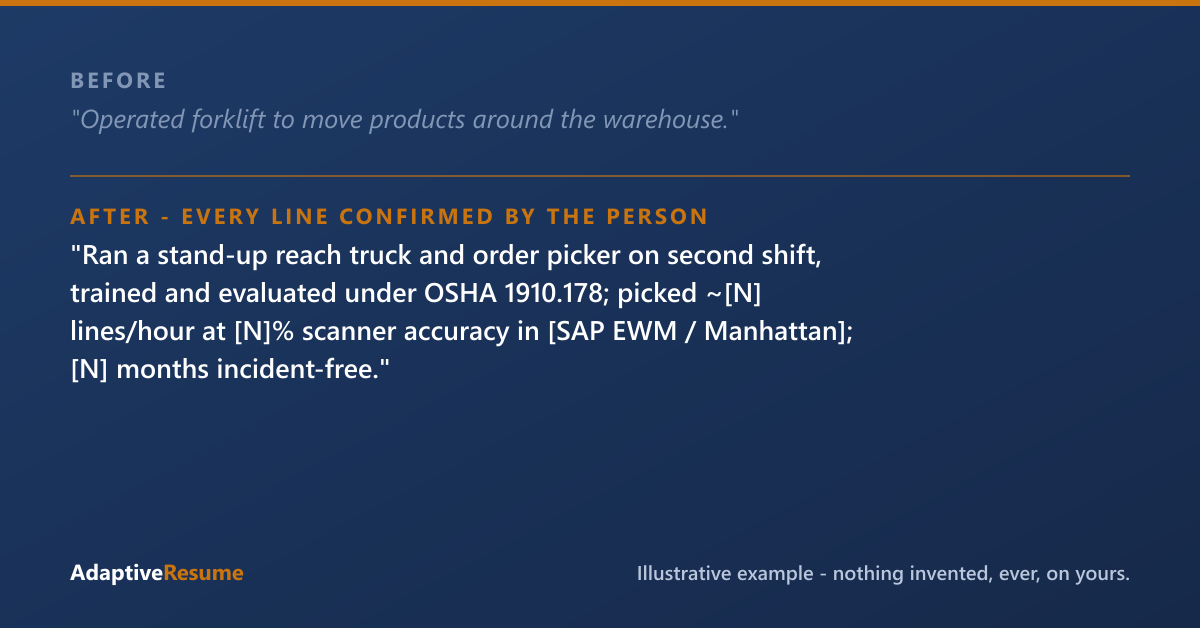
Illustrative example. On your resume, every line comes from your real history — proposed as a question, added only when you confirm it.
The second version answers the questions the first one forces a reader to guess at: which truck, how fast, how accurate, how safe. It also names the warehouse system by brand, which matters more than it looks — postings filter on it.
Name the truck, not just “forklift”
OSHA’s powered industrial truck standard, OSHA groups powered industrial trucks under its standard, 29 CFR 1910.178, into seven classes, Class I through Class VII — from electric riders to rough-terrain machines. You don’t need to recite the list, but you do need to name what you’ve operated in the words hiring managers use:
- Sit-down counterbalance (Class I electric, or Class IV/V internal combustion) — the classic dock-and-aisle forklift.
- Stand-up reach truck (Class II narrow aisle) — high racking, tight aisles.
- Order picker (Class II) — you go up with the load, picking at height.
- Electric pallet jack / walkie rider (Class III) — the workhorse of pick lines and trailers.
For each type, a year count and a setting (“reach truck, [N] years, racking to [N] feet”) is worth more than an adjective. If you’ve run internal-combustion trucks outdoors, or a tow tractor, or rough-terrain equipment on a yard, say so — those are separate skills.
One more line that separates operators who know their machine from operators who drive it: the data plate. Every truck’s rated capacity assumes a load center — commonly rated at 24 inches, the distance from the fork face to the load’s center of gravity — and capacity drops as the load center moves out. If you’ve handled long, wide, or off-center loads and adjusted for it, that’s a real bullet, and it tells a safety manager you understand why the plate matters.
”Forklift certified” — what’s actually true, and why the honest version reads better
Here is the wording that holds up. OSHA’s powered industrial truck standard, 29 CFR 1910.178, requires employers to train and evaluate every operator, to re-evaluate at least once every three years, and to certify in writing that it was done. There is no national forklift license, so the honest wording is employer training:
Forklift operator — trained and evaluated under OSHA 29 CFR 1910.178 (sit-down counterbalance, stand-up reach, order picker, pallet jack); last evaluation [year].
Why bother, when every template says “certified”? Because the person reading your resume for a warehouse job has sat through the same standard you have. “Certified” with no issuer named reads like a phrase copied off a template. “Trained and evaluated under OSHA 1910.178” reads like an operator who knows exactly what their employer signed. When the job is keeping people from getting hurt around several thousand pounds of moving steel, sounding precise about safety is the whole audition.
Two more safety lines worth writing precisely:
- Pre-shift inspections. The standard, at 1910.178(q)(7), requires trucks to be examined before being placed in service — at least daily, and after each shift where trucks run round the clock. “[N] years of pre-shift inspections, defects tagged and reported same day” is a line a safety manager stops on.
- Hazmat awareness. If your building shipped hazardous materials and you took DOT (Department of Transportation) hazmat employee training under 49 CFR 172.704, list it with the year. Only list it if you actually took it.
If your site tracked a Total Recordable Incident Rate (TRIR — recordable injuries per 200,000 hours worked) and you know where your shift landed, you can write it; if you don’t know the figure, “[N] months / [N] years incident-free” is just as readable and easier to stand behind.
RF scanning and the warehouse system
If your building ran RF (radio frequency) scanning — the handheld or truck-mounted scanner that drives your picks and putaways — say so, and name the system behind it by its actual product name if you know it: SAP Extended Warehouse Management (SAP EWM), Manhattan, Blue Yonder, or whatever your building ran. “Used a WMS” (warehouse management system) without the brand doesn’t pass the filter that “Manhattan experience preferred” creates.
Environment counts too. Cold storage and freezer work is its own qualification — the pace, the gear, the condensation on the truck — so if you’ve picked or hauled in a [freezer / cooler] environment, write it with the hours: “[N] hours/shift in freezer conditions.” Trailer loading and unloading, dock work, wrapping and staging, cycle counting from the truck — all of it belongs on the page in plain words.
Warehouse worker resume — same rules, whatever you’re pushing
If your title is warehouse associate, picker, packer, loader, or material handler, everything above applies at your scale — the truck section just gets smaller and the numbers get bigger. Replace “responsible for picking and packing orders” with what you actually moved and how well: “picked ~[N] lines/hour at [N]% accuracy on an RF scanner; loaded [N] trailers/shift; [N] months incident-free.” Name the equipment you do run, even if it’s a manual pallet jack, and name the system.
Then write the lines that point upward: trained new hires on the pick line, ran the cycle count team, covered the lead’s duties, learned a second truck type. If you’re aiming past the floor entirely, our warehouse supervisor resume guide covers the crew-size, throughput, and safety proof that role is read for.
Format notes
Length follows your history, not a page rule. If you’ve run trucks in three buildings, or you came to the floor from another trade, that history is your advantage — don’t cram it into one page to satisfy a convention.
The honest rule: two pages is normal and expected once you have more than one substantive role to describe. Every line still has to earn its space. Cut duties every operator shares — “followed all safety procedures” — and keep truck types, numbers, systems, and your record.
One genuine exception worth knowing: federal applications through USAJOBS cap at two pages as of the September 2025 OPM change. Federal warehouse and materials-handling jobs exist, so if that’s where you’re headed, treat it as a hard requirement.
Otherwise: reverse chronological, single column, a one-line scope statement under every employer, and a clearly labeled block for equipment and systems. Skip the graphics and skill bars — the software that reads your file first handles plain text best.
A bullet bank you can adapt — keep only what’s true
- “Operated [sit-down counterbalance / stand-up reach / order picker / pallet jack] on [shift]; trained and evaluated under OSHA 1910.178, last evaluation [year]”
- “Picked ~[N] lines/hour at [N]% scanner accuracy in [SAP EWM / Manhattan / Blue Yonder]”
- “Moved ~[N] pallets/shift across [receiving / putaway / replenishment / shipping]”
- “Loaded and unloaded [N] trailers/day; staged, wrapped, and shipped at [N]% on-time”
- “[N] months incident-free; completed pre-shift inspections daily and tagged [N] defects for repair”
- “Worked [N] hours/shift in [freezer / cold storage] conditions at [temperature] without missing rate”
- “Completed DOT hazmat employee training (49 CFR 172.704), [year]; handled [hazard class] freight”
- “Trained [N] new operators on [truck type] and the [WMS] scanner flow”
What screening software looks for on a forklift operator resume
Filters commonly read for: forklift operator, powered industrial truck, sit-down, counterbalance, reach truck, order picker, pallet jack, electric pallet jack, cherry picker, clamp truck, OSHA, 1910.178, pre-shift inspection, RF scanner, WMS, SAP EWM, Manhattan, Blue Yonder, picking, putaway, replenishment, loading, unloading, shipping and receiving, cycle counts, inventory, pallets, LTL (less-than-truckload), cold storage, freezer, hazmat, safety, and incident-free. O*NET’s profile for industrial truck and tractor operators lists “Forklift Operator” among its reported titles and has the full task list.
The highest-risk lines are the ones that overstate a credential — a “license” no one issues, a truck class you’ve never sat in, a rate you never hit. The people hiring you have driven the same trucks and read the same standard, and the precise, honest version of your experience is the one that sounds like an operator they’d trust.
The Role Skills Checklist below helps you inventory what your shifts actually prove, which is often considerably more than the resume currently says. Our build does it with you: we work backwards from your real trucks, rates, systems, and record, propose the standards and equipment that work like yours normally involves, and ask you to confirm every item before it appears. We never add a credential, a truck type, or a number you didn’t tell us about.
Common questions
Can I write 'forklift certified' on my resume?
There is no national forklift license or certification, so 'certified' on its own invites a question you don't want. What actually exists: OSHA (the Occupational Safety and Health Administration) requires your employer to train and evaluate you under 29 CFR 1910.178 and to certify in writing that it was done. So write it as employer training: 'Forklift operator, trained and evaluated under OSHA 1910.178 — sit-down counterbalance, stand-up reach, order picker, pallet jack,' with the year of your last evaluation. To a safety-conscious reader, that wording says you understand the rule better than 'certified' ever could.
Does my forklift training carry over to a new employer?
Your skills do; the paperwork doesn't. The OSHA standard puts the training duty on each employer, so a new building will evaluate you on their trucks in their workplace before you operate solo — though an operator with prior training who shows competent in that evaluation doesn't have to repeat the whole course. Your resume's job is to make that evaluation an easy yes: name the truck types, the years on each, and your record.
Which numbers should I put on a forklift operator resume if I never saw the official reports?
Use the numbers you can stand behind. You know roughly how many pallets you moved or lines you picked on a normal shift, whether your scanner accuracy was tracked and where it landed, and how long you went without an incident. Write those with an honest 'about' or a range, and leave off anything you'd have to guess at. '~[N] picks/hour' that you can back up beats a precise figure you can't.
Should I list the OSHA truck classes by number?
Names first, classes if you like. Hiring managers post for 'reach truck' and 'order picker,' not 'Class II.' Naming the class as well — 'Class I sit-down counterbalance, Class II stand-up reach' — is a small, honest signal that you know the standard, and it costs you nothing. Just never list a class or truck type you haven't actually operated.
Role Skills Checklist
Pop your email in and the download unlocks right here — and being on the list before launch day locks in 25% off your first build. We'll also send the occasional useful note and tell you the moment AdaptiveResume goes live. No spam.
Download: Role Skills ChecklistThanks — you're on the launch list, your 25% is locked in, and your download is ready below.
That email didn't look right — mind trying it again?
Ready to do this on your own resume?
We'll find what you've left off and you approve every line — nothing made up.
Build your resume — $49Try the demo first — a sample review, no sign-up · See how the service works
Paid a resume service and got a template back? Start at Fix my resume.