Guides · For job seekers
Underwriter Resume: Authority, Volume, and the Line You Work
Underwriter resumes are read for three things first: what line of business you underwrite, how much authority you hold, and how many files or accounts you move. How to write yours honestly — mortgage and insurance branches covered separately.
Published 09/02/2026
“Underwriter” is one word for at least two different jobs. A mortgage underwriter reads credit, income, and collateral against agency guidelines and signs off on a loan. An insurance underwriter prices and accepts or declines risk on a policy. The systems, the credentials, and the numbers are different, and a resume that just says “underwriter” makes the reader do the sorting. Tell them which one you are in the first line.
The second thing a hiring manager wants is your authority and your volume: how large a loan or account you can approve on your own signature, and how many files or how much premium you move in a month. Most underwriter resumes never say either. They say “reviewed applications in accordance with guidelines,” which describes every underwriter alive.
Lead with your line, your authority, and your volume
Under each employer, give the context in one line before the bullets — line of business, authority level, monthly volume, and the systems the work ran through.
Before: “Reviewed and approved loan applications in accordance with company and investor guidelines.”
After: “Conventional and FHA underwriter; [N] files per month with signing authority to [$X]; DU and LPA findings reviewed on every file; [N]% of suspended files cleared to approval within [N] business days.”
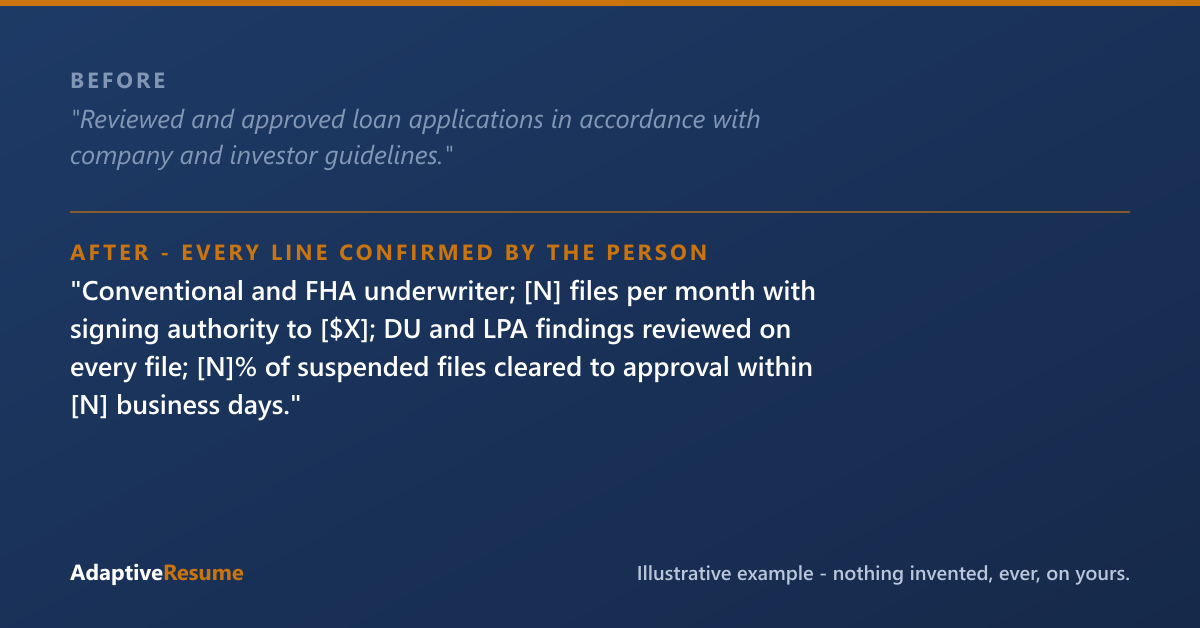
The second version answers what the first leaves a reader guessing: which programs, how much you can sign for, how fast, and which automated systems you actually ran. For an insurance underwriter the same line looks like: “Commercial package and BOP; book of [$X] written premium; authority to [$X] per account; quotes turned in [N] days on average.” Same shape, different nouns.
Insurance underwriter resume
Name the line of business and the market segment. Commercial property, general liability, workers’ compensation, commercial auto, personal lines, excess and surplus, life, disability, or health — say it plainly, and say whether you worked small business, middle market, or large accounts. Insurance hiring is segmented by line, and a “P&C underwriter” with no line named competes badly against people who name theirs.
Put the numbers on the page. The metrics insurance managers read for are the ones they’re measured on themselves: loss ratio (claims paid against premium earned), hit ratio (quotes that bound as policies), written premium on your book, authority limit per account, quote turnaround, renewal retention, and new-business count. If your book beat plan, say by how much. If you inherited a book and improved it, say what changed.
Systems are a hard filter. Name your policy administration and rating platforms — Guidewire PolicyCenter, Duck Creek Policy, or whatever your carrier runs — plus rating tools and any ISO or NCCI classification work you did. Larger carriers screen for the platform by name.
Designations, exactly as held. For property-casualty, The Institutes issues the CPCU (Chartered Property Casualty Underwriter), the AU (Associate in Commercial Underwriting), and the AINS (Associate in Insurance). For life and health, LOMA issues the FLMI (Fellow, Life Management Institute) and ALMI (Associate, Life Management Institute), and the Academy of Life Underwriting confers the AALU (Associate, Academy of Life Underwriting) and FALU (Fellow, Academy of Life Underwriting). List the ones you’ve earned with the year. If you’re mid-program, write “in progress” and the courses completed — that’s honest and it still counts.
Claims adjusters share a lot of vocabulary with underwriters, but the resume is a different one — it’s built on claims handled, reserves, and settlement authority rather than accepting risk.
Mortgage underwriter resume
Name the loan programs. Conventional, FHA, VA, USDA, jumbo, non-QM, construction, HELOC. Then the agency or investor guidelines you worked under. A hiring manager for a government-lending desk wants FHA and VA in the first screen.
Authority and program designations carry real weight. An FHA Direct Endorsement (DE) underwriter is registered by their lender with HUD through FHA Connection and receives an FHA underwriter ID number that follows them between employers — if you hold one, put “FHA DE underwriter” on the page with the year you were registered. For VA lending, a Staff Appraisal Reviewer (SAR) is a lender employee approved by VA under the Lender Appraisal Processing Program (LAPP) to review VA appraisals for the lender; VA requires at least three years of qualifying experience before approval. If you’re SAR-approved, say so. Don’t write DE or SAR because you underwrote FHA or VA files under someone else’s authority — that’s exactly the line a reference check catches.
Automated systems, by name. Fannie Mae’s Desktop Underwriter (DU) and Freddie Mac’s Loan Product Advisor (LPA) are the automated underwriting systems nearly every conventional file runs through. Say you ran them, read the findings, and cleared the conditions. Name your loan origination system too — Encompass from ICE Mortgage Technology is the most common, and postings list it as a requirement.
The metrics. Files underwritten per month, decision turn times, your signing authority in dollars, pull-through (files that closed against files you approved), condition cure rates, and post-closing or investor audit results — a low defect rate on QC review is one of the strongest lines a mortgage underwriter can write. Manual underwriting experience is worth its own line; many underwriters have only worked findings.
One honest note on licensing. NMLS licensing is for loan originators. An underwriter employed by a licensed lender and working under licensed originators generally doesn’t need one; independent contract underwriters are treated differently under the SAFE Act. List an NMLS ID only if you actually hold one.
Junior underwriters and underwriting assistants
If you’re in a trainee or assistant role, describe the real scope: files prepared for a senior underwriter, conditions gathered, income calculated, appraisals reviewed, submissions rated. Volume still matters here — “[N] files prepared per month for [N] underwriters” is a stronger line than “supported the underwriting team.” If you’ve been given limited authority, state the limit. Small authority is still authority.
Format notes
Length follows your history, not a page rule. If you’ve underwritten across two lenders and three loan programs, or moved from processing into underwriting, or came from a credit or claims role that sharpened your judgment — that history is your edge, and cutting it to fit one page throws it away.
The honest rule: two pages is normal and expected once you have more than one substantive role to describe. What matters is that every line earns its place. Cut duties every underwriter shares; keep authority, volume, programs, systems, and audit results.
One genuine exception: federal applications through USAJOBS cap at two pages as of the September 2025 OPM change. That’s a hard requirement, not a style preference.
Otherwise: reverse chronological, single column, a line-of-business and authority line under every employer, and a clearly labeled systems block — DU, LPA, Encompass, Guidewire, Duck Creek, whatever you ran. Skip the graphics. Underwriting is a conservative field; a plain, dense, accurate page is the right signal.
A bullet bank you can adapt — keep only what’s true
- “Underwrote [N] [conventional/FHA/VA/jumbo] files per month with signing authority to [$X]”
- “Registered FHA DE underwriter since [year]; VA SAR-approved under LAPP since [year]”
- “Ran DU and LPA on every file; cleared findings and conditions to approval with a [N]% post-closing defect rate”
- “Managed a [$X] written-premium book in [line of business]; loss ratio of [N]% against a plan of [N]%”
- “Quoted [N] new-business submissions per month in [Guidewire PolicyCenter/Duck Creek]; hit ratio of [N]%”
- “Held authority to [$X] per account; referred [N]% of submissions above authority with written recommendations”
- “Turned quotes in [N] days on average against a service standard of [N]”
- “Prepared [N] files per month for senior underwriters; calculated income and reviewed appraisals on each”
What screening software looks for on an underwriter resume
Filters commonly read for: risk assessment, credit analysis, income analysis, collateral review, appraisal review, DU, LPA, Desktop Underwriter, Loan Product Advisor, Encompass, FHA, VA, conventional, jumbo, Direct Endorsement, SAR, loss ratio, hit ratio, premium, rating, policy administration, Guidewire, Duck Creek, ISO, NCCI, CPCU, AU, FLMI, authority limit, quality control, and investor guidelines. O*NET’s insurance underwriter profile has the full task list; O*NET files mortgage underwriting under its Loan Officers profile rather than as its own occupation.
The highest-risk lines are the ones that overstate authority — a DE or SAR you don’t hold, a signing limit that was really your manager’s, or a loss ratio that belonged to the whole team. Lenders and carriers confirm these things, and the industry is small enough that they confirm them informally too.
The Role Skills Checklist below helps you inventory what your files or your book actually prove, which for most underwriters is a good deal more than the resume currently says. Our build does it with you: we work backwards from your real programs, systems, and authority, propose the designations and platforms that work like yours normally involves, and ask you to confirm every item before it appears. We never add a credential, a system, or an authority level you didn’t tell us about.
Common questions
Do I need a designation like CPCU to be hired as an underwriter?
No. Plenty of working underwriters hold none, and most employers weigh your line of business, authority, and file quality more heavily. A designation from The Institutes, LOMA, or the Academy of Life Underwriting is worth listing with its true status — earned, or in progress with the courses done so far — but it never replaces the numbers. Write what you hold and let the work carry the rest.
I'm a mortgage underwriter. Should my resume show an NMLS number?
Only if you actually have one. NMLS licensing is built for loan originators. Underwriters who are employees of a licensed lender, working under a licensed originator, generally do not need their own license. Independent or contract underwriters are treated differently under the SAFE Act. If you hold an NMLS ID, list it. If you don't, say nothing — and never write 'NMLS licensed' because a posting mentioned it.
How do I show my authority limit without giving away my employer's numbers?
Round it or give a range: 'signing authority up to the mid six figures' or 'loan amounts to [$X]' says what a reader needs. Your authority level is about you, not about your employer's book, so it's normally fine to state. What you leave off is anything confidential — specific accounts, borrower names, internal loss figures that haven't been published.
Should one resume cover both mortgage and insurance underwriting?
They read as two different jobs to a hiring manager, so give the branch you're applying into the top of the page. If you've done both, keep both under accurate titles, but lead with the one that matches the posting and keep its systems and metrics in the first screen. A resume that's evenly split reads as unsure.
Role Skills Checklist
Pop your email in and the download unlocks right here — and being on the list before launch day locks in 25% off your first build. We'll also send the occasional useful note and tell you the moment AdaptiveResume goes live. No spam.
Download: Role Skills ChecklistThanks — you're on the launch list, your 25% is locked in, and your download is ready below.
That email didn't look right — mind trying it again?
Ready to do this on your own resume?
We'll find what you've left off and you approve every line — nothing made up.
Build your resume — $49Try the demo first — a sample review, no sign-up · See how the service works
Paid a resume service and got a template back? Start at Fix my resume.