Guides · For job seekers
Insurance Agent Resume: Licenses, Book of Business, and Real Scope
Insurance hiring reads for three things first: the lines you are licensed to sell, the size and health of the book you handle, and the systems you quote and service in. Here's how to write yours honestly — agents, producers, account managers, and adjusters covered.
Published 09/08/2026
Insurance hiring runs on the book. The agency principal reading your resume wants to know one thing first: can they hand you a territory and a set of carrier appointments and trust you to write and keep business? Generic language (“licensed agent providing excellent customer service and exceeding sales goals”) doesn’t answer that. The specifics do — the lines you are licensed to sell, the size and retention of your book, the carriers you place business with, and the systems you quote and service in.
The other problem is scope vagueness. A captive agent writing one carrier’s personal lines, an independent producer placing commercial accounts, an account manager servicing renewals, and a claims adjuster settling losses are related but different jobs, and a resume that just says “insurance professional” competes badly against one that names the role and the work. Say what your job was, and what you did in it.
The book line: your scope in one sentence
Under each role, give one line an insurance person would recognize instantly.
Before: “Licensed insurance agent responsible for selling policies and providing excellent customer service to clients.”
After: “Licensed P&C producer ([state], Property and Casualty); managed a [$1.8M] premium book of [900] personal-lines policies at [92]% retention, appointed with [N] carriers; quoted in [EZLynx], serviced in [Applied Epic].”
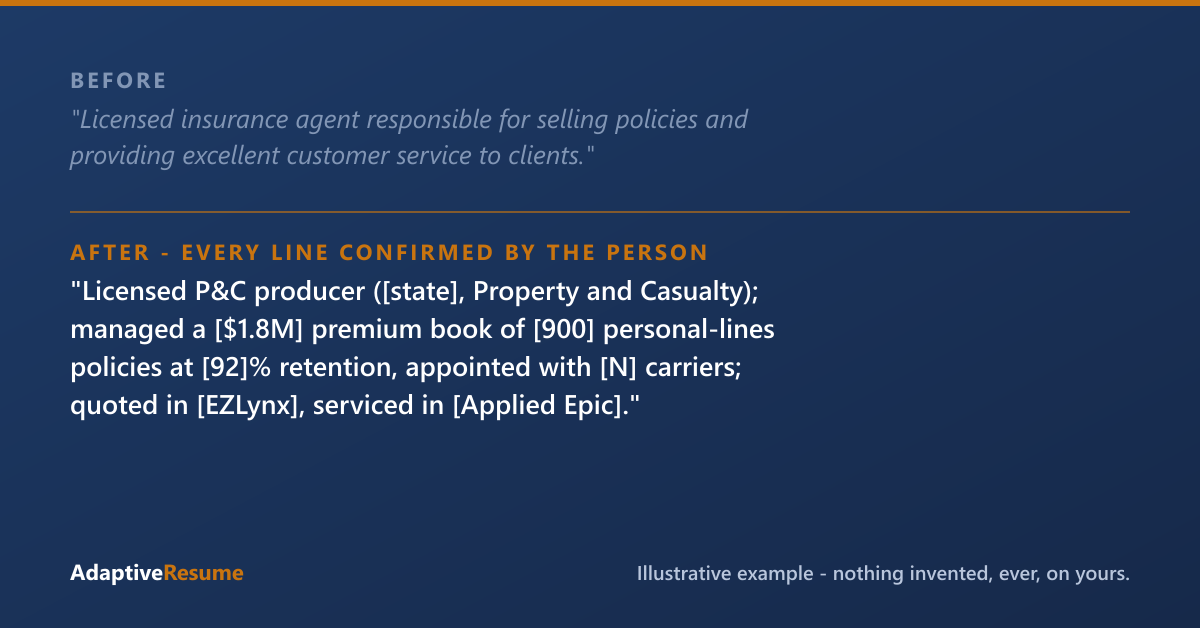
Illustrative example. On your resume, every line comes from your real history — proposed as a question, added only when you confirm it.
The second version is scannable in four seconds and answers what the first leaves a reader guessing at. Notice the rewrite invents nothing; it just says plainly what the vague version was hiding. Fill the brackets with your real numbers.
Licenses and designations, exactly as held
Every item in this block gets checked — a producer license is a public record. Our guide on how to list certifications on a resume covers placement and format; here is what typically belongs in an insurance block:
- State producer license, by line of authority. Licensing runs through each state’s insurance department, issued per line. The NAIC (National Association of Insurance Commissioners) recognizes six major lines of authority: Life; Accident and Health or Sickness; Property; Casualty; Variable Life and Variable Annuity Products; and Personal Lines. Write the state and the lines you hold: “[State] resident producer license — Property, Casualty.” Non-resident licenses go the same way. Your NPN (National Producer Number), the ID kept by NIPR (National Insurance Producer Registry), is optional.
- Continuing education. Hours and cycle vary by state. “CE current through [month/year]” is enough.
- CPCU — Chartered Property Casualty Underwriter, awarded by The Institutes. The senior designation in property and casualty; it leads the block if you hold it.
- AINS — Associate in Insurance, also from The Institutes. A foundational designation, honest and useful for newer agents and service staff.
- CIC — Certified Insurance Counselor, from the Risk & Insurance Education Alliance (formerly The National Alliance for Insurance Education & Research). CIC carries a yearly update requirement, so list it as current. The same body awards the CISR (Certified Insurance Service Representative) for account managers and CSRs.
- CLU — Chartered Life Underwriter, and ChFC — Chartered Financial Consultant, both from The American College of Financial Services. These belong to life and health agents.
- FINRA registrations, only where they apply. If you sell variable products or securities, you do so as a registered representative of a broker-dealer. The SIE (Securities Industry Essentials), Series 6, and Series 7 exams are FINRA’s; the Series 63, 65, and 66 are NASAA (North American Securities Administrators Association) state-law exams. List what you hold and your broker-dealer. Fixed products only? Leave this out.
List exactly what you hold, with real status. “CPCU — [N] of 8 courses completed” is honest and reads fine. A misnamed designation or an overstated line of authority is the fastest way to lose ground when the license lookup takes a minute.
The parts of the job that carry the most weight
The book. Premium written or in force, policy count, account count — whichever your agency measures. If you inherited a book, say so: “inherited a [$X] book; grew it to [$Y]” is a stronger and truer line than a growth figure with no starting point.
Retention. The number that separates a producer from an order-taker. Write it with the period it covers: “[92]% policy retention over [year].” If your agency tracks account retention instead, use that and label it.
Lines and markets. Personal lines (auto, home, umbrella), commercial lines (BOP — business owners policy, general liability, workers’ compensation, commercial auto), life, health, annuities, benefits. Name the lines you actually write and the segment: small commercial, middle market, high-net-worth personal lines, Medicare.
Carriers and appointments. An appointment is a carrier’s formal authorization for you to sell its products. Independent agents should say how many carriers they are appointed with and, where it isn’t confidential, which ones. Captive agents should name the carrier — it’s the whole context of the job.
Prospecting and cross-sell. Where your business came from: referrals, purchased leads, cold outreach, realtor or lender partnerships. “Cross-sold [N] life policies into an existing P&C book” says more than “upsold clients.”
Systems. Agency management systems by name — Applied Epic, Vertafore AMS360, HawkSoft — and comparative raters like EZLynx or Applied Rater. Screening software keys on the system name.
Service work. Endorsements, renewals, certificates of insurance, claims intake, remarketing at renewal. Account managers and CSRs should write this with volume: “[N] accounts serviced,” “[N] certificates per month.”
If you’re a claims adjuster
A claims adjuster resume is read for different specifics. Give it its own scope line: the claim types you handle (property, auto, liability, workers’ compensation), whether you are a staff, independent, or public adjuster, your settlement authority, pending claim count, and cycle time. “Property field adjuster; [N] open claims, [$X] settlement authority, [N]-day average cycle time; estimates in Xactimate” is the shape.
On credentials: many states license adjusters, some don’t, and the rules vary — write the license you actually hold (“[State] adjuster license”), and if it’s a designated home state license because your own state doesn’t license adjusters, say which state. The AIC (Associate in Claims) from The Institutes is the field’s designation. Name your estimating platform — Xactimate (Verisk) for property — and any catastrophe deployments. If you underwrite instead of adjust, our underwriter resume guide covers that job separately.
Format notes
Length follows your history, not a page rule. Two pages is normal and expected once you have more than one substantive insurance role to describe; one page is right for new licensees or career changers. Order matters more than length: license and designation block near the top in its own labeled section (screening software keys on it), then experience with a book line atop each role. If you’re trimming to fit, cut older non-insurance detail before any line of authority, carrier, or retention figure.
One genuine exception worth knowing: federal applications through USAJOBS cap at two pages as of the September 2025 OPM change. That’s a hard requirement, not a style preference.
Otherwise: reverse chronological, single column, standard headings, real text rather than graphics or tables — hiring systems parse plain layouts most reliably. Skip the graphics.
A bullet bank you can adapt — keep only what’s true
- “Licensed [P&C (property and casualty) / L&H (life and health)] producer, [state]; [resident/non-resident] licenses in [N] states”
- “Managed a [$X] premium book of [N] policies across [personal/commercial] lines at [N]% retention”
- “Wrote [$X] in new business premium in [year] from [referrals/leads/outreach]; [N] new policies per month”
- “Appointed with [N] carriers; placed [commercial/personal] accounts in [standard/E&S (excess and surplus lines)] markets”
- “Cross-sold [N] [life/umbrella/commercial auto] policies into existing accounts; raised policies per household to [N]”
- “Serviced [N] accounts: renewals, endorsements, certificates of insurance, claims intake; [Applied Epic / AMS360 / HawkSoft]”
- “Adjusted [N] [property/auto/liability] claims with [$X] settlement authority; [N]-day average cycle time in [Xactimate]”
Each bullet is a frame, not a claim. If a line isn’t true of your work, it doesn’t go on your page — an interviewer’s first follow-up question will find it.
What screening software looks for on an insurance agent resume
Agency and carrier filters read for the vocabulary of the business, and a human reads for the same words minutes later. The terms that typically matter: property and casualty, P&C, personal lines, commercial lines, life and health, producer license, book of business, premium, retention, new business, renewals, cross-sell, carrier appointments, endorsements, claims, CPCU, CIC, CLU, ChFC, AINS, CISR, AIC, Applied Epic, AMS360, HawkSoft, EZLynx, and Xactimate.
One honesty note on job codes: O*NET profiles this work under Insurance Sales Agents (41-3021.00). That code covers the selling side; service staff and adjusters are coded elsewhere — which is exactly why your book line and role specifics have to carry the message the code can’t.
The highest-risk lines are the ones that overstate scope — a line of authority you don’t hold, a securities registration you never earned, or a book you serviced written as one you built. Insurance is a licensed, looked-up field, and employers check.
The Role Skills Checklist below helps you inventory what your work actually proves, which is often considerably more than the resume currently says. Our build does it with you: we work backwards from your real licenses, book, carriers, and systems, propose the lines and credentials that history supports — each one offered as a question, not a decision made for you — and ask you to confirm every item before it appears. We never add a license, a designation, or a number you didn’t tell us about.
Common questions
Do I need a designation like CPCU or CLU to work as an insurance agent?
No. The license is the gate; designations are differentiators. Plenty of working agents hold none, and agencies weigh your lines of authority, your book, and your retention more heavily. If you hold one, list it with its true status — earned, or in progress with the courses completed so far. Never list a designation you are 'planning to start.'
How do I show my book of business without giving away my agency's numbers?
Round it or give a range: 'premium book in the low seven figures' or '[N] policies in force' says what a reader needs. Your book, your retention rate, and your new-business count describe your work, so they normally belong on the page. What stays off is anything confidential — client names, carrier loss ratios, or internal commission figures.
I'm a CSR or account manager at an agency, not a producer. Does this guide apply to me?
Yes. Service roles carry the book between renewals, and the same specifics matter: the lines you service, the number of accounts or policies you handle, the carriers you work with, and your agency management system. If you hold a producer license, say so; many CSRs (customer service representatives) do. The CISR (Certified Insurance Service Representative) designation from the Risk & Insurance Education Alliance is built for this role and belongs in your credentials block if you hold it.
Should I list FINRA securities registrations on an insurance resume?
Only if you actually hold them. Agents who sell variable life or variable annuity products, mutual funds, or other securities do so as registered representatives of a broker-dealer, with exams like the SIE and Series 6 or 7 through FINRA (the Financial Industry Regulatory Authority) and state-law exams like the Series 63 or 66 from NASAA. If that's you, list the registrations and the broker-dealer. If you sell fixed products only, say nothing — a securities registration you don't hold is the fastest way to lose the reader's trust.
Role Skills Checklist
Pop your email in and the download unlocks right here — and being on the list before launch day locks in 25% off your first build. We'll also send the occasional useful note and tell you the moment AdaptiveResume goes live. No spam.
Download: Role Skills ChecklistThanks — you're on the launch list, your 25% is locked in, and your download is ready below.
That email didn't look right — mind trying it again?
Ready to do this on your own resume?
We'll find what you've left off and you approve every line — nothing made up.
Build your resume — $49Try the demo first — a sample review, no sign-up · See how the service works
Paid a resume service and got a template back? Start at Fix my resume.