Guides · For job seekers
Data Analyst Resume: Show Decisions, Not Dashboards
Tool lists don't make an analyst's case — decisions do. How to show SQL, Excel, and BI work as outcomes, and why padding your stack backfires.
Published 07/30/2026 · Updated 08/06/2026
Data analyst resumes cluster into two failure modes: the tool list with no evidence (“SQL, Python, Tableau, Power BI, R, Excel…”) and the duty list with no outcome (“created weekly reports for management”). Both miss what the reader is hunting for — proof that your analysis changed a decision. Analysis nobody acted on is the job’s overhead; analysis that moved something is the job.
The data analyst resume bullet formula: data → decision → result
Every strong analyst bullet has three parts: what you analyzed, what decision it informed, and what happened.
Before: “Built dashboards in Power BI to track sales performance.” After: “Built a Power BI dashboard tracking sales-rep pipeline conversion; flagged a drop-off at the quoting stage that led ops to rework the quote template — stage conversion recovered the following quarter.”
The second version proves the thing tool lists can’t: someone acted on your work. If you honestly don’t know what happened downstream of an analysis, say what you can defend — who used it and for what — and go find out the outcome for next time; those answers are interview gold.
The tool stack: only what you can be interviewed on
The strong move is a short stack listed at your true level: “SQL (daily — joins, CTEs, window functions), Excel (pivot tables, Power Query), Tableau (dashboards in production use).” The weak move is naming every tool you’ve ever opened — analytics interviews probe the stack directly, and one stumble on a tool you padded discredits the ones you actually know. A shorter honest stack outperforms a longer inflated one everywhere it matters: past the applicant tracking system (ATS — the screening software; your real tools are the keywords), through the screen, and in the room.
Certificates and coursework: real, in their place
Google Data Analytics, Microsoft PL-300, and similar certificates are worth listing — as certificates, in an education/credentials section, not dressed up as experience. A bootcamp or cert on top of real work history reads as investment. Standing alone, it needs a projects section to carry it (below).
Career-changers: your old job is a dataset
Moving into analytics from operations, finance, teaching, logistics? You likely did analyst work without the title — the Excel model that set staffing levels, the error tracking that found the bad supplier, the benchmark data you regrouped students on. Claim that work as what it was: analysis with a decision attached. Then add a small projects section (public datasets, a portfolio dashboard, a SQL project) — labeled honestly as projects, never disguised as employment.
What the ATS needs from an analyst resume
Spell out both the tools and the methods in real words: “SQL,” “data cleaning,” “forecasting,” “A/B test” — as they appear in the postings you’re targeting, and only where true. Single column, no charts-as-images (screenshots of dashboards don’t parse; describe the dashboard, link a portfolio if you have one).
Format notes
One page if you’ve held one substantive role; two pages is normal once you have more than one to describe (federal applications through USAJOBS cap at two pages as of the September 2025 OPM change). Skills block near the top with the honest stack, then experience bullets that show each tool attached to a decision. Numbers marked as estimates where they are estimates — an analyst resume with un-defendable numbers is a walking contradiction.
A bullet bank you can adapt - keep only what’s true
- “Built [N] recurring dashboards in [Power BI/Tableau/Looker] serving [~N] users across [teams]”
- “Automated [report/process] with [SQL/Python]; saved [~N] hours/week of manual work”
- “Cleaned and joined [N] sources into a reporting model the [team] still runs”
- “Analysis of [area] led to [the decision that followed - stated plainly, not inflated]”
- “Partnered with [role] to define metrics; killed [N] vanity metrics nobody acted on”
What screening software looks for on a data analyst resume
Filters read for: SQL, Python or R, Excel (state your true level), Power BI, Tableau, dashboards, data visualization, ETL, data cleaning, statistical analysis, A/B testing, stakeholder reporting. O*NET’s business intelligence analyst profile carries the fuller vocabulary. Every tool listed is an interview topic - list the ones you can be questioned on, at the depth you’d survive.
The before-and-after, at a glance
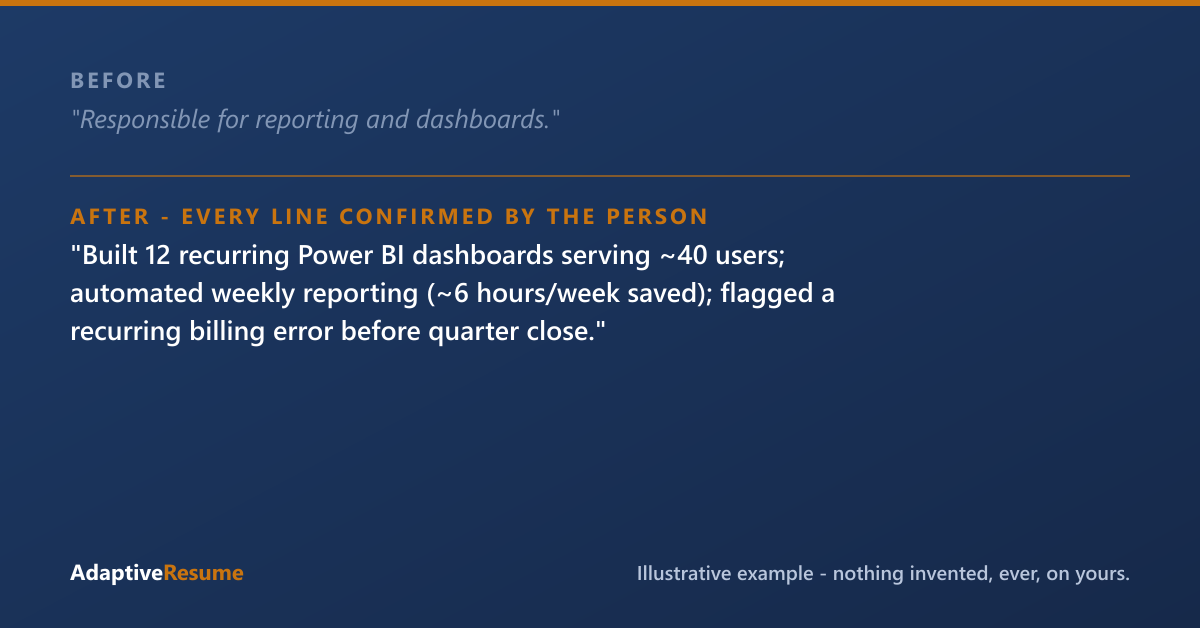
Illustrative example. On your resume, every line comes from your real history - proposed as a question, added only when you confirm it.
The Role Skills Checklist below helps you inventory the analysis work your history already contains. Our build does the same thing with you — it reads what you did, proposes what it implies, and asks you to confirm every claim. For an analyst, that’s not just ethics — it’s the job skill on display.
Common questions
Do I need SQL on a data analyst resume?
Almost always yes for screening - and only at the level you truly work at. 'Wrote joins and window functions daily' is checkable in a technical interview; 'SQL' padded onto a resume that can't back it falls apart in the interview.
Portfolio or resume - which matters more?
The resume makes the case for the interview; the portfolio has to survive it. Link one if you have one, but the bullets still need the data-to-decision shape on their own.
How do I quantify analyst work that never shipped a dollar figure?
Count what's honestly countable: dashboards built, users served, hours automated away, reporting cycles shortened. If a business result followed your analysis, say what the DECISION was - the analyst's product is the decision, not the chart.
Role Skills Checklist
Pop your email in and the download unlocks right here — and being on the list before launch day locks in 25% off your first build. We'll also send the occasional useful note and tell you the moment AdaptiveResume goes live. No spam.
Download: Role Skills ChecklistThanks — you're on the launch list, your 25% is locked in, and your download is ready below.
That email didn't look right — mind trying it again?
Ready to do this on your own resume?
We'll find what you've left off and you approve every line — nothing made up.
Build your resume — $49Try the demo first — a sample review, no sign-up · See how the service works
Paid a resume service and got a template back? Start at Fix my resume.