Guides · For job seekers
ER Nurse Resume: Triage, Trauma, and the Cert Block
Emergency nursing has its own credential alphabet — TNCC, CEN, ENPC — and its own proof points: acuity, throughput, and judgment under load. Write them in.
Published 07/30/2026 · Updated 08/06/2026
Emergency nursing hires on a specific question: can this nurse handle what comes through the door tonight? Your resume answers it with three kinds of evidence — the certification block, the department line, and bullets that show judgment at speed. Generic care language (“provided emergency nursing care to diverse patients”) answers nothing.
The ER nurse resume credential alphabet, exactly as held
After the license line: BLS and ACLS are assumed but still listed; PALS and ENPC if you take pediatric patients; TNCC if you take trauma; NIH Stroke Scale for stroke-receiving departments. CEN is the specialty’s board certification — if you hold it, it leads the block; if you’re sitting for it, “CEN — exam scheduled [month/year]” is honest and worth a line. Exact names, current status, nothing padded: every item here gets verified during credentialing, so the resume that rounds up gets found out at the worst moment.
The department line
One sentence a charge nurse would recognize:
Before: “Worked as a registered nurse in a busy emergency department.” After: “24-bed Level II trauma center ED, ~180 patients/day; full triage rotation (ESI); trauma, stroke, and STEMI receiving.”
Trauma level, bed count or daily volume, and whether you triage — that’s the acuity picture in twelve seconds. Use your department’s real numbers; approximations marked ”~” are fine.
Bullets that show emergency judgment
- Triage — running ESI (Emergency Severity Index) triage is a trust position; say how often and at what volume.
- Response roles — code team, trauma bay assignments, first-round stroke/STEMI workflows. Name the role you actually played (“primary nurse for trauma activations on nights”).
- Throughput — ERs live on flow; work like “held 6-patient assignments during boarding surges” is honest evidence of load tolerance.
- Charge, precepting, SANE — leadership and specialty add-ons each get their own line; SANE (Sexual Assault Nurse Examiner) certification especially is rare and searchable.
New to the ER, or ER-adjacent
Coming from tele, ICU, or urgent care? Lead with the overlap that’s real — ACLS in use, drips, codes, high-turnover assignment loads — and label the gap honestly instead of hiding it. Departments hire transition candidates constantly; what they screen out is inflation. Urgent-care experience is emergency-adjacent, not ED experience — presented accurately, it’s still strong evidence.
Travel ER nurses
Contract-by-contract listing: facility, trauma level, weeks, EMR. The travel-specific skill — safe practice in a department you learned two days ago — is best shown through the pace of successful contracts, not claimed as an adjective.
Format notes
Two pages for experienced RNs, one for new grads (federal applications through USAJOBS — VA hospitals, for example — cap at two pages as of the September 2025 OPM change). Certifications in their own labeled block — hospital screening software (the ATS) keys on it — and the department line atop each role. Single column, no graphics.
A bullet bank you can adapt - keep only what’s true
- “ER RN, Level [N] trauma center: typical [N]:1 ratios, [N]-bed department”
- “Triage lead [N] shifts/week; charge duties [frequency]”
- “ACLS, PALS, TNCC, [CEN] - exactly as held, with current-through dates”
- “Precepted [N] new-graduate RNs through ED orientation”
- “[Epic/Cerner] documentation; stroke/STEMI/sepsis pathway compliance in [N] audited cases”
What screening software looks for on an ER nurse resume
Filters read for: emergency department, trauma, triage, ACLS, PALS, TNCC, CEN, critical care, charge nurse, preceptor, Epic or Cerner, patient ratios, stroke/STEMI/sepsis protocols. O*NET’s registered nurse profile carries the base vocabulary; your ED specifics carry the interview.
The before-and-after, at a glance
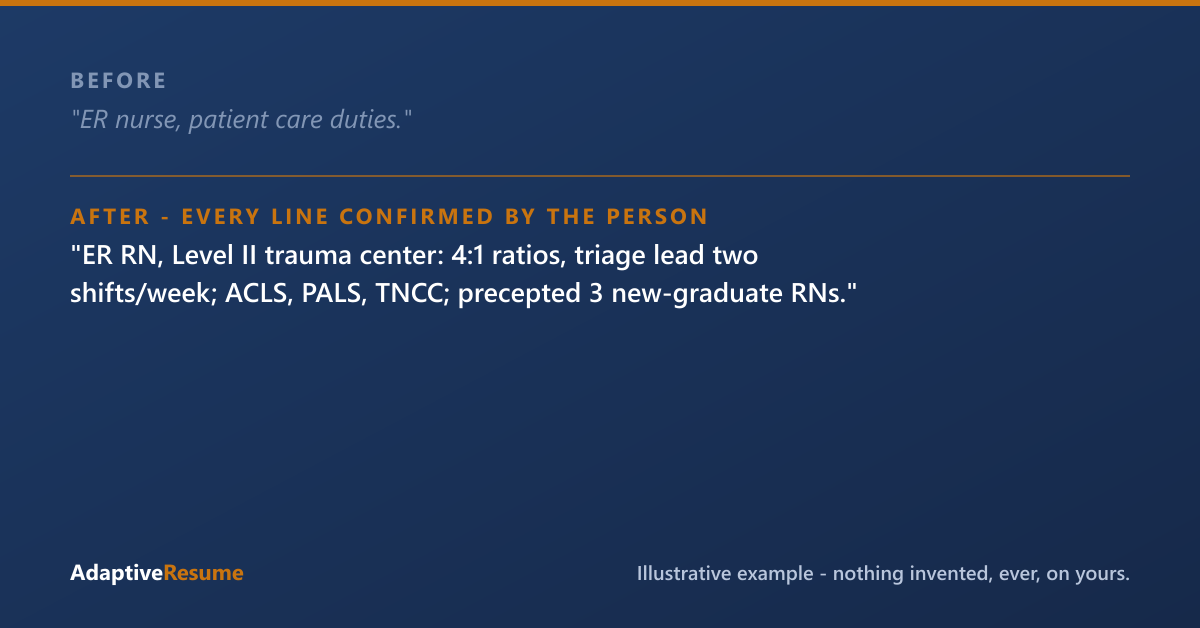
Illustrative example. On your resume, every line comes from your real history - proposed as a question, added only when you confirm it.
The Role Skills Checklist below helps you inventory what your department time proves. Our build reads your history, proposes the certifications and scope it implies — and asks before anything goes on the page. In a specialty where every credential gets verified, that’s the only way a resume should be built.
Common questions
How do I show ER competence beyond certifications?
Ratios, acuity, and trust roles: the trauma level of your ED, your typical assignment, triage or charge duties, and who you precepted. Those say 'capable under pressure' better than any adjective.
Should travel/contract ER work be listed differently?
Same format, honest agency-and-facility attribution: '[Agency] contract - [Facility], Level [N] ED'. Contract work reads as adaptability when the facilities and ratios are named plainly.
Which certifications actually matter for screening?
ACLS and PALS are near-universal filters; TNCC and CEN separate ER specialists. List exactly what you hold with dates - and nothing you're 'about to take.'
Role Skills Checklist
Pop your email in and the download unlocks right here — and being on the list before launch day locks in 25% off your first build. We'll also send the occasional useful note and tell you the moment AdaptiveResume goes live. No spam.
Download: Role Skills ChecklistThanks — you're on the launch list, your 25% is locked in, and your download is ready below.
That email didn't look right — mind trying it again?
Ready to do this on your own resume?
We'll find what you've left off and you approve every line — nothing made up.
Build your resume — $49Try the demo first — a sample review, no sign-up · See how the service works
Paid a resume service and got a template back? Start at Fix my resume.