Guides · For job seekers
Financial Advisor Resume: Licenses, the Book, and Honest Numbers
Financial advisor resumes are read licenses-first, then for the book. How to write your Series exams, designations, and client numbers exactly as held — in a field where every claim sits next to a public record.
Published 09/04/2026
A financial advisor resume is read in a fixed order: licenses first, then the book. Whoever screens it — a recruiter, a branch manager, a Registered Investment Adviser (RIA) principal — checks whether your registrations fit the seat before reading a single bullet, and then looks for real numbers: how many households, roughly how much in assets, how long clients stay. A resume that says “provided comprehensive financial planning services” without either gets set aside, not because the career is thin but because the page never shows it.
There’s a second reader in this field: compliance. Every registration you claim sits next to a public record — FINRA’s BrokerCheck and the SEC’s Investment Adviser Public Disclosure database — and firms look before they call. That cuts in your favor. Exaggeration is unusually easy to catch here, which means accurate specifics are unusually easy to believe.
Put the book in one honest line
Under your current firm, give the shape of your practice in one line before the bullets.
Before: “Responsible for managing client relationships and providing comprehensive financial planning services.”
After: “Lead advisor for [N] households, roughly [$X]M in assets under management; delivered [N] full financial plans last year; [N]% household retention across [N] years.”
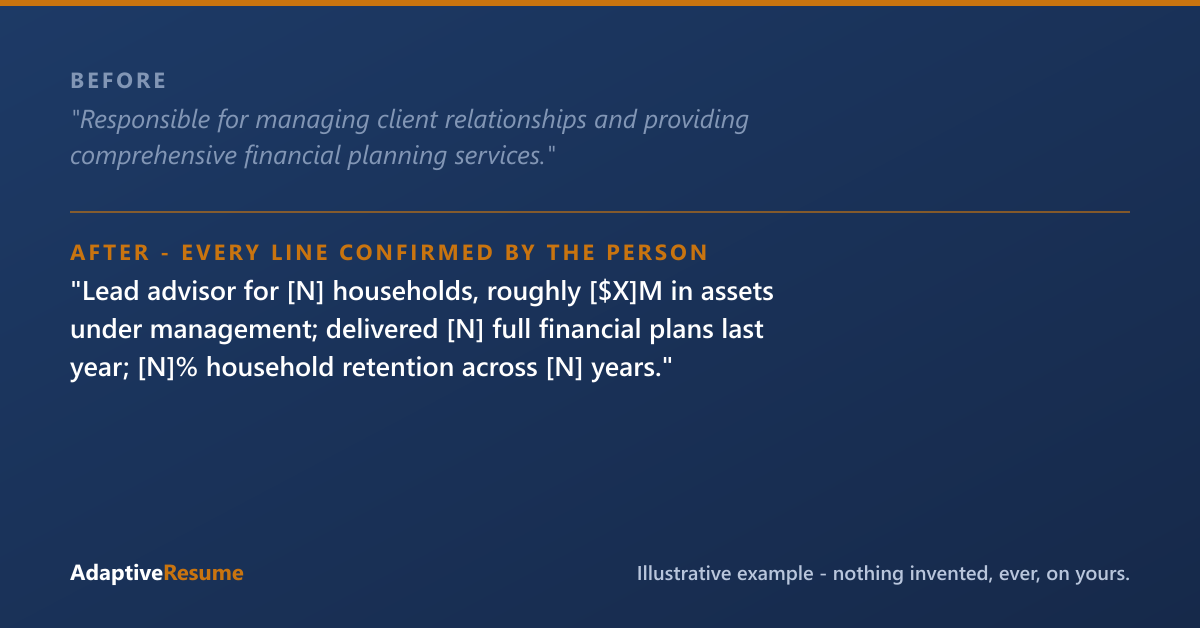
Illustrative example. On your resume, every line comes from your real history — proposed as a question, added only when you confirm it.
The second line answers, in one pass, the questions the first line leaves open: how big the practice is, whether you plan or only gather, and whether clients stay. The brackets are your real numbers — and part of being honest is saying whose numbers they are. A book you built, a book you inherited, and a team book you co-manage are three different (and all legitimate) stories. Name which one is yours.
Licenses and registrations, exactly as held
Write these in their own block, near the top, with real names and real status:
- SIE — the Securities Industry Essentials exam, administered by FINRA (the Financial Industry Regulatory Authority). If it’s all you hold so far, list it; it tells a hiring firm exactly where you are.
- Series 7 — the General Securities Representative exam, administered by FINRA. The registration it supports is held through a firm, so state the status truthfully: active through your current firm, or previously held.
- Series 66 — the Uniform Combined State Law Examination, written by NASAA (the North American Securities Administrators Association) and administered by FINRA. Passing it counts as having passed both the 63 and the 65, so you don’t list all three.
- Series 63 and Series 65 — the Uniform Securities Agent State Law exam and the Uniform Investment Adviser Law exam, both NASAA exams administered by FINRA. List whichever you actually sat for.
- State insurance licenses — issued by each state’s insurance department, not by FINRA. If you’re licensed for life insurance and annuities, say so and name the states: “Life and annuity licensed in [states].”
If a posting names a license you don’t hold, don’t stretch. “Series 65 scheduled for [month]” is a legitimate line; an implied registration is not, and the public record settles the question fast.
Designations, with their real issuers
Designations do the same work here that they do on an underwriter resume — they’re screening filters before they’re anything else, so the letters have to be exactly right.
- CFP — Certified Financial Planner, granted by CFP Board. Getting there involves approved coursework, the exam, qualifying experience, and an ethics commitment — which is why the letters carry weight, and why you can’t use them until CFP Board says you’re certified. In progress? Write the true stage.
- ChFC — Chartered Financial Consultant, granted by The American College of Financial Services. Planning-focused, course-by-course; list it with the year earned.
- CFA — Chartered Financial Analyst, granted by CFA Institute. More common on the portfolio-management side, but if you hold the charter or have passed a level, it signals analytical depth — state the level honestly (“passed CFA Level [I/II]” is its own real line).
Name your setting: RIA, broker-dealer, or both
Your setting is a sorting label the reader applies immediately, so state it plainly. An RIA is a firm registered with the Securities and Exchange Commission (SEC) or state regulators, and advisers there owe clients a fiduciary duty under the rules that govern them. A broker-dealer (BD) representative operates under the SEC’s Regulation Best Interest. Many advisors are dually registered and work both sides. None of that is a judgment about which model serves clients better — it’s industry structure, and on a resume it’s simply a fact about your seat that the reader needs in order to place you: “dually registered advisor at an independent BD/RIA,” “IAR (investment adviser representative) at a fee-only RIA,” “bank-channel advisor.”
If you came up through a bank branch — one of the common on-ramps into this career — the bank teller resume guide covers how to write the platform side of that story so it feeds this one.
The numbers that are yours to claim
Beyond the book line, these are the honest metrics this field reads for — every one bracketed until it’s your real figure:
Households and assets — [N] households, [$X]M–[$X]M range, and how the book was built: referrals, a bank platform, seminars, acquisition. Retention — [N]% of households retained over [N] years says more than any adjective about relationships. Plans delivered — [N] full financial plans a year separates planners from pure gatherers. Net new assets — [$X]M brought in over [period], with the source named honestly. Client contact discipline — [N] review meetings a year, documented in your CRM (customer relationship management system) — name it if it’s Salesforce or Redtail, because clean notes are a compliance skill firms actively want.
What’s never yours to claim: client names, individual outcomes, or performance numbers. Describe the practice, not the portfolios.
Format notes
Length follows your history, not a page rule. If you’ve held seats at two firms, carry insurance licenses in several states, and hold a designation, cramming that into one page throws away your evidence. The honest rule: two pages is normal and expected once you have more than one substantive role to describe — as long as every line earns its space. One genuine exception: federal applications through USAJOBS cap at two pages as of the September 2025 OPM change.
Otherwise: reverse chronological, single column, a licenses-and-designations block near the top, and no graphics. This is a conservative, compliance-reviewed field; a clean, plain document reads as a professional habit, because it is one.
A bullet bank you can adapt — keep only what’s true
- “Lead advisor for [N] households representing approximately [$X]M in assets under management”
- “Delivered [N] comprehensive financial plans per year covering retirement, insurance, and education funding”
- “Retained [N]% of households across [N] years, measured at annual review”
- “Brought in [$X]M in net new assets over [period], primarily through [referrals / bank platform / COI (centers-of-influence) relationships]”
- “Held [N] client review meetings per year; documented every interaction in [Salesforce/Redtail]”
- “Passed SIE, Series 7, and Series 66; life and annuity licensed in [N] states”
- “Transitioned [N] households through [firm change/custodian conversion] with [N]% retention”
- “Partnered with [CPAs/estate attorneys] on [N] joint client cases per year”
What screening software looks for on a financial advisor resume
Filters commonly read for: financial planning, wealth management, retirement planning, Series 7, Series 66, Series 65, SIE, CFP, assets under management, book of business, client acquisition, client retention, portfolio review, insurance planning, annuities, fiduciary, Regulation Best Interest, RIA, broker-dealer, Salesforce, and Redtail. O*NET’s Personal Financial Advisors profile has the full task list.
The highest-risk lines are the ones the public record can contradict: a registration written as active when it lapsed, letters used before the issuer granted them, a shared book written as personal. In a field this checkable, precision is the advantage.
The Role Skills Checklist below helps you inventory what your practice actually shows — licenses, designations, systems, and the numbers you can stand behind — which is often more than the resume currently says. Our build does it with you: we work backwards from your real seats, registrations, and client work, propose the licenses and systems work like yours normally involves, and ask you to confirm every item before it appears. We never add a credential, a registration, or a number you didn’t tell us about.
Common questions
Is the Series 7 a license I can list like a certification?
It's an exam, and the registration it supports rides with a firm — so write the true status. 'Series 7 (General Securities Representative), registered through [firm]' if you're active; 'previously held' if you've been out of a seat long enough for it to lapse. Firms look you up on BrokerCheck before they call, so the resume should match what they'll see there.
Should I put assets under management on my resume?
Yes, if the number is honestly yours to describe. Say whether it's your own book, a team's, or a branch's — 'co-managed [$X]M with a three-person team' is a strong line precisely because it's precise. A range is fine. What hurts you is rounding a shared number into a personal one, because this is a field that checks.
I passed the CFP exam but haven't finished the experience requirement. Can I write CFP?
No. The marks belong to CFP Board and can only be used once you're certified. Write what's actually true — 'passed the CFP exam, [date]; experience requirement in progress.' That line is honest and still carries real weight, because the exam is the part everyone knows is hard.
Can I mention specific clients or the returns I got them?
Describe your work, not your clients. Household counts, plan volume, retention, and asset ranges are yours to state; a client's name or portfolio performance is not, and quoting returns can create problems a resume doesn't need. Your firm's compliance rules govern what you can say publicly — when in doubt, describe scope, not results.
Role Skills Checklist
Pop your email in and the download unlocks right here — and being on the list before launch day locks in 25% off your first build. We'll also send the occasional useful note and tell you the moment AdaptiveResume goes live. No spam.
Download: Role Skills ChecklistThanks — you're on the launch list, your 25% is locked in, and your download is ready below.
That email didn't look right — mind trying it again?
Ready to do this on your own resume?
We'll find what you've left off and you approve every line — nothing made up.
Build your resume — $49Try the demo first — a sample review, no sign-up · See how the service works
Paid a resume service and got a template back? Start at Fix my resume.