Guides · For job seekers
Human Resources Resume: Certs, Systems, and Caseload
HR resumes get screened by HR — the hardest audience there is. Lead with the credential ladder, name your HRIS, and put honest numbers on the caseload.
Published 07/30/2026 · Updated 10/27/2026
An HR resume faces the toughest reader in hiring: another HR professional, who knows exactly what the job involves and exactly which phrases are filler. “Supported the full employee lifecycle” doesn’t survive that reader. Credentials, systems, and caseload numbers do.
The human resources resume credential ladder, stated exactly
HR has two main certifying bodies and a real hierarchy — list what you hold by its precise name: aPHR, PHR, or SPHR from HRCI; SHRM-CP or SHRM-SCP from SHRM. Holding one is a screening advantage at nearly every level; holding none is survivable if the experience carries — but never blur “SHRM member” into looking like a certification, and list an exam date honestly if one is scheduled. The reader knows the difference on sight.
Name your systems
HR runs on software, and HR recruiters filter on it by name: Workday, ADP, Paychex, BambooHR, UKG, SuccessFactors, Greenhouse, iCIMS — whatever you actually administered or worked in daily, at your true level (“Workday HCM — day-to-day transactions and reporting” vs “led the ADP-to-Workday migration for 300 employees”). A named system with a real scope line beats a long list every time.
Caseload: the numbers HR readers scan for
- Headcount supported — “HR generalist for a 220-employee manufacturing site” places every other bullet in context.
- Recruiting load — requisitions carried, roles filled per quarter, hiring managers supported.
- Employee relations — investigations handled, accommodations processed. No details, ever — just honest volume (“handled ~15 ER cases/year through resolution”).
- Programs owned — open enrollment for how many, onboarding you redesigned, the handbook you rewrote.
Before: “Responsible for recruiting, onboarding, and employee relations.” After: “Sole HR generalist for a 180-person site: carried 10-15 requisitions at a time, ran onboarding for ~60 hires/year, and handled employee relations through investigation and resolution.”
Compliance work is real work — claim it
FMLA and leave administration, ADA accommodations, I-9/E-Verify, OSHA recordkeeping, EEO-1 reporting, wage-and-hour cleanup — this is the load-bearing half of HR that resumes undersell. Name the specific compliance areas you personally administered. It’s also exactly the kind of implied expertise a job history carries without saying: if you ran leave administration for years, you have FMLA fluency that belongs on the page.
Coordinator to generalist to manager: show the scope shift
Each HR level is a scope claim: coordinators own processes, generalists own client groups, managers own outcomes and other people. Write each past role at its true altitude, and if you absorbed generalist work in a coordinator seat — a common step in the field — claim the work explicitly (“carried generalist duties for two client groups after a team departure”) rather than inflating the title. The reader has seen both versions and trusts only one. (Our promotions guide covers the stacked-title format for the moves that did come with new titles.)
Format notes
One to two pages by depth of career — two is normal once you have more than one substantive role (federal HR jobs through USAJOBS cap at two pages as of the September 2025 OPM change). Single column for the very applicant tracking system (ATS) your reader administers. Certifications in a labeled block; systems in a short skills section, each one backed by a bullet somewhere in the history.
A bullet bank you can adapt - keep only what’s true
- “HR generalist for a [N]-employee [site/org]: recruiting, benefits, ER, compliance”
- “Full-cycle recruiting: [~N] hires/year at [days] average time-to-fill”
- “Administered benefits open enrollment for [N] employees across [N] plans”
- “[ADP/Paylocity/Workday] administration - onboarding, changes, reporting”
- “[N] clean I-9 / DOL / workers-comp audits; maintained files to retention policy”
- “Handled [N] employee-relations cases/year with documented, consistent process”
What screening software looks for on a human resources resume
Filters read for: full-cycle recruiting, onboarding, benefits administration, employee relations, HRIS (name yours), FMLA/ADA/FLSA familiarity, I-9 compliance, performance management, open enrollment, offboarding. O*NET’s HR specialist profile lists the standard set. Compliance terms only where you truly worked them - each is an interview scenario waiting.
The before-and-after, at a glance
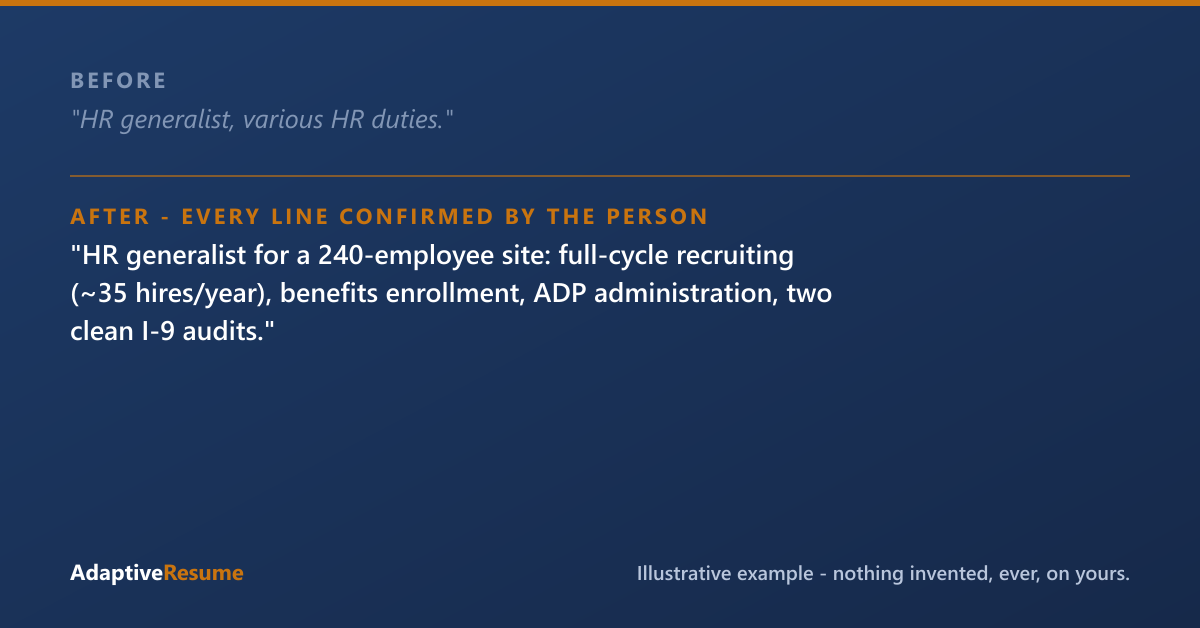
Illustrative example. Everything on your resume is yours: the experience you listed, plus the skills, tools, responsibilities, and credentials your work already involved, each added only after you confirm it’s true.
The Role Skills Checklist below helps you inventory the compliance areas, systems, and caseloads your history proves. Our build does it with you — proposes what your work implies, asks you to confirm each one, and keeps the resume at the standard your own profession screens against.
Common questions
Do HR certifications (PHR/SHRM-CP) matter on the resume?
They're often a screening filter at larger employers and never hurt - listed exactly as held. Without one, scope carries you: headcount supported, hires per year, systems run, audits survived.
How do I show HR results without breaching confidentiality?
Aggregates and process outcomes are yours to share: time-to-fill trends, retention movement, clean audits, programs shipped. Individual cases never appear - which interviewers read as its own competence signal.
Generalist or specialist resume - which way should I frame?
Frame what you actually did most: a generalist who ran full-cycle recruiting plus benefits plus employee relations (ER) states all three with volumes; forcing a specialist frame you can't back narrows you into interviews you'll struggle in.
Role Skills Checklist
Pop your email in and the download unlocks right here. Joining our list also takes 25% off your first purchase within 30 days of joining, when you create your account with this same email. We'll also send the occasional useful note. No spam.
Download: Role Skills ChecklistThanks, you're on our list, and your download is ready just above. Your 25% off a first purchase is good for 30 days from the day this email joined our list.
That email didn't look right — mind trying it again?
Ready to do this on your own resume?
We'll find what you've left off, and nothing goes on your resume that you didn't give us or confirm.
Get your resume build — $29Every purchase is one payment, and nothing renews. A single resume build can be used any time within 12 months of buying it, and AR Pass builds you don't use end when its 90 days end.
Try the demo first — a sample review, no sign-up · See how the service works
Paid a resume service and got a template back? Start at Fix my resume.