Guides · For job seekers
Landscaping Resume: Your Crews, Your Equipment, and the Licenses Behind the Work
Landscaping resumes are read for the work you can do on your own, the equipment you run, the licenses you hold, and how reliably your crew finished the route. Here's how to write yours with real properties, numbers, and credentials.
Published 10/13/2026 · Updated 10/30/2026

A landscaping resume is read by a crew leader, a branch or account manager, or the owner of a landscaping company. They are looking for proof that you can do the work without being watched: which equipment you run safely, what kinds of properties you have maintained or built, what licenses you hold, and whether you show up through a hot summer and a busy spring. A resume that says “experienced landscaper, hard worker, good with plants” tells them none of that.
Landscaping work is counted by the property and the day, so you likely know your own numbers well: the properties on your route, the size of your crew, and the jobs you finished in a day. Put them on the page.
Lead with your properties, your equipment, and your credentials
Before: “Landscaper responsible for mowing, trimming, and general yard maintenance.”
After: “Landscape crew member for a [commercial maintenance company]: mowed and maintained about [12] commercial properties a day on a [3]-person crew, ran [zero-turn and stand-on mowers], string trimmers, and blowers, installed [N] cubic yards of mulch a season; [state] commercial pesticide applicator license ([category]); returned for [4] seasons.”
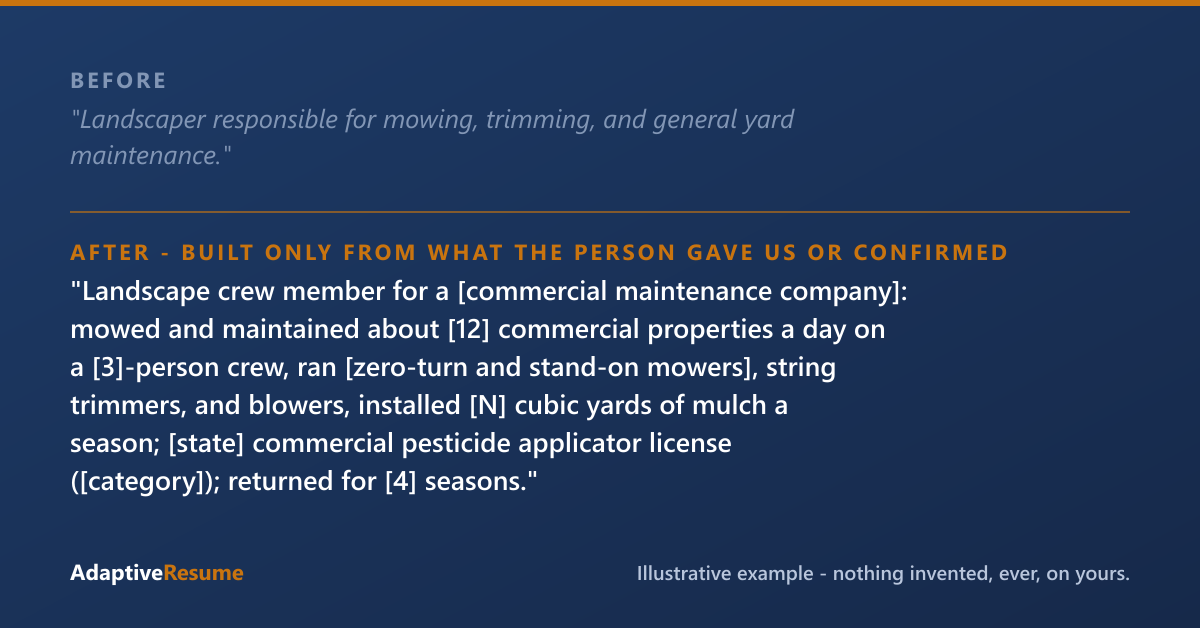
Illustrative example. Everything on your resume is yours: the experience you listed, plus the equipment, licenses, and training your work already involved, each added only after you confirm it’s true.
The second version tells the owner the type of work, the volume, the crew size, the equipment, the license, and the reliability in two lines.
Licenses and certifications, named exactly
Pesticide applicator license. Federal rules require certification for commercial applicators who use or supervise the use of restricted use pesticides, with categories such as ornamental and turf pest control. States run the testing, and the competency standards require a written exam in the core standards and in each category. Many states also license commercial application of other pesticides, and a few, such as Florida, Maryland, and Virginia, also certify commercial fertilizer applicators. If you hold a license, write the state, the category, and the expiration date. If you applied products under someone else’s license, describe it that way. The EPA’s applicator certification page explains how the federal and state rules fit together.
Arborist certification. The ISA Certified Arborist credential requires three years of full-time arboriculture experience or a combination of education and practical experience, plus an exam. If you hold it, put it near the top. If you do tree work without it, describe the work: pruning, removals, climbing, rigging, and chipper and stump grinder operation.
Industry certifications. The National Association of Landscape Professionals offers Landscape Industry Certified credentials for technicians and managers, and the Irrigation Association offers irrigation certifications such as irrigation technician and auditor. Some states also license irrigation contractors. Write each credential with its issuer and year.
Safety and driving. Chainsaw safety training, first aid and CPR, and heat illness training belong on the resume with their dates. A clean driving record and experience towing an equipment trailer are worth one line, because crews move between properties all day.
Equipment and skills
Equipment. Name what you run: zero-turn, stand-on, and walk-behind mowers, string trimmers, edgers, blowers, hedge trimmers, aerators, dethatchers, sod cutters, skid steers, mini excavators, plate compactors, chainsaws, chippers, and stump grinders. Say what you can run on your own.
Maintenance. Describe mowing, edging, pruning shrubs, bed maintenance, mulching, leaf cleanup, aeration and seeding, and turf care. If you learned to diagnose turf or plant problems, say so.
Installation and hardscape. Describe planting trees and shrubs, laying sod, grading, installing pavers, retaining walls, and drainage, and the size of the jobs, such as square feet of pavers or linear feet of wall.
Irrigation. Describe installing, repairing, and adjusting irrigation systems, setting controllers, and finding leaks. Water savings from a system audit or a controller change are a strong number.
Snow and ice. If your company did snow removal, name the equipment you ran, the properties you cleared, and the hours you worked through storms.
The numbers a landscaping manager reads
Give properties maintained per day or per week, the type of properties (residential, commercial, municipal, HOA, or campus), crew size, the jobs you installed and their size, and how many seasons you returned. If you led a crew, write how many people, how many properties, and how you kept the route on schedule.
Moving up
Lines that point upward matter: running the route when the crew leader is out, training new crew members, earning a license, or moving from maintenance into installation, irrigation, or tree work. If you are aiming at a crew leader or account manager role, add the crew size, the route, and the customers you handled. If you are moving into construction, our construction worker guide covers how that resume is read, and our heavy equipment operator guide covers moving into machine work.
Format notes
Length follows your history. A landscaper with one or two employers usually fits on one page. Two pages is normal and expected once you have more than one substantive job to describe, such as several companies, a business of your own, or a mix of landscaping and construction. Keep the equipment, the licenses, the properties, and the numbers; cut the duties every crew shares.
Use reverse chronological order and a single column, and leave out graphics and photos. Many larger landscaping companies run applications through hiring software, and a two-column template can scramble the read. Put licenses and certifications in their own section near the top.
Seasonal gaps are normal. Write each season with its dates and give any other gap one plain dated line.
Landscaping resume examples: a bullet bank you can adapt — keep only what’s true
- “Mowed and maintained about [N] [commercial/residential] properties a day on a [N]-person crew”
- “Ran [zero-turn/stand-on] mowers, trimmers, edgers, and blowers; trained new crew members on safe operation”
- “Installed [N] square feet of pavers and [N] linear feet of retaining wall in [year]”
- “Installed and repaired irrigation systems on [N] properties; cut water use by [N]% after controller adjustments”
- “[State] commercial pesticide applicator license, [category], expires [month/year]”
- “ISA Certified Arborist ([year]); pruned and removed trees with climbing and rigging”
- “Ran the route as acting crew leader on [N] days; finished every property on schedule”
- “Returned for [N] seasons; ran snow removal on [N] properties through the winter”
What screening software looks for on a landscaping resume
Filters commonly read for: landscaper, landscape technician, groundskeeper, lawn care, turf, mowing, zero-turn mower, trimming, edging, pruning, mulching, planting, sod, hardscape, pavers, retaining wall, irrigation, sprinkler, pesticide applicator license, herbicide, fertilizer, arborist, tree care, chainsaw, skid steer, snow removal, equipment maintenance, and customer service. O*NET’s profile for landscaping and groundskeeping workers has the full task list.
The highest-risk lines are the ones an owner can check with one call: a license in someone else’s name, equipment you have never run alone, or an installation you only watched. Write what you actually did.
The Role Skills Checklist below helps you inventory what your landscaping history actually proves, which is usually more than the resume currently says. Our build does it with you: we work backwards from your real jobs, crews, and properties, and we ask you about the equipment, licenses, and training that work like yours normally involves. Nothing goes on your resume that you didn’t give us or confirm, so a license, a machine, or a job you never told us about stays off the page.
Common questions
Do I need a license to spray weed killer or fertilizer for a landscaping company?
It depends on the product and the state. Federal rules allow restricted use pesticides to be applied only by a certified applicator or by someone working under a certified applicator's direct supervision. Your state may also require its own license for other pesticide work, and a few states require a certification for commercial fertilizer work. If you sprayed under someone else's license, say so plainly, for example "applied herbicide under the supervision of a licensed applicator," and list your own license only if it is in your name.
My landscaping work was seasonal. How do I show that?
List each season with its dates and the employer, and say what you did in the off-season if you worked, such as snow removal or holiday lighting. Seasonal work is normal in this industry, and returning to the same employer year after year is a strong signal of reliability. Write it as "returned for [N] seasons."
I mostly mowed. What skills can I put on my resume?
You can list more than you think. Write the equipment you ran, the size and type of the properties, how many you finished in a day, and any trimming, edging, mulching, or cleanup work. Add the safety training you completed and any time you trained a new crew member or ran the route when the lead was out.
Should I list plant identification on my resume?
Yes, list it if you can do it on the job. Name the kinds of plants and pests you can identify and how you used that knowledge, such as choosing plants for a site, spotting disease, or deciding what not to prune. Tree identification is one of the tested areas on the ISA Certified Arborist exam, so the industry treats it as a real skill, and it is worth a line.
Role Skills Checklist
Pop your email in and the download unlocks right here. Joining our list also takes 25% off your first purchase within 30 days of joining, when you create your account with this same email. We'll also send the occasional useful note. No spam.
Download: Role Skills ChecklistThanks, you're on our list, and your download is ready just above. Your 25% off a first purchase is good for 30 days from the day this email joined our list.
That email didn't look right — mind trying it again?
Ready to do this on your own resume?
We'll find what you've left off, and nothing goes on your resume that you didn't give us or confirm.
Get your resume build — $29Every purchase is one payment, and nothing renews. A single resume build can be used any time within 12 months of buying it, and AR Pass builds you don't use end when its 90 days end.
Try the demo first — a sample review, no sign-up · See how the service works
Paid a resume service and got a template back? Start at Fix my resume.