Guides · For job seekers
Travel Nurse Resume: Contract Lines, Compact License, First-Day Ready
Travel nurse resumes are read contract by contract: facility, unit, bed count, ratio, charting system, and whether you were extended. How to write yours so a recruiter and a unit manager can both see you're ready on day one.
Published 09/08/2026
Travel nurse hiring is a two-reader problem. An agency recruiter reads your resume to decide whether to submit you, and a unit manager at the facility reads it — often in a stack, often quickly — to decide whether you can take a full assignment on your first shift with little orientation. Both are asking the same question: what have you actually worked, where, with what patients, on what system? A resume that says “travel nurse providing care at various hospitals” answers none of that.
The fix is structural rather than clever. Write each contract as its own entry, and give each one a line a fellow nurse would recognize instantly: facility, unit, bed count, ratio, charting system, contract length, and whether you were extended. Everything else on a travel nurse resume — your license status, your certifications, your specialties — supports that contract-by-contract story.
Travel nurse resume examples: the contract line
Under each contract, give one line before the bullets that carries the whole assignment.
Before: “Travel RN providing patient care at various hospitals across multiple states.”
After: “Travel RN, [Facility] ([City, State]); [24]-bed Medical ICU, [1:2] ratio; [13]-week contract, extended [once]; floated to [step-down] as needed; [Epic] charting.”
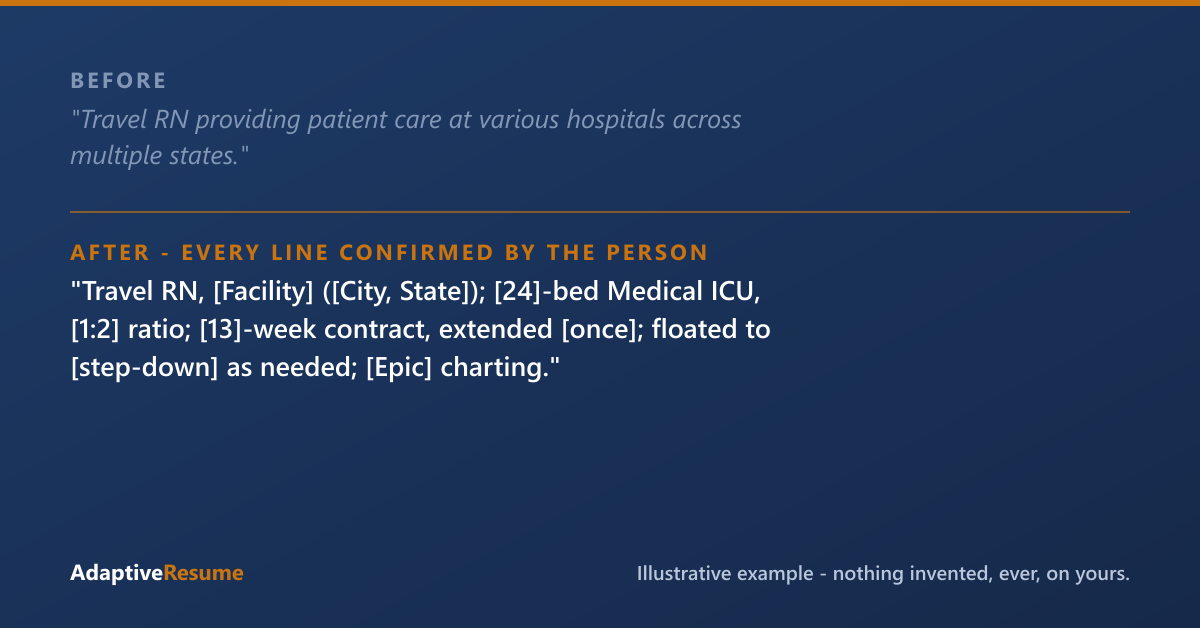
Illustrative example. On your resume, every line comes from your real history — proposed as a question, added only when you confirm it.
The second version is scannable in four seconds. Notice the rewrite invents nothing; it says plainly what the vague version was hiding. Fill the brackets with your real facility and numbers. Repeat the pattern for every contract, most recent first, and the resume becomes a readable log of assignments instead of a blur of “various hospitals.”
A few things worth putting in that line every time:
- Facility and location. Name the hospital and the city and state. Managers know facilities, and screening software keys on them.
- Unit and bed count. “Medical ICU (intensive care unit), [24] beds” says more than “critical care.”
- Ratio. “[1:2]” or “[1:5]” tells a manager what load you carried without a paragraph.
- Float status. If you floated, say where — “floated to [ER/step-down/telemetry]” — because float-ready travelers are what many facilities are buying.
- Charting system. Epic, Oracle Health (formerly Cerner), or MEDITECH by name. First-day readiness on the facility’s system is a hard filter for many assignments.
- Contract length and extensions. Contracts are commonly around thirteen weeks, though shorter and longer ones exist. An extension is the facility asking you to stay — write it.
Credentials, exactly as held
Every item in this block goes into your credentialing packet and gets checked before you start, so it has to be exactly right. Our guide on how to list certifications on a resume covers placement and format; here is what belongs in a travel nurse block:
- RN (registered nurse) license — multistate or single-state. Under the Nurse Licensure Compact (NLC), administered by the NCSBN (National Council of State Boards of Nursing), a nurse whose primary state of residence is a compact state can hold one multistate license and practice in other compact states without a separate license, as long as that compact state remains your primary residence. Write it as “RN — multistate license, [home state], NLC.” If your home state is not in the compact, or a contract takes you to a non-compact state, you hold a single-state license there; list each one with the state and its status. The compact’s own site, nursecompact.com, keeps the current list of participating states.
- BLS and ACLS — Basic Life Support and Advanced Cardiovascular Life Support, typically through the American Heart Association (AHA). Many facilities specify AHA cards, so name the issuer.
- Specialty certifications by unit. PALS (Pediatric Advanced Life Support) for pediatric and ER (emergency room) contracts; NRP (Neonatal Resuscitation Program) for L&D (labor and delivery) and NICU (neonatal intensive care unit) contracts; TNCC (Trauma Nursing Core Course) where trauma centers ask for it; the specialty’s board certification — CCRN (the critical-care credential from AACN, the American Association of Critical-Care Nurses), RNC-OB (Inpatient Obstetric Nursing, from NCC, the National Certification Corporation), and so on — if you hold it. Our unit-specific guides, including labor and delivery, cover which credentials each specialty reads for.
- Current-through dates on every card. Credentialing teams check expiration first.
List exactly what you hold, with real status. “ACLS — renewal scheduled [month/year]” is honest and reads fine. A misnamed or lapsed credential is the fastest way to lose an assignment you were otherwise ready for.
The parts of the job that carry the most weight
First-day readiness. This is the heart of what a facility buys when it hires a traveler. Say it in evidence rather than adjectives: the units you’ve taken full assignments on with a short orientation, the charting systems you’ve used, and how many contracts you’ve completed. “[8] contracts across [5] states, [4] facilities on Epic, [2] on MEDITECH” reads as ready.
Skills checklists and credentialing packets. Before an agency submits you, you complete a specialty skills checklist — a self-rating on the procedures, equipment, and patient types for your unit — and a credentialing packet with your licenses, certifications, immunization records, and references. Facilities read the checklist alongside the resume. Write the resume from the same true history so the two agree; a skill claimed on one and rated “no experience” on the other is the kind of mismatch a manager notices.
Floating and flexibility. Many facilities hire travelers partly to float. If you floated to other units, name them and say how often. If you took charge shifts on contract, say so — it’s unusual and worth a line.
Agency versus direct contracts. Some travelers work through a staffing agency; some contract directly with a facility or a hospital system’s internal travel program. Both count. Name the arrangement once per contract (“via [Agency]” or “direct contract”) so the reader understands who employed you, and keep the facility as the main heading — that’s what a manager recognizes.
Charting systems. Epic, Oracle Health (formerly Cerner), and MEDITECH are the names screening software and managers look for. If you’ve been proficient on more than one, say so; a traveler who can chart on the facility’s system without hand-holding is easier to place.
Contracts that ended early. Census drops and facility cancellations happen. Write true dates and, if useful, a plain note. Hiding a shortened contract reads worse than explaining one.
Format notes
Length follows your history, not a page rule. Two pages is normal and expected once you have more than one substantive nursing role to describe, and a traveler with a run of contracts gets there quickly. Order matters more than length: license and certification block near the top in its own labeled section (screening software keys on it), then contracts in reverse chronological order with a contract line atop each one. If you have many contracts, give the recent ones full detail and trim the oldest to a single line each — facility, unit, dates.
One genuine exception worth knowing: federal applications through USAJOBS cap at two pages as of the September 2025 OPM change. That’s a hard requirement, not a style preference, and it applies if you’re pursuing a Veterans Affairs or other federal nursing position.
Otherwise: reverse chronological, single column, standard headings, real text rather than graphics or tables — agency and hospital systems parse plain layouts most reliably. Skip the graphics.
A bullet bank you can adapt — keep only what’s true
- “Travel RN, [Facility] ([City, State]); [N]-bed [unit], [1:N] ratio; [N]-week contract, extended [N] times”
- “Took a full assignment after [N] shifts of orientation; charted in [Epic/Oracle Health/MEDITECH]”
- “Floated to [unit] and [unit] as needed; [N] float shifts over the contract”
- “Completed [N] travel contracts across [N] states; [N] extended by the facility”
- “Held multistate RN license ([home state], NLC) plus single-state licenses in [state, state]”
- “Managed [patient type] on [ventilators/drips/telemetry] per unit protocol at a [Level N trauma center]”
- “Served as charge nurse [frequency] on contract at [Facility]”
- “Precepted [N] new-hire nurses on [unit] during an extended assignment”
Each bullet is a frame, not a claim. If a line isn’t true of your practice, it doesn’t go on your page — the skills checklist and the first shift will both find it.
What screening software looks for on a travel nurse resume
Agency and hospital filters read for the vocabulary of the unit and the credentials, and a human reads for the same words minutes later. The terms that typically matter: travel nurse, travel RN, contract, extension, float, ICU, ER, med-surg, telemetry, step-down, PACU (post-anesthesia care unit), OR (operating room), L&D, NICU, ratio, bed count, charge nurse, compact license, multistate license, NLC, BLS, ACLS, PALS, NRP, TNCC, CCRN, Epic, Cerner, Oracle Health, MEDITECH, and EMR (electronic medical record).
One honesty note on job codes: O*NET profiles this work under Registered Nurses (29-1141.00). Travel nursing is an employment arrangement within the RN occupation, not a separately coded job — which is exactly why your contract lines have to carry the message the occupation code can’t. For the unit-level specifics that each specialty reads for, our nursing resume guides cover ICU, NICU, ER, L&D, and more the same honest way.
The highest-risk lines are the ones that overstate scope — a unit you floated to written as a home unit, a charting system you observed rather than used, a license listed as active while an application is pending, or a contract stretched past its real dates. Credentialing checks all of it, and the traveling nurse world is small enough that managers compare notes.
The Role Skills Checklist below helps you inventory what your contracts actually prove, which is often considerably more than the resume currently says. Our build does it with you: we work backwards from your real facilities, units, systems, and licenses, propose the lines and credentials that history supports — each one offered as a question, not a decision made for you — and ask you to confirm every item before it appears. We never add a credential, a facility, or a charting system you didn’t tell us about.
Common questions
Do I list every travel contract separately, or group them under the agency?
List each contract as its own entry, with the agency named once alongside it. A recruiter and a unit manager are both reading for the facility, the unit, the bed count, the ratio, and the charting system — and those change with every assignment. Grouping them under one agency heading hides exactly what they want to see. If you've worked many contracts, the oldest ones can be trimmed to a single line each; the recent ones get full detail.
How do I show a compact license on a travel nurse resume?
Write it as held: 'RN — multistate license, [home state], Nurse Licensure Compact.' A multistate license lets you practice in other compact states without a separate license, and it is issued by your primary state of residence, so name that state. Any single-state licenses go on their own lines with the state and status. Never list a state you're 'applying to' as if it were active — write 'application in progress' if you want it there.
Does a short contract or an early end look bad?
A contract that ended early can happen for reasons that have nothing to do with you — census drops and facility-side cancellations are common in travel nursing. Write the true dates and, if you want, a plain note: 'contract shortened by facility — low census (a low patient count).' What reads badly is a gap you've quietly hidden or a contract stretched to look longer than it was. Extensions, on the other hand, are worth saying out loud: they're the facility asking you to stay.
Should my travel nurse resume match my skills checklist?
Yes, and the safest way is to write both from the same true history. Agencies typically ask for a specialty skills checklist and a credentialing packet (licenses, certifications, immunizations, references) before submitting you, and facilities compare the two. A resume that claims skills your checklist rates as 'no experience' creates a problem on day one. Our build works backwards from your real units and asks you to confirm each skill before it appears, so the two documents say the same thing.
Role Skills Checklist
Pop your email in and the download unlocks right here — and being on the list before launch day locks in 25% off your first build. We'll also send the occasional useful note and tell you the moment AdaptiveResume goes live. No spam.
Download: Role Skills ChecklistThanks — you're on the launch list, your 25% is locked in, and your download is ready below.
That email didn't look right — mind trying it again?
Ready to do this on your own resume?
We'll find what you've left off and you approve every line — nothing made up.
Build your resume — $49Try the demo first — a sample review, no sign-up · See how the service works
Paid a resume service and got a template back? Start at Fix my resume.