Guides · For job seekers
Lineman Resume: Journeyman Status, Voltage, and Crew Scope
A lineman resume gets read for three things: whether you topped out or are still an apprentice, the voltage and work methods you have actually run, and the equipment and construction you can do without a hand on your shoulder. How to put all three on paper honestly.
Published 09/08/2026
A lineman resume gets read by people who have done the work, and they read it for three things. Did you top out, or are you still an apprentice — and through which program? What voltage have you actually worked, and by which method — rubber glove, hot stick, de-energized? And what can you do on your own: set and frame a pole, string conductor, connect a transformer bank, run the digger derrick, troubleshoot an outage at 2 a.m.?
Generic lines (“responsible for installing and maintaining electrical lines in a safe manner”) answer none of that. A foreman has to guess whether you’re a third-step apprentice or a twenty-year journeyman who has worked live transmission. Say the status, say the voltage, say the work.
The crew line: your scope in one sentence
Under each employer, give one line a fellow lineworker would read in four seconds and understand completely.
Before: “Lineman responsible for installing, maintaining, and repairing overhead and underground electrical lines in a safe manner.”
After: “Journeyman Lineman, [utility/contractor] distribution crew ([4]-person); energized rubber-glove work to [12.47] kV, hot-stick work to [69] kV; set and framed [N] poles per month, built transformer banks, and ran URD; Class A CDL, digger derrick and bucket truck.”
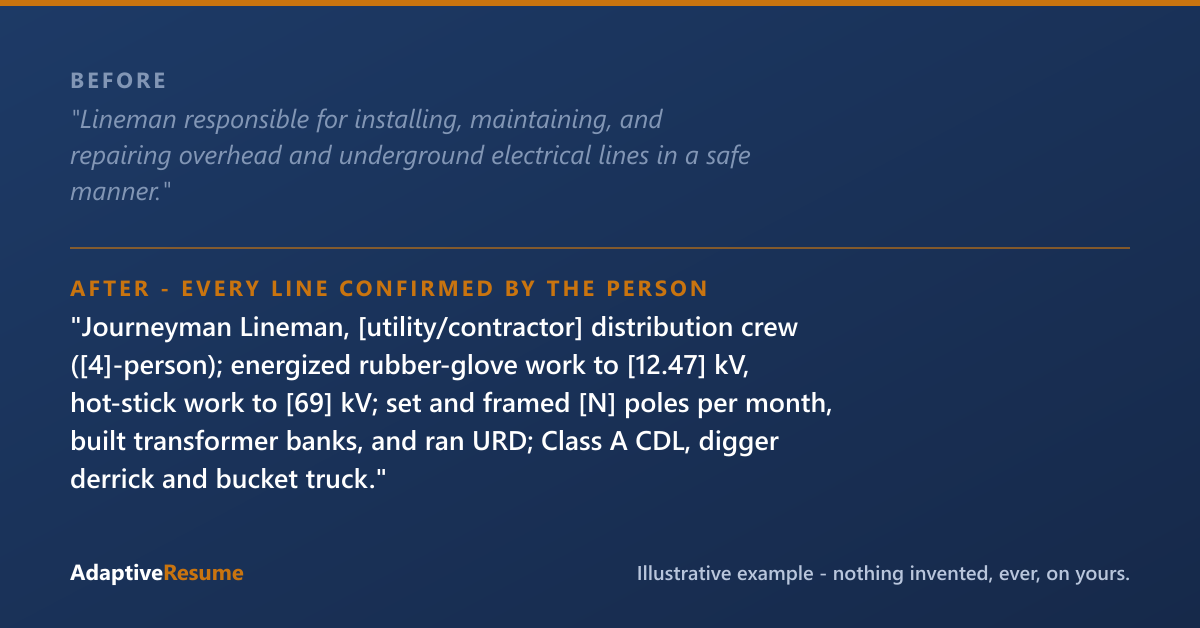
Illustrative example. On your resume, every line comes from your real history — proposed as a question, added only when you confirm it.
The second line invents nothing. It says plainly what the first was hiding: status, voltage, method, construction, equipment, and license. Fill the brackets with your real crew, voltages, and numbers — only those.
Credentials, exactly as held
Everything here gets checked before you are released to a crew, so it has to match your paperwork. Our guide on how to list certifications on a resume covers placement and format; here is what typically belongs in a lineman’s block:
- Apprenticeship and journeyman status. Most linemen come up through a registered apprenticeship — registered with the U.S. Department of Labor’s Office of Apprenticeship or a state apprenticeship agency — and it ends with a Certificate of Completion of Apprenticeship. Many programs are joint IBEW (International Brotherhood of Electrical Workers) and NECA (National Electrical Contractors Association) committees, known as JATCs (Joint Apprenticeship and Training Committees): the Northwest Line JATC, ALBAT (the American Line Builders Joint Apprenticeship & Training Committee), and the Southwestern Line Constructors Joint Apprenticeship & Training Program are three. Utilities and non-union contractors run their own. Name yours, the years, and the hours if you know them.
- Class A CDL — a commercial driver’s license under FMCSA (Federal Motor Carrier Safety Administration) rules. List the state, the class, and any endorsements or restrictions exactly as printed on the card.
- OSHA training. The OSHA (Occupational Safety and Health Administration) Outreach Training Program’s 10-hour and 30-hour construction courses issue completion cards — OSHA itself says a card is not a certification or license, so write “OSHA 30-Hour Construction Outreach card, [year]” rather than “OSHA certified.”
- Electric power standards training. Two OSHA standards govern the work: 29 CFR 1910.269 (Electric power generation, transmission, and distribution — the general industry standard that covers operation and maintenance) and 29 CFR 1926 Subpart V (Electric Power Transmission and Distribution — the construction standard for building and altering lines). Both restrict work on or near exposed energized parts to qualified employees, and 1910.269 spells out the training a qualified employee needs, including minimum approach distances and the use of protective equipment and insulated tools. Name the training you completed and who delivered it. CFR means the Code of Federal Regulations.
- CPR (cardiopulmonary resuscitation) and First Aid — 1910.269 requires people with first-aid training — which the standard defines to include CPR — on crews working on or near exposed energized lines and equipment. List the provider and expiration date.
- Flagger / traffic control. Where required, name the card and issuer — an ATSSA (American Traffic Safety Services Association) flagger certification or your state’s flagger card — with the expiration date.
- Crane operator certification, only if you hold it. Name the certifying body and the card’s exact classifications.
List exactly what you hold, with real status. A misnamed credential, or a journeyman claim a phone call to your JATC can’t back up, costs more than a blank line ever would.
The parts of the job that carry the most weight
Voltage and method. This is the center of the resume. Distribution and transmission are different work at different voltages, and a foreman wants both the class and the method: rubber-glove work to [N] kV, hot-stick (live-line tool) work to [N] kV, de-energized work under clearance, and live-line barehand only if you have done it. kV means kilovolts — thousands of volts. Say what you have worked, not what the crew was rated for.
Overhead construction. Pole setting with a digger derrick, framing, crossarms and insulators, guying and anchoring, conductor stringing and sagging, splicing, and the transformer banks you built and connected. If you have done transmission structure work — steel or wood H-frame, lattice — say so and name the voltage.
Underground. URD (underground residential distribution): pulling primary and secondary cable, pad-mount transformers, elbows, splices, and terminations. Underground work has its own paragraph in 1910.269, and employers filter for it separately.
Equipment. Bucket truck (aerial lift), digger derrick, pole trailers, tensioners and pullers. “Operated equipment” hides the one thing a reader wants to know; name the machines.
Troubleshooting and outage response. Fuses, reclosers, cutouts, sectionalizing, locating faults, and restoring service. Storm restoration deserves its own lines with dates, the utility you were released to, and what was rebuilt.
Climbing and safety roles. Hooks-and-gaffs pole climbing is still expected on many crews; say plainly that you climb. Then the safety work you did — grounding and clearance procedures, tailboard briefings, rubber goods inspection — and any role you held: crew lead, safety observer, apprentice trainer.
Apprentice and groundman resumes
If you are a groundman or an early-step apprentice, do not write around it. Groundman work is real, nameable work: rigging material to the bucket, running the winch, setting grounds, traffic control, and driving. Write your step and your program, then the tasks you have been signed off on — “climbing school complete; set [N] poles under journeyman supervision.” A foreman reading that knows exactly where to put you. If you moved up steps or into a lead role, our guide on how to list promotions on a resume shows how to make that progression visible.
Format notes
Length follows your history, not a page rule. Two pages is normal once you have more than one substantive role to describe; one page is right for an apprentice or a groundman. Order matters more than length: credentials block near the top in its own labeled section (screening software keys on it), then experience with a crew line atop each role. Trim older non-line work before you trim a single voltage or method.
One genuine exception worth knowing: federal applications through USAJOBS cap at two pages as of the September 2025 OPM change. That’s a hard requirement, not a style preference.
Otherwise: reverse chronological, single column, standard headings, real text rather than graphics or tables. Skip the graphics.
A bullet bank you can adapt — keep only what’s true
- “Journeyman Lineman; completed [program] registered apprenticeship ([N] hours), [year]”
- “Energized rubber-glove work to [N] kV and hot-stick work to [N] kV on [distribution/transmission] circuits”
- “Set and framed [N] poles per [month/year] with digger derrick; guyed, anchored, and strung [N] spans”
- “Built and connected [single-phase/three-phase] transformer banks and services for [residential/commercial] customers”
- “Installed URD primary and secondary cable, pad-mount transformers, and terminations on [N] subdivisions”
- “Responded to outages and storm restoration, including [N]-day mutual-aid deployment to [utility], [month/year]”
- “Operated bucket truck and digger derrick; Class A CDL with [endorsements]”
- “Led tailboard briefings for a [N]-person crew; [N] recordable-incident-free [months/years]”
Each bullet is a frame, not a claim. If a line isn’t true of your work, it doesn’t go on the page — the first follow-up question at the interview will find it.
What screening software looks for on a lineman resume
Utility and contractor filters read for the vocabulary of the trade, and a foreman reads for the same words minutes later. The terms that typically matter: lineman, lineworker, journeyman lineman, apprentice lineman, groundman, distribution, transmission, overhead, underground, URD, energized, rubber glove, hot stick, live-line, kV, pole setting, framing, conductor stringing, transformer bank, bucket truck, digger derrick, storm restoration, outage, troubleshooting, Class A CDL, OSHA 10, OSHA 30, 1910.269, Subpart V, CPR, First Aid, flagger, IBEW, and JATC.
O*NET profiles this work under Electrical Power-Line Installers and Repairers (49-9051.00) — the government’s name for the lineman trade — with the full task and equipment list. If you came up through a related trade, our journeyman electrician and HVAC technician guides handle license and scope the same honest way.
The highest-risk lines are the ones that overstate scope — transmission voltage in a distribution-only history, barehand work you watched but never did, or a journeyman claim before the certificate. Line work is a small world, and the crew you join will know within a week.
The Role Skills Checklist below helps you inventory what your crew work actually proves, which is often considerably more than the resume currently says. Our build does it with you: we work backwards from your real crews, voltages, and equipment, propose the lines and credentials that history supports — each one offered as a question, not a decision made for you — and ask you to confirm every item before it appears. We never add a credential, a voltage class, or a method you didn’t tell us about.
Common questions
How do I show journeyman lineman status on a resume?
State how you earned it. A registered apprenticeship ends with a Certificate of Completion of Apprenticeship issued by the U.S. Department of Labor's Office of Apprenticeship or your state apprenticeship agency, so write the program and the year: 'Journeyman Lineman — completed [program name] registered apprenticeship, [year].' If you topped out through a utility's own program instead, say that. If you're still an apprentice, write your step: 'Apprentice Lineman, step [N] of [N], [program].' Both are honest and both get read correctly.
Do I need a Class A CDL to be a lineman?
Most line crews expect one, because the trucks that carry the crew and its material — digger derricks, bucket trucks, and the trailers behind them — commonly fall under commercial driver's license rules. Many apprenticeship programs list a Class A CDL as a condition of entry. Put it in your credentials block with the state, the class, and any endorsements or restrictions exactly as printed on the card, including a restriction you are working to remove.
Should I list OSHA 10 or OSHA 30 as a certification?
List it, but call it what it is. OSHA's Outreach Training Program issues a 10-hour or 30-hour completion card, and OSHA itself says the card is not a certification or license. 'OSHA 30-Hour Construction Outreach card, [year]' is exact. The training that matters more on a line crew is the qualified-employee training under 29 CFR 1910.269 and 29 CFR 1926 Subpart V — name that training and who ran it, rather than folding it into the OSHA card.
How do I write storm work on a lineman resume?
As real work with dates and scope, not a highlight reel. Storm restoration is where a lot of your hardest hours live: 'Storm restoration, [utility or region], [month/year]; [N]-day deployment; rebuilt [N] spans and replaced [N] poles under mutual-aid crew.' Name the utility you were released to, the crew size, and what was rebuilt. Leave out anything you watched but didn't do — the foreman who reads it has worked the same storms.
Role Skills Checklist
Pop your email in and the download unlocks right here — and being on the list before launch day locks in 25% off your first build. We'll also send the occasional useful note and tell you the moment AdaptiveResume goes live. No spam.
Download: Role Skills ChecklistThanks — you're on the launch list, your 25% is locked in, and your download is ready below.
That email didn't look right — mind trying it again?
Ready to do this on your own resume?
We'll find what you've left off and you approve every line — nothing made up.
Build your resume — $49Try the demo first — a sample review, no sign-up · See how the service works
Paid a resume service and got a template back? Start at Fix my resume.