Guides · For job seekers
How to List Self-Employment on a Resume: Freelance, Contract, and Gig Work
Self-employment belongs in your work history like any other job. Here's how to title it, show your clients and your numbers, handle gig work, and answer the questions a hiring manager or recruiter will have.
Published 10/28/2026
Self-employment is work, and it belongs in your work history the same way a job does. A hiring manager or recruiter reading that entry wants four answers: what you did, who you did it for, how much of it you did, and whether it was real. A line that says only “Self-employed, 2019 – 2024” answers none of them, and it can read like a gap with a label on it.
The fix is to write the entry like any other job. Give it a title that names the work, real dates, one line about who your clients were, and bullets with numbers.
The format, written the way a hiring manager reads it
Before: “Self-employed, 2019 – 2024. Did freelance work for various clients.”
After: “Freelance Bookkeeper (Self-employed), 03/2019 – 06/2024. Kept the books for 11 small-business clients in QuickBooks Online, closed each client’s month within 5 business days, and prepared year-end packets for their tax preparers.”
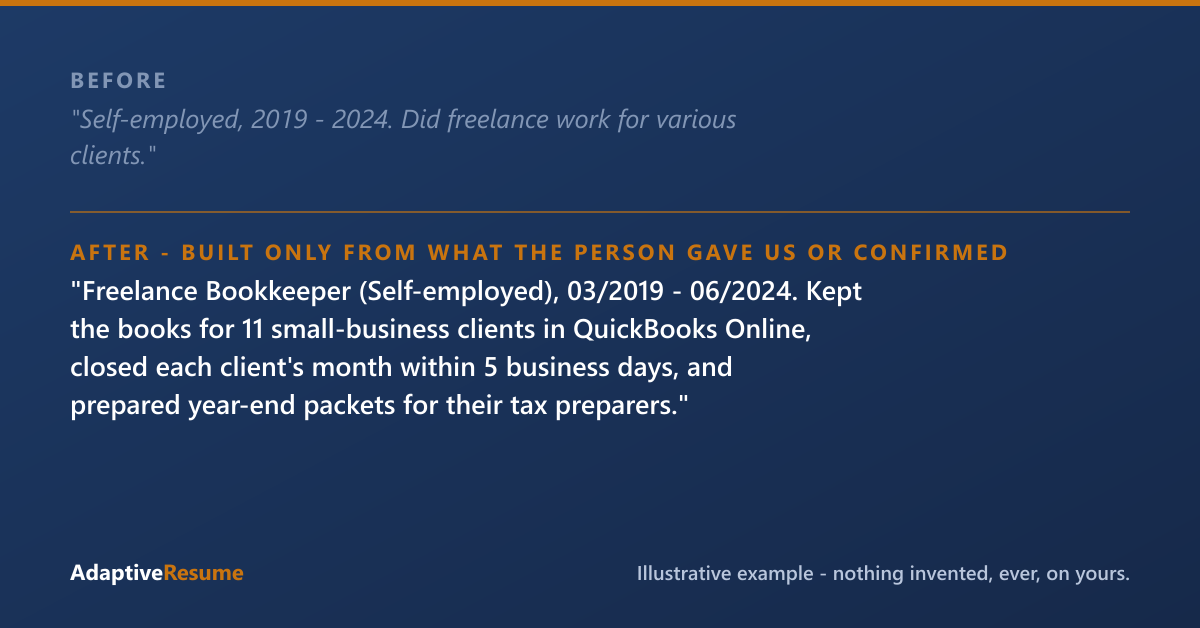
Illustrative example. Everything on your resume is yours: the experience you listed, plus the clients, tools, and results your work already involved, each added only after you confirm it’s true.
The second version names the trade, the number of clients, the software, and a result a hiring manager can picture. It also keeps “Self-employed” in the heading, so nobody mistakes the entry for an employer they could call.
Pick a title that names the work
When you work for yourself, you choose your own title, so choose one that describes the work a reader will recognize:
- Name the trade. Freelance Graphic Designer, Independent IT Consultant, Contract Bookkeeper, and Self-employed Electrician all tell a reader what you did before they read a single bullet.
- Use “Owner” when you ran a business. If you had customers, equipment, a storefront, or people working for you, “Owner” fits. Add what the business did, such as “Owner, residential lawn care business.”
- Size the title to the work. “CEO” or “Founder and President” of a one-person business can read as inflated, and it makes a reader wonder how big the company really was. A plain title is easier to trust.
- Use the posting’s words when they are true. If you did the work of an “accounting clerk” for your clients, you can use that wording in your summary and bullets. Keep every word true to what you actually did.
Contract work through a staffing agency is a regular job. If an agency paid you on a W-2 and placed you with a client, list the agency as the employer and name the client, such as “Contract Accounts Payable Clerk, [Agency], assigned to [Client].” Write “Self-employed” only when you were paid as an independent contractor; the IRS explains the difference between an independent contractor and an employee.
Show your clients, your work, and your numbers
The bullets under a self-employment entry carry more weight than they do under a regular job, because there is no well-known employer name to lean on.
Describe your clients. A reader wants to know whether you worked for households, small businesses, or large companies. Describing them by type and size works well: “a regional hospital system,” “four restaurants and a hardware store.” Name a client only if the relationship is public and you have their permission. Many client contracts include confidentiality terms, so check yours before you name anyone.
Count what you did. Clients served, projects finished, repeat clients, jobs per week, and on-time delivery are all numbers a reader can use. Revenue is optional; include it only if you are comfortable sharing it and it helps the job you want. If you need help finding your numbers, our guide on how to quantify resume bullets walks through it.
Name your tools and credentials. The software, equipment, licenses, and certifications you used for clients count the same way they would at a company. A licensed electrician who worked for themselves still holds the license, and it belongs on the resume.
Mention running the business, briefly. Quoting, invoicing, scheduling, and keeping your own books show that you are organized and reliable. One bullet usually covers it, unless the job you want is in operations, sales, or office management, where those skills are the point.
Gig and app-based work
Driving, delivery, shopping, and task apps are paid work, and they can show reliability and customer service. Write them as one entry with one title, and name the apps in the line under it:
Independent Delivery Driver (Self-employed), 01/2023 – Present. Deliveries through DoorDash and Instacart: about 2,400 completed orders and a 4.9 customer rating.
Our delivery driver resume guide covers driving work in more detail.
If you did gig work alongside a regular job, list both with their real dates and mark the gig work part-time. Overlapping dates are normal, and a recruiter can read them as two jobs held at once.
When self-employment filled the time between jobs
If you freelanced or took contract work after a layoff, those months are work experience, and listing them is honest. Write the real dates, and say “part-time” or “project-based” if the work was not full-time.
Describe it at its true size. A few paid projects are a few paid projects, and that is fine to show. Stretching the dates to cover a longer stretch, or turning occasional work into a business it never was, is the kind of detail a reference call or a tax form can contradict. If you also had months with no paid work, our guide on how to explain an employment gap covers how to write that part plainly.
Where it goes and how to format it
- Put it in your experience section, in date order, like any other job. Moving it to an “Other” section at the bottom makes it look like something you would rather not discuss.
- Write the dates as month and year, the same as your other jobs.
- Use your business name or “Self-employed” as the company line, and include your city and state.
- Add a link to your work if the job values it. A designer, writer, photographer, or developer can put a portfolio or business website address in the header or in the entry. Show only work you have the right to share.
- Keep it plain. A logo, a text box, or a table can be dropped or scrambled by screening software, and our guide on what screening software reads shows why.
If an employer checks
Employers often verify work history, and self-employment is checked differently from a regular job because there is no HR department to call. Have proof ready before you apply:
- Client references. Ask two or three clients who know your work whether they are willing to take a call.
- Your own records. Invoices, signed contracts, statements of work, and any 1099 forms clients sent you all show the work happened. Households and some small clients never send a 1099, so keep your invoices and payment records.
- IRS transcripts. The IRS offers several transcript types at no charge. A wage and income transcript shows information from forms such as 1099s that were filed with the IRS, and a tax return transcript shows most line items from your return as filed, along with its forms and schedules. Sole proprietors report business income on Schedule C, so the tax return transcript can show the business existed. The tax return transcript covers the current year and the three years before it, and the wage and income transcript covers the current year and the nine years before it, so keep your own copies of older returns.
Share proof that the work happened, never a client’s confidential files or data.
Questions a hiring manager may have
“Why go back to a job?” One sentence in your summary answers it before anyone asks: “Bookkeeper with five years of client work, looking for a full-time accounting role on an in-house team.”
“Can you work inside someone else’s process?” Bullets that show deadlines you met for clients, client teams you worked with, and systems you learned for them answer this one.
“Are you still running the business?” Know your answer before the interview, whether you are closing it, pausing it, or keeping a small amount of side work.
How we help
When we build your resume with you, self-employment is treated as part of your work history, not a footnote to it. We ask about your clients, your projects, your tools, and your numbers, and we help you turn your answers into an entry a hiring manager or recruiter can read at a glance. Nothing goes on your resume that you didn’t give us or confirm, so a client, a number, or a credential you never told us about stays off the page. The Achievement-Quantification Worksheet below helps you find your numbers first.
Common questions
Should I write my business name or "Self-employed"?
Use whichever a stranger will understand faster, and you can use both. If your business had a name, write it with a short note, such as "Ridgeline Books (my bookkeeping business)." If you worked under your own name, write "Self-employed" and let the job title name the trade, such as "Freelance Bookkeeper." Either way, the title should say what you did, not only that you worked for yourself.
Will a hiring manager worry that I'll go back to working for myself?
Some will wonder, so answer it on the page. Your summary can say in one plain sentence which role you want now. If you are closing the business or keeping only a little side work, be ready to say so in the interview. The resume's job is to show that the skills you used for your clients are the skills the posting asks for.
How do I prove self-employment if an employer asks?
Have two or three kinds of proof ready. A client who has agreed to be a reference is the most common. Your own records work too: invoices, signed contracts, or any 1099 forms clients sent you, though households and some small clients never send one. The IRS also offers free transcripts, including a wage and income transcript that shows information from forms such as 1099s filed with the IRS for you. Share proof of the work, never a client's confidential files.
Does gig work like rideshare or delivery count?
Yes, paid gig work is work experience. Group it into one entry instead of listing each app on its own, with a title such as "Independent Delivery Driver" and the apps named underneath. Add the numbers the app shows you, such as completed deliveries or your rating, when they help with the job you want.
What if my self-employment was only a few small jobs?
List it if it was real paid work, and describe it at its true size. A handful of projects can be "Freelance carpentry, part-time" with the kinds of jobs you did. Don't call it a company or give it staff it never had, because a recruiter's first follow-up question would bring that out.
Achievement-Quantification Worksheet
Pop your email in and the download unlocks right here. Joining our list also takes 25% off your first purchase within 30 days of joining, when you create your account with this same email. We'll also send the occasional useful note. No spam.
Download: Achievement-Quantification WorksheetThanks, you're on our list, and your download is ready just above. Your 25% off a first purchase is good for 30 days from the day this email joined our list.
That email didn't look right — mind trying it again?
Ready to do this on your own resume?
We'll find what you've left off, and nothing goes on your resume that you didn't give us or confirm.
Get your resume build — $29Every purchase is one payment, and nothing renews. A single resume build can be used any time within 12 months of buying it, and AR Pass builds you don't use end when its 90 days end.
Try the demo first — a sample review, no sign-up · See how the service works
Paid a resume service and got a template back? Start at Fix my resume.