Guides · For job seekers
Home Health Aide Resume: The Federal Training Line, Your Clients, and the Care Plan You Followed
Home health aide resumes are screened for the training and competency evaluation first, then for the visits, the care tasks, and the records. Here's how to write yours with the exact qualification line, real client and visit numbers, and the documentation an agency checks.
Published 10/11/2026 · Updated 10/30/2026
A home health aide resume is read by a staffing coordinator or a clinical manager who has to answer one question before anything else: can this person legally be sent into a patient’s home on our behalf? For an agency that bills Medicare, that question has a regulatory answer, and the resume should give it in the first few lines. Then the reader wants to know how many clients you have seen, what care you gave, and whether your visit records were complete.
Many home health aide resumes open with “compassionate caregiver dedicated to helping patients” and leave the reader to dig for the training and the numbers. Put the qualification first, and put real numbers on the visits.
Lead with the qualification line, written exactly
Before: “Compassionate home health aide with experience caring for elderly patients in their homes.”
After: “Home health aide, [state] [training program name] ([year]), [75]-hour training and competency evaluation; [12] hours of in-service training a year. [5]-[7] client visits a day across [county], bathing and transfers on each care plan, vital signs reported to the supervising RN, every visit clocked in [HHAeXchange].”
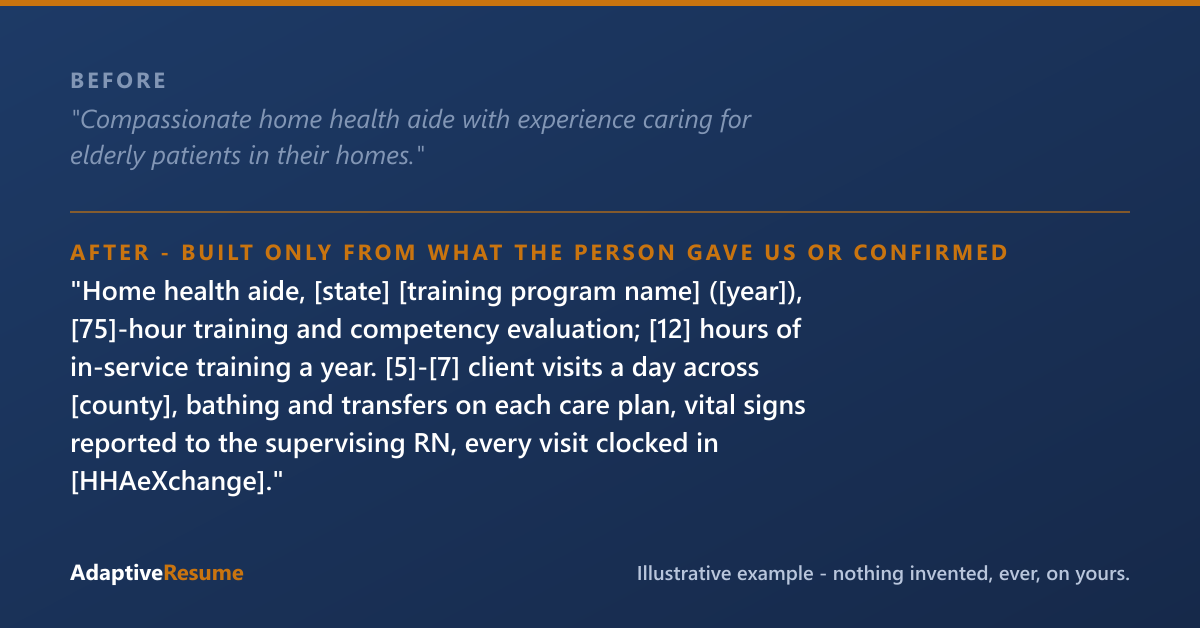
Illustrative example. Everything on your resume is yours: the experience you listed, plus the training, care tasks, and records your work already involved, each added only after you confirm it’s true.
The second version tells the agency that you meet the qualification, that you keep your training current, how much work you carry, and that your records are clean. Write only the program you actually completed, with the name on your certificate.
What the federal rule asks for, and how to write it
A home health agency that participates in Medicare can only use aides who meet 42 CFR 484.80. The rule offers four routes: a training and competency evaluation program, a competency evaluation program on its own, a state-approved nurse aide program with a current listing in good standing on the state registry, or a state licensure program that meets the same standard. The training route requires at least 75 hours, including at least 16 hours of supervised practical training, and at least 16 hours of classroom training must come before the practical hours.
The competency evaluation is more than a written test. The rule requires an evaluator to watch you perform several tasks with a patient or a stand-in, including communication, vital signs, personal hygiene, safe transfers, and range of motion and positioning. If your program put you through that observed evaluation, your resume can say “training and competency evaluation completed,” which uses the same words as the federal rule an agency checks your certificate against.
After you qualify, the rule requires at least 12 hours of in-service training in every 12-month period. Listing that training, with the topics and the year, shows the agency that you are current without them having to ask. Some states add their own layer, such as a state certificate or a home care registry listing. New York, for example, lists home health aides and personal care aides who completed a state-approved program on its Home Care Registry. Write your state’s credential by its exact name if you hold one.
The parts of the job that carry the most weight
Clients and visits, in numbers. Give your visits per day or per week, the number of clients on your schedule, the area you covered, and the visit length. “Five to seven visits a day across two counties” tells a coordinator you can carry a full route.
The care tasks on the plan. List the tasks you carried out, such as bathing, grooming, toileting, dressing, transfers with a gait belt or a mechanical lift, range-of-motion exercises, ambulation, meal preparation to a prescribed diet, and medication reminders where your state and agency allow them. Write the tasks you actually performed, and keep them inside the aide scope. Sterile wound care, injections, and giving medications are generally nursing tasks, and listing them as yours can raise a red flag with a home health agency unless your state and your agency allowed you to do them.
Observation and reporting. Write how you took vital signs and reported changes in skin condition, appetite, mood, or mobility, and falls, each to the supervising nurse the same day. Under the federal rule, the agency checks the aide’s work on a set schedule: a registered nurse or therapist assesses it at least every 14 days for patients receiving skilled care, and a registered nurse visits at least every 60 days for patients who are not. A clean record across those reviews is worth one line.
Visit records. State Medicaid programs require electronic visit verification for Medicaid-paid home health visits, which records the type of service, the person served, the date, the location, the aide, and the start and end times. Name the app your agency used and describe your record honestly, for example “every visit clocked in and out on site, no missed check-ins in [N] months.”
Patients and conditions. Name the groups you have cared for, such as older adults after a hospital stay, people living with dementia, stroke recovery, hospice support alongside the hospice team, pediatric home care, and clients with disabilities. Agencies often match aides to patients by experience, so this line helps them place you.
Credentials and checks, as held
List the training program and year, the competency evaluation, the state certificate or registry listing with its status, CPR and first aid with the issuing organization and expiration, and any dementia-care or hospice training with the provider. A valid driver’s license and reliable transportation matter on many home health routes, so one line saying you have both is useful when the posting asks.
A background check is a condition of the job rather than a credential, but if the posting asks for it, one line saying it is current is fine.
Moving into home health from other care jobs
From a nursing home or hospital CNA job. If your registry listing is current and in good standing, you already qualify through one of the routes the federal rule accepts, though your state may add a short transition course. You also bring the vital signs, transfers, and documentation habits. What changes is working alone in the client’s home, driving between visits, and reporting by phone or app instead of at the nurses’ station. Write the CNA work in full and say plainly that you are moving into home care.
From private-duty caregiving. You have the client relationships and the personal care. What you may not have is the federal qualification. If you have completed home health aide training, list it with the year; if you are enrolled, list it as in progress with the expected date. Do not change your old job titles to “home health aide,” and use our caregiver guide for how to write the private-duty work itself.
Format notes
Length follows your history, not a page rule. An aide with several agencies and a CNA background has more that matters than one page holds. Two pages is normal and expected once you have more than one substantive job to describe. Keep the qualification, the visit numbers, the care tasks, the populations, and the records; cut the duties every aide shares.
Use reverse chronological order and a single column, put the qualification line near the top, and leave out graphics and photos. Home health agencies often take applications through hiring software, and a two-column template can scramble the read. Gaps get one plain dated line, especially if a gap is long enough to raise the 24-month retraining question.
A bullet bank you can adapt — keep only what’s true
- “Home health aide, [program name], [year]: 75-hour training and competency evaluation; [N] hours of in-service training in [year]”
- “Completed [N] client visits a day across [area]; [N]-minute to [N]-hour visits on a set weekly schedule”
- “Provided bathing, dressing, toileting, and gait-belt transfers for [N] clients following each written care plan”
- “Took and recorded vital signs at every visit; reported changes in skin, appetite, or mobility to the supervising RN the same day”
- “Clocked every visit in [EVV app] with no missed check-ins in [N] months”
- “Cared for clients living with [dementia/stroke recovery/COPD]; supported [N] hospice clients alongside the hospice nurse”
- “CPR and first aid, [issuing organization], current through [month/year]; dementia care training, [provider], [year]”
- “Oriented [N] new aides on agency visit procedures and documentation”
What screening software looks for on a home health aide resume
Filters commonly read for: home health aide, HHA, certified home health aide, CNA, personal care, activities of daily living, ADLs, bathing, transfers, gait belt, Hoyer lift, range of motion, vital signs, care plan, documentation, EVV, dementia care, Alzheimer’s, hospice, CPR, first aid, infection control, valid driver’s license, and the visit-verification app the agency uses. O*NET’s profile for home health aides has the full task list.
The highest-risk lines are the ones an agency checks before your first visit: a training program you did not finish, a registry listing that has lapsed, a nursing task written as your own, or a title from a past job changed to match the posting. Write only what your certificate, your registry listing, and your own work history show.
The Role Skills Checklist below helps you inventory what your home care history actually proves, which is often more than the resume currently says. Our build does it with you: we work backwards from your real clients, visits, and training, and we ask you about the care tasks, conditions, and records that work like yours normally involves. Nothing goes on your resume that you didn’t give us or confirm, so a credential, a task, or a visit count you never told us about stays off the page.
Common questions
What is the difference between a home health aide and a caregiver on a resume?
The difference is the training and the employer. A home health aide at a Medicare-certified home health agency has met the federal qualification rule, and each visit follows written care instructions that a registered nurse or therapist prepares and supervises. A caregiver or personal care aide usually provides non-medical help without that qualification. If you have done both kinds of work, keep them as separate entries with their own titles, and read our caregiver guide for the non-medical side.
I'm a CNA. Can I list myself as a home health aide?
You can, but only if you actually worked as one. The federal rule lets a nurse aide who is listed in good standing on a state registry qualify for home health aide work, so many CNAs move into home care without repeating a full course, although some states, such as New York, require a short transition course first. But the title on your resume should be the title you were hired under. Write the CNA certification exactly as your state registry shows it, and add the home health job as its own entry once you hold one.
My training certificate is from years ago. Does it still count?
It depends on whether you kept working. Under the federal rule, an aide who goes 24 consecutive months without providing paid aide services has to complete a new training or competency evaluation before working again. If you have worked steadily, list the original program and year along with your recent in-service training. If you had a long break, say so plainly and list the refresher you completed or are scheduled for.
Should I list the agency's software on my resume?
Yes, list it by name. Many home health agencies record every visit electronically, and a handful of scheduling and visit-verification apps are widely used. If a posting names the app you already use, that is one less thing to train you on. Write the app and what you did in it, such as clocking in and out at the client's home and completing the visit checklist.
Role Skills Checklist
Pop your email in and the download unlocks right here. Joining our list also takes 25% off your first purchase within 30 days of joining, when you create your account with this same email. We'll also send the occasional useful note. No spam.
Download: Role Skills ChecklistThanks, you're on our list, and your download is ready just above. Your 25% off a first purchase is good for 30 days from the day this email joined our list.
That email didn't look right — mind trying it again?
Ready to do this on your own resume?
We'll find what you've left off, and nothing goes on your resume that you didn't give us or confirm.
Get your resume build — $29Every purchase is one payment, and nothing renews. A single resume build can be used any time within 12 months of buying it, and AR Pass builds you don't use end when its 90 days end.
Try the demo first — a sample review, no sign-up · See how the service works
Paid a resume service and got a template back? Start at Fix my resume.