Guides · For job seekers
Carpenter Resume: Skills, Credentials, and Real Scope
Carpentry hiring reads for what you can actually build: the framing, finish, and formwork you've done, the safety training you hold, and a scope line with crew size and square footage. Here's how to write yours honestly.
Published 09/08/2026
Carpentry hiring runs on one question: what can you actually build, and how much of it have you done? A superintendent reading your resume wants to know whether you can lay out a wall from the plans, frame it plumb and square, and hand off a room that passes punch list. Generic language (“skilled carpenter with a strong work ethic and attention to detail”) doesn’t answer that. The specifics do — the kind of carpentry, the size of what you built, the crew you worked with, and the training you hold exactly as issued.
The other thing that costs carpenters on paper is scope blur. Rough framing, finish and trim, concrete formwork, cabinet installation, and commercial interiors are related but different jobs, and a resume that says “carpenter, all phases” competes badly against one that names the phases and puts numbers next to them.
The scope line: your work in one sentence
Under each job, give one line another carpenter would recognize instantly.
Before: “Carpenter responsible for framing, finish work, and other duties on residential and commercial projects.”
After: “Lead carpenter on a [4]-person crew; rough framing and layout on [12] single-family homes per year ([2,400]–[3,200] sq ft each), plus interior trim, door hanging, and punch-list closeout; read architectural plans and set layout from them.”
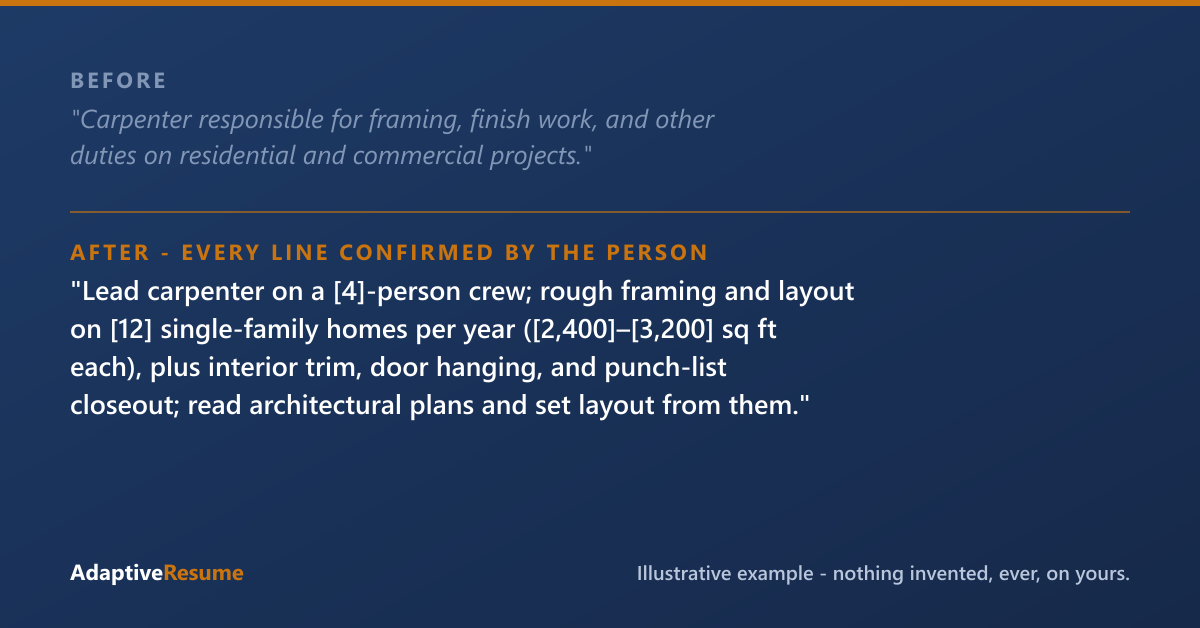
Illustrative example. On your resume, every line comes from your real history — proposed as a question, added only when you confirm it.
The second version is scannable in four seconds. Notice the rewrite invents nothing; it just says plainly what the vague version was hiding.
Credentials and training, exactly as held
Carpentry has few required credentials, so the ones you hold get read closely. Our guide on how to list certifications on a resume covers placement and format; here is what typically belongs in a carpenter’s block, listed with the issuing body and year.
- Apprenticeship and journeyman status. A UBC (United Brotherhood of Carpenters and Joiners of America) apprenticeship is a registered apprenticeship with the U.S. Department of Labor; most run four years, with curriculum from the CITF (Carpenters International Training Fund) through regional training centers. Completing it makes you a journeyman carpenter — write “Journeyman Carpenter — [training center], [year],” or “Carpenter Apprentice, [year] of [N]” if you’re still in it. Non-union registered apprenticeships count the same way; name the sponsor.
- NCCER Carpentry. The NCCER (National Center for Construction Education and Research) structures its carpentry curriculum in three tiers — General Carpentry; Advanced Carpentry: Frame & Finish; and Form Carpentry — with NCCER Core as the prerequisite. List the tier completed and the year.
- OSHA 10-hour or 30-hour construction card. OSHA (Occupational Safety and Health Administration) runs the Outreach Training Program; the 10-hour class is for workers, the 30-hour for supervisors or anyone with safety responsibility. Write “OSHA 30-Hour Construction, [year].” OSHA itself says the card is not a certification or license, so don’t call it one.
- Scaffold training. OSHA’s construction scaffold standard, 29 CFR 1926 Subpart L, requires anyone who works on a scaffold to be trained by a qualified person, and anyone who erects, moves, or dismantles one to be trained by a competent person. If your employer has designated you the scaffold competent person, say so — it’s worth a line.
- Fall protection training. OSHA’s construction fall protection standard, 29 CFR 1926 Subpart M, requires training for workers exposed to fall hazards. Name the training and year.
- Aerial lift / MEWP training. Boom lifts fall under OSHA’s construction aerial lift rule (29 CFR 1926.453); OSHA treats scissor lifts as mobile scaffolds under the scaffold standard (29 CFR 1926.452(w)). The ANSI/SAIA A92.24 training standard for mobile elevating work platforms covers both. List equipment type and year.
- First aid and CPR. Typically through the American Red Cross or the American Heart Association; list the current-through date.
- ICRA training. ICRA (Infection Control Risk Assessment) training covers construction inside occupied hospitals and clinics; the UBC runs its own program, UBC ICRA Best Practices in Health Care Construction — a 24-hour course that issues a card. If you’ve built containment barriers under negative-air protocols in a live healthcare facility, the credential plus that experience line is a real differentiator.
- State contractor license. Only if you hold one — that’s for carpenters who run their own work, and the rules vary by state. Name the state and the license class as your state names it.
Nothing you’re “about to take” unless it’s labeled that way — “OSHA 30, scheduled [month/year]” is honest. A misnamed credential loses ground fast with a reader who holds the same one.
Carpenter resume skills: the parts of the job that carry weight
Most carpenter resumes get this section wrong by listing nouns (“framing, trim, power tools”) instead of work. Write each skill as something you did, at a size, with a tool or a plan behind it.
Rough framing and layout. Wall, floor, and roof framing; stairs; setting layout from the plans with a tape, chalk line, and level. Say the type of construction — wood-frame residential, light-gauge metal stud, engineered lumber — and the scale: homes per year, square feet, stories.
Concrete formwork. Wall forms, footings, slabs, columns, stripping and resetting gang forms. Name the form system ([system]) and the pour sizes — formwork is its own specialty and often filtered for by name.
Finish and trim. Baseboard, casing, crown, wainscot, stair rail and balusters, window and door trim. Finish carpentry is judged on fit, so say the level — production tract trim versus custom work — and the materials: paint-grade, stain-grade, hardwood.
Doors, hardware, and cabinetry. Pre-hung and slab doors, commercial hollow-metal frames, hardware sets and closers, kitchen and bath cabinets, countertops, built-ins. Count them: “[N] cabinet installs.”
Drywall and related work. Drywall, acoustical ceilings, insulation, siding, decks, windows — list what you’ve actually done, but not ahead of your core carpentry.
Plans and code. Reading architectural and structural drawings, taking off materials from them, and working under the IRC (International Residential Code) or IBC (International Building Code), both published by the International Code Council. Name only the code your work was actually inspected against.
Tools. Name the ones you run: framing nailers, miter and table saws, track saws, routers, laser levels, powder-actuated fasteners if you hold the tool-specific training. Skip “power tools.”
Leading a crew and closing out. Crew size, apprentices trained, material ordering, coordinating with other trades, punch-list closeout. If you were the lead, say how many people you led. Our guide on how to list promotions on a resume covers the apprentice-to-lead progression cleanly.
Format notes
Length follows your history, not a page rule. Two pages is normal and expected once you have more than one substantive carpentry job to describe; one page is right for apprentices and people entering the trade. Order matters more than length: credentials block near the top in its own labeled section (screening software keys on it), then experience with a scope line atop each job. If you’re trimming, cut older non-trade jobs before a single carpentry specific.
One genuine exception worth knowing: federal applications through USAJOBS cap at two pages as of the September 2025 OPM change. That’s a hard requirement, not a style preference.
Otherwise: reverse chronological, single column, standard headings, real text rather than graphics or tables — hiring systems parse plain layouts most reliably. Skip the graphics and the photo.
A bullet bank you can adapt — keep only what’s true
- “Lead carpenter on a [N]-person crew; rough framing on [N] [homes/units] per year, [N] sq ft each”
- “Set layout from architectural plans; framed walls, floors, and roofs to IRC on [wood-frame/engineered] construction”
- “Formed and stripped [footings/walls/columns] for pours up to [N] cubic yards using [system] forms”
- “Installed [paint-grade/stain-grade] trim, casing, crown, and stair rail on [N] custom homes”
- “Hung [N] commercial hollow-metal doors and hardware sets on a [N]-story [project type]”
- “Built ICRA containment barriers and worked under negative-air protocols on a [N]-bed hospital renovation”
- “Trained [N] apprentices; ran punch-list closeout on [N] units to the superintendent’s sign-off”
Each bullet is a frame, not a claim. If a line isn’t true of your work, it doesn’t go on your page — a superintendent’s first question on site will find it.
What screening software looks for on a carpenter resume
Hiring systems read for the vocabulary of the trade, and a human reads for the same words minutes later. The terms that typically matter: carpenter, journeyman, apprentice, rough framing, layout, formwork, concrete forms, finish carpentry, trim, cabinet installation, doors and hardware, drywall, metal stud, blueprint reading, IRC, IBC, OSHA 10, OSHA 30, scaffold, fall protection, aerial lift, punch list, and lead carpenter.
One useful anchor: O*NET profiles this work under Carpenters (47-2031.00). Its task list — measuring and marking cut lines, cutting to spec, installing windows, frames, flooring, trim, and hardware — is a good check that your scope lines say the same things in plainer words. If you also weld, run electrical, or maintain a facility, our guides for welders, journeyman electricians, and maintenance supervisors cover those trades the same way.
The highest-risk lines overstate scope — a crew you worked on written as one you led, or a training card called a certification. Every jobsite is a small world, and a foreman can tell in a morning.
The Role Skills Checklist below helps you inventory what your jobsite work actually proves, which is often considerably more than the resume currently says. Our build does it with you: we work backwards from your real jobs, crews, and training, propose the lines and credentials that history supports — each one offered as a question, not a decision made for you — and ask you to confirm every item before it appears. We never add a credential, a project, or a skill you didn’t tell us about.
Common questions
Do I need a certification to work as a carpenter?
Usually not. Most carpentry jobs have no license requirement for the worker; the contractor holds the license. What employers check is training and proof of work: a completed apprenticeship, an OSHA 10- or 30-hour construction card, and the specific kinds of carpentry you've done. If you hold NCCER (National Center for Construction Education and Research) credentials or a journeyman certificate, list them exactly as issued. If you don't, your scope lines carry the message.
How do I write a carpenter resume with no experience?
Lead with what's true: any pre-apprenticeship or trade-school program, an OSHA 10-hour card, and hands-on work you've actually done — a framing job with a relative, a deck, formwork on a summer crew. Name the tools you can run safely. One honest line ('Framed [N] decks and a [N]-square-foot garage addition with a licensed contractor') says more than a paragraph of 'hard worker' language.
What skills should a carpenter resume list?
The ones you've done, by name: rough framing, layout, concrete formwork, finish and trim, door hanging and hardware, cabinet installation, drywall, and plan reading. Add the code you work under (IRC — International Residential Code — or IBC — International Building Code), the tools you run, and the scope around the work: crew size, square footage, units, and punch-list closeout. Skip skill lists that just say 'carpentry' and 'teamwork.'
Should I list my union apprenticeship on a carpenter resume?
Yes, as a credential with its own line. A completed UBC (United Brotherhood of Carpenters and Joiners of America) apprenticeship is a registered program with the U.S. Department of Labor, and finishing it makes you a journeyman — that's a status, not a job title, and it belongs in your credentials block with the training center and year. If you're still in the program, write 'Carpenter Apprentice, [year] of [N]' so the reader knows exactly where you stand.
Role Skills Checklist
Pop your email in and the download unlocks right here — and being on the list before launch day locks in 25% off your first build. We'll also send the occasional useful note and tell you the moment AdaptiveResume goes live. No spam.
Download: Role Skills ChecklistThanks — you're on the launch list, your 25% is locked in, and your download is ready below.
That email didn't look right — mind trying it again?
Ready to do this on your own resume?
We'll find what you've left off and you approve every line — nothing made up.
Build your resume — $49Try the demo first — a sample review, no sign-up · See how the service works
Paid a resume service and got a template back? Start at Fix my resume.