Guides · For job seekers
Caregiver Resume: Client Load, Real Skills, and the Credentials Your State Actually Issues
Home care agencies and families read a caregiver resume for three things: who you cared for and at what level, the skills your shifts prove, and whether the credential you list is the one your state actually issues. Here's how to write yours honestly.
Published 09/26/2026 · Updated 10/30/2026
A home care agency, an assisted living community, or a family reads a caregiver resume in a few seconds, and it reads for three things. Who did you care for, and at what level? Which of the skills on the page did you actually do on a real shift? And is the credential you list the one your state actually issues, written the way the state writes it? “Compassionate caregiver with a passion for helping others” answers none of that. The specifics do.
The other thing that sinks caregiver resumes is leaving off the work. Caregivers do a great deal that never makes the page: full personal care, transfers with a lift or a gait belt, medication reminders on a schedule, dementia redirection, and documenting every visit in an agency app. Nearly all of it is what the next agency is screening for, and this guide is about putting it on the page without stretching a word of it.
The shift line: your scope in one sentence
Under each job, give one line another caregiver or a care coordinator would recognize instantly.
Before: “Caregiver responsible for assisting clients with daily activities and providing companionship.”
After: “Caregiver, [Washington] certified Home Care Aide (active); [3] private-duty clients per week in their homes, [12]-hour shifts; full personal care, gait belt transfers, medication reminders on a written schedule, meals to a [diabetic] diet; visits verified and charted in [HHAeXchange].”
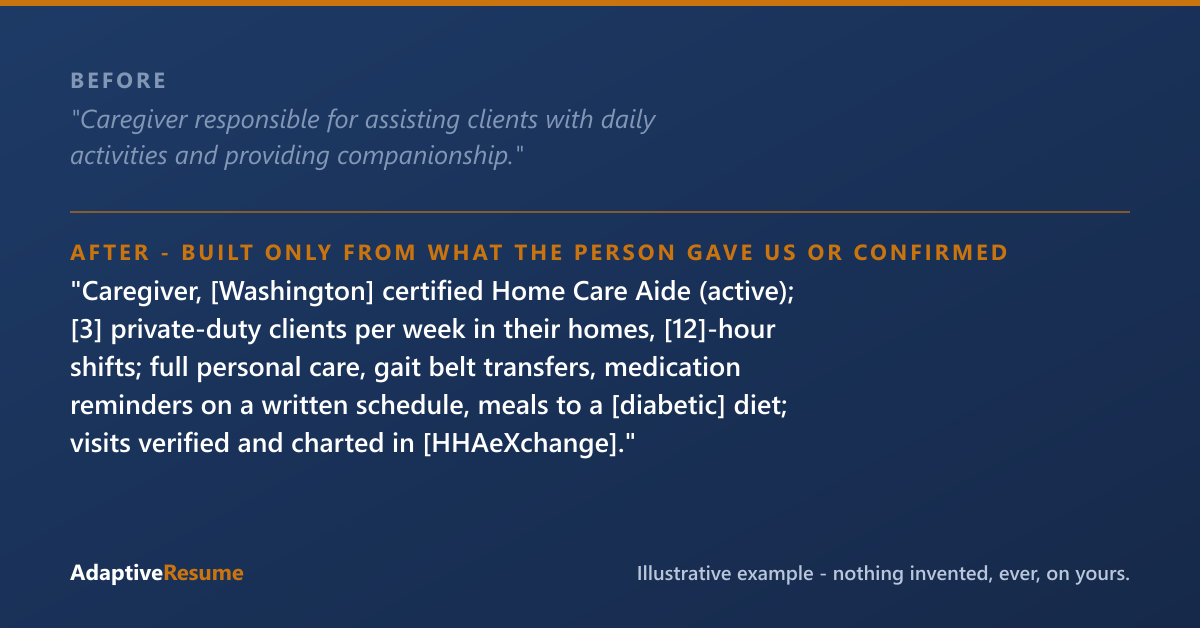
Illustrative example. Everything on your resume is yours: the experience you listed, plus the skills, tools, responsibilities, and credentials your work already involved, each added only after you confirm it’s true.
Read the second version once and you know what the first never says: the credential you hold, how many clients you carried, where and for how long, what care you gave, and where you charted it. Nothing in it is invented. Fill the brackets from your real schedule and the care you actually gave, not from what a “typical” caregiver does.
Credentials, exactly as held
The caregiver credential depends almost entirely on your state and your setting, so write exactly what you hold and nothing you don’t. Our guide on how to list certifications on a resume covers placement; here is what belongs in yours.
- Your state credential, by its real name. Some states certify or register caregivers directly. Washington’s Department of Health issues the certified Home Care Aide credential: 75 hours of training through a program approved by the Department of Social and Health Services, a fingerprint background check through that same department, and a certification examination delivered by Prometric. Write it as the state does: “Washington Home Care Aide, certified, [year].” California runs a public Home Care Aide Registry for aides who have cleared a Live Scan background check; if you’re on it, write “California Home Care Aide Registry, registered, [year].” Arizona’s Direct Care Worker program, run through the state Medicaid agency, requires a knowledge test and a skills test for aides serving Medicaid members, and assisted living caregivers there complete a separate training program approved by the state’s NCIA Board (Board of Examiners of Nursing Care Institution Administrators and Assisted Living Facility Managers) and pass its caregiver certification exam. If your state has no credential for your setting, don’t invent one; write the training you completed instead.
- Agency training, with the hours. Write the agency, the program, and the hours: “[Agency] caregiver orientation and skills training, [N] hours, [year]; annual in-service current.” A number an agency can confirm beats “certified caregiver” with no issuer behind it.
- CPR (cardiopulmonary resuscitation) and first aid, by issuer and course name. Write the card exactly as it reads. For most caregivers that is the American Heart Association’s “Heartsaver First Aid CPR AED” (AED means automated external defibrillator) or the American Red Cross “Adult First Aid/CPR/AED,” each valid for two years. “BLS Provider” (Basic Life Support) is the healthcare-provider course; if you hold that, write that. Don’t write one when you hold the other, and don’t swap the issuer.
- Dementia-care credentials. If you completed a named program, name it. The Certified Dementia Practitioner credential from the National Council of Certified Dementia Practitioners requires an eight-hour Alzheimer’s Disease and Dementia Care seminar, at least one year of paid experience working directly with people living with dementia, and recertification every two years. The Alzheimer’s Association’s essentiALZ program is an online course with an exam. Write the program, the issuer, and the year.
- Home health aide, only if you hold it. A home health aide who works for a Medicare-certified home health agency has qualified under 42 CFR (Code of Federal Regulations) 484.80. The most common path is a training program of at least 75 hours, including at least 16 hours of supervised practical training, followed by a competency evaluation. The rule also accepts a competency evaluation on its own, an active listing on a state nurse aide registry, or a state licensure program that meets the same standard. Whichever path you took, write it with the program or registry and the year. If you don’t hold it, write “caregiver” or “personal care aide,” because the agency will ask for the paperwork.
- CNA, if you hold it. Many caregivers are also certified nursing assistants. If you are, your state nurse aide registry listing is a separate credential and belongs on its own line with its status. Our CNA resume guide covers how to write it.
- Background check and health screening. One line near the credentials covers the conditions most caregiving jobs set: “Fingerprint background check cleared, [state], [year]; TB (tuberculosis) test current; valid driver’s license, own vehicle.”
Write only what you hold today, with its real status. An expired card belongs in the past tense, and the agency’s compliance file will show the date.
The parts of the job that carry the most weight
Client load, with the setting. The number means nothing without where. “[3] private-duty clients per week, [12]-hour shifts in their homes” and “[8]-resident assignment on a [24]-bed memory-care floor” are both honest and both tell a hiring manager what pace you’ve handled. Give the load, the setting, and the shift length.
Level of care. Companion care, standby assistance, partial assistance, and full personal care are different jobs, and agencies match caregivers to clients by that level. Say which one you provided and for whom, described by condition rather than by name: “full personal care for a client with [advanced Parkinson’s disease],” “standby assistance and companionship for a client recovering from [a hip replacement].”
ADL care. ADLs (activities of daily living) are bathing, dressing, grooming, toileting, feeding, and mobility, and they’re what the posting is filtering for. Say which ones you handled and at what level. “Full bathing, dressing, and toileting care for [2] bed-bound clients” says far more than “assisted with ADLs.” Meal preparation to a prescribed diet, housekeeping, and driving to appointments belong here too.
Safe transfers and mobility. Gait belts, Hoyer lifts, sit-to-stand lifts, slide sheets, two-person transfers, and wheelchair-to-car transfers. Name the equipment you’re trained on and used. Fall-risk awareness, skin checks, and repositioning schedules reported to a nurse or a family belong here as well.
Medication reminders, in the words your state allows. In most states a caregiver provides medication reminders or medication assistance and keeps the log. Write it that way: “medication reminders and logs for [4] clients on a written schedule.” If your state issued you a medication aide or medication technician credential, write that and then describe what it let you do. Never write “administered” for work that was reminding.
Dementia and behavioral care. Redirection, routine-building, sundowning management, wandering precautions, and any structured program you were trained in. Write what you did: “redirected and de-escalated residents with dementia on a [24]-bed secured memory-care floor.”
Observation and reporting. “Reported changes in condition, skin, appetite, and mood to the [agency nurse / family / care coordinator] the same day” is a line agencies look for, because the caregiver is often the only person who sees the client every day.
Documentation and visit verification. Name the system. Federal law, Section 12006 of the 21st Century Cures Act, required every state Medicaid program to use EVV (electronic visit verification) for personal care services by January 1, 2020 and for home health services by January 1, 2023. That is why most agency caregivers clock in and out of visits and chart in an app such as HHAeXchange, AxisCare, or AlayaCare. Write the product name; “maintained accurate records” matches nothing a filter is looking for.
Hospice care and family caregiving. If you cared for clients on hospice, say so and say who you worked alongside: “supported [N] clients on hospice, working with the hospice nurse and social worker.” Years spent caring for a parent, a spouse, or a child with a disability are experience too, and they go on the page as an entry with dates, a level of care, and tasks. If your state’s Medicaid program paid you for it, name the program, such as California’s In-Home Supportive Services, because that makes it a documented job with a supervisor of record. Our guide on how to explain an employment gap on a resume covers the wording if you left another job to do it.
Notice what isn’t in this list: nursing assessments, wound care a nurse did not delegate and train you on, and medication administration outside a state credential. A caregiver works within a care plan someone else wrote, and the resume should read that way. If you’re moving toward nursing, our CNA resume guide and LPN resume guide cover those pages; this one covers yours.
Caregiver resume skills: the list, and how to make it true
Put a skill on a caregiver resume only if you did it for a real client and could walk a care coordinator through it. Here are the ones postings name most, in their own words: personal care and ADL assistance, bathing and grooming, toileting and incontinence care, feeding assistance and aspiration precautions, meal preparation to prescribed diets, gait belt and mechanical lift transfers, fall prevention, repositioning and skin checks, medication reminders, vital signs where trained, dementia and Alzheimer’s care, hospice and end-of-life care, companionship, light housekeeping and laundry, transportation to appointments, infection control and PPE (personal protective equipment), observation and reporting, and documentation in your agency’s app.
Two rules keep it honest. First, list only what you’ve done, not what your orientation covered; a training checklist is not the same as a shift. Second, put the setting next to the skill where it changes the meaning: transfers in a client’s bathroom alone and transfers on a staffed memory-care floor are the same skill in very different weeks.
Format notes
Length follows your history, not a page rule. One page is right for a new caregiver or for a few years with one agency. Two pages is normal once you have more than one substantive role to describe, such as private-duty work and an assisted living floor, each with its own load and systems. Order matters more than length: your state credential, CPR and first aid, and background check status near the top in their own labeled section, because screening software keys on them, then experience with a shift line atop each role.
Reverse chronological, single column, standard headings, real text rather than graphics or tables; applicant systems parse plain layouts most reliably. Agencies hire from a phone screen, so put the city you can reach for shifts next to your name.
Caregiver resume examples: a bullet bank you can adapt — keep only what’s true
- “Caregiver, [state credential, status]; [N] private-duty clients per week in their homes, [N]-hour shifts; full personal care for [N] clients and standby assistance for [N]”
- “Provided full ADL care for a client with [advanced dementia]: bathing, dressing, toileting, feeding with aspiration precautions; redirected and de-escalated during sundowning”
- “Performed transfers with a gait belt, a Hoyer lift, and two-person assist; [zero] falls on my shifts in [N] years”
- “Provided medication reminders and kept the log for [N] clients on written schedules; reported missed doses to the agency nurse the same day”
- “Clocked and charted every visit in [HHAeXchange]; [N] visits per week with [no] EVV exceptions”
- “Family Caregiver, [years]: full-time care for a parent with [Parkinson’s disease], including transfers, medication reminders, and coordination with a home health nurse and a hospice team; paid through [state Medicaid program], [years]”
- “Completed [Agency] caregiver training, [N] hours, [year]; Heartsaver First Aid CPR AED, American Heart Association, current through [month year]”
Each bullet is a frame, not a claim. If a line isn’t true of your shifts, it doesn’t go on the page; your former care coordinator is the reference.
What screening software looks for on a caregiver resume
Agency filters read for the vocabulary of care work, and a care coordinator reads for the same words minutes later. The terms that typically matter: caregiver, personal care aide, PCA, home care aide, direct care worker, companion care, personal care, ADL, activities of daily living, bathing, toileting, transfers, gait belt, Hoyer lift, fall prevention, medication reminders, dementia care, Alzheimer’s care, memory care, hospice, meal preparation, light housekeeping, transportation, CPR, first aid, background check, EVV, and the name of your agency’s app.
One honesty note on job codes: O*NET profiles this work under Personal Care Aides (31-1122.00), and its own sample titles include Caregiver, Direct Care Worker, Home Care Aide, and Personal Care Aide; Home Health Aides (31-1121.00) is the related, separately credentialed occupation. That is exactly why writing your state’s title plus “caregiver” once covers you on every posting without claiming a credential you don’t hold.
The highest-risk lines overstate standing or scope: a home health aide title without the certificate, a lapsed CPR card written as current, medication administration that was medication reminding, or a nursing task written as your own. Home care is a small world with public registries; each of those claims takes one lookup or one call to check.
The Role Skills Checklist below helps you inventory what your training and your shifts actually prove, which is often considerably more than the resume currently says; our skills you forgot, by trade guide is built around exactly that problem. Our build does it with you: we work backwards from your real clients, settings, systems, and credentials, propose the lines that history supports, each one offered as a question rather than a decision made for you, and ask you to confirm every item before it appears. We never add a credential, a number, or a skill you didn’t tell us about.
Common questions
I cared for a parent for three years. Does that go on a caregiver resume?
Yes, as its own entry, written the way any job is written. Give it a title ('Family Caregiver'), the dates, the level of care, and what you actually did: '[3] years of full-time care for a parent with [dementia]; bathing, dressing, transfers with a gait belt, medication reminders on a written schedule, and coordination with a home health nurse and a hospice team.' Agencies hire people who have done exactly this. If your state's Medicaid program paid you for it, name the program, because that makes it a documented job with a supervisor of record.
Am I a caregiver, a personal care aide, or a home health aide? Which title do I write?
Write the title your employer or your state gave you, and put 'caregiver' beside it once. 'Personal care aide' and 'caregiver' usually mean non-medical care. 'Home health aide' is a specific credential: it means you qualified under the federal rules a Medicare-certified home health agency follows, usually by completing a training program and passing a competency evaluation, or by holding an active listing on a state nurse aide registry. Don't write 'home health aide' unless you hold that, because the agency will ask for the paperwork. If your state issues a title of its own, such as Washington's certified Home Care Aide, write that one exactly.
Should I put medication on my resume? I gave my clients their pills every day.
Write what you were allowed to do, in the words your agency used. In most states a caregiver provides medication reminders or medication assistance, which means prompting, opening the container, and recording that the dose was taken. Administering medication is a different scope, and it usually requires a state medication aide or medication technician credential or a nurse. 'Medication reminders and logs for [4] clients on a written schedule' is honest and specific. 'Administered medications' is a claim your reference will be asked about.
How do I show the level of care without a client's private details?
Describe the care, not the person. 'Full personal care for a client with advanced Parkinson's: two-person transfers, feeding assistance with aspiration precautions, and skin checks reported to the nurse' says everything a hiring manager needs and names nobody. Never write a client's name, address, or anything that would identify them, even a first name. Agencies read that as a privacy problem, not as detail.
Role Skills Checklist
Pop your email in and the download unlocks right here. Joining our list also takes 25% off your first purchase within 30 days of joining, when you create your account with this same email. We'll also send the occasional useful note. No spam.
Download: Role Skills ChecklistThanks, you're on our list, and your download is ready just above. Your 25% off a first purchase is good for 30 days from the day this email joined our list.
That email didn't look right — mind trying it again?
Ready to do this on your own resume?
We'll find what you've left off, and nothing goes on your resume that you didn't give us or confirm.
Get your resume build — $29Every purchase is one payment, and nothing renews. A single resume build can be used any time within 12 months of buying it, and AR Pass builds you don't use end when its 90 days end.
Try the demo first — a sample review, no sign-up · See how the service works
Paid a resume service and got a template back? Start at Fix my resume.