Guides · For job seekers
CNA Resume: Registry Status, Patient Load, and Real Skills
Nursing homes and hospital floors read a CNA resume for three things: your registry status written exactly right, the load you actually carried, and the skills your training and your shifts prove. Here's how to write yours honestly.
Published 09/18/2026 · Updated 10/30/2026
A nursing home or a hospital floor reads a CNA (certified nursing assistant) resume in a few seconds, and it reads for three things. Is your registry status active and written correctly? What load did you actually carry, and where? And do the skills on the page match what your training and your shifts would prove if someone asked? Generic language — “provided compassionate patient care and assisted the nursing staff” — answers none of that. The specifics do.
The other thing that sinks CNA resumes is leaving off the work. Aides do a great deal that never makes the page: ADL (activities of daily living) care, lifts and transfers, intake and output, restorative walks, charting every task in a facility system, working a floor through a state survey. Most of it is exactly what the next employer is filtering for. This guide is about getting it on the page truthfully.
The shift line: your scope in one sentence
Under each job, give one line another aide or a charge nurse would recognize instantly.
Before: “CNA responsible for providing patient care and assisting nurses with daily tasks.”
After: “CNA, [state] Nurse Aide Registry (active); [12]-resident assignment on a [40]-bed skilled nursing unit, [day] shift; full ADL care, vitals and intake/output, Hoyer and sit-to-stand lifts; charted in [PointClickCare Point of Care].”
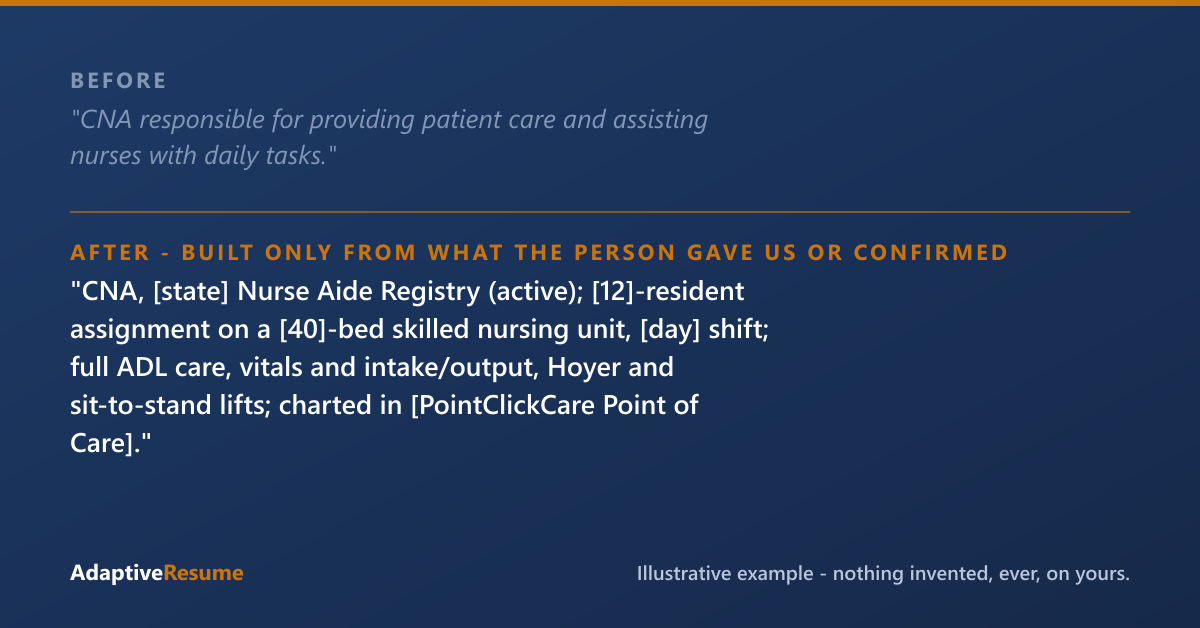
Illustrative example. Everything on your resume is yours: the experience you listed, plus the skills, tools, responsibilities, and credentials your work already involved, each added only after you confirm it’s true.
The second version answers, in one line, what the first leaves a reader guessing at: where you worked, how many people you were responsible for, what shift, what you actually did, and what system you documented it in. It invents nothing. Fill the brackets from your real assignments and the care you actually gave — not from what a “typical” aide does.
Credentials, exactly as held
A CNA’s credential block is short, and every line in it gets checked. Our guide on how to list certifications on a resume covers placement; here is what belongs in yours.
- Your registry listing. This is the credential. Federal rules for nursing facilities require that aides be listed on the state nurse aide registry after completing training and passing a competency evaluation, and employers look you up there, not on your card. Write it as the employer will find it: “[State] Nurse Aide Registry, active, listed [year].” If you’re on more than one state’s registry, list each with its status.
- Your training program. Under 42 CFR (Code of Federal Regulations) 483.152, a nurse aide training program must consist of no less than 75 clock hours, including at least 16 hours of supervised practical training — that is the federal floor, and many states set a higher minimum. Write the school, the program, and the hours you completed: “[School] Nurse Aide Training Program, [N] hours, [year].” Don’t state a state’s hour requirement unless you’ve checked your own board’s current figure.
- The competency exam. Many states use the NNAAP (National Nurse Aide Assessment Program), which is delivered by Credentia and has a written or oral part plus a skills demonstration. Other states use a different vendor. Write whichever you passed: “NNAAP written and skills, passed [month year].” If you’re not sure of the exam’s name, your registry letter has it.
- State title variations. Ohio issues the STNA (State Tested Nurse Aide). Washington issues the NAC (Nursing Assistant Certified); it also issues the NAR (Nursing Assistant Registered), a registration that lets someone work as a nursing assistant before completing training and testing — in a nursing home, an NAR has four months to earn the NAC. New Hampshire and Vermont use LNA (Licensed Nursing Assistant). Write the title your state gave you, and put “CNA” beside it once so screening software finds both.
- BLS (Basic Life Support) or CPR (cardiopulmonary resuscitation). Write the issuer and the course name exactly as your card shows them — “BLS Provider, American Heart Association, current through [month year]” or “CPR/AED (automated external defibrillator), American Red Cross.” BLS is the healthcare-provider course and CPR/AED is the general course; both organizations offer both. Don’t write one when you hold the other, and don’t swap the issuer.
- Additional training. Dementia-care training (name the program), restorative aide training, medication aide certification where your state offers it, and any facility competencies you completed — safe patient handling, restraint alternatives, infection control. Each with a year.
List exactly what you hold, with real status. A registry entry that has lapsed is a “was,” not an “is,” and the registry says so to anyone who looks.
The parts of the job that carry the most weight
Patient load, with the setting. The number means nothing without the unit. “[12]-resident assignment, skilled nursing” and “[6]-patient assignment, med-surg floor” are both honest and both tell a manager what pace you’ve handled. Give the load, the unit type, and the shift.
ADL care. ADLs (activities of daily living) — bathing, dressing, grooming, toileting, feeding, and mobility — are the core of the job, and they’re what the posting is filtering for. Say which ones you handled and at what level: full care, partial assist, standby. “Full ADL care for [8] total-care residents” says far more than “assisted with ADLs.”
Vital signs and intake/output. Blood pressure, pulse, respirations, temperature, oxygen saturation, weights, and intake/output tracking. If you took and charted them every shift, say so — and say what you escalated: “reported [changes in condition / abnormal vitals] to the charge nurse.”
Safe patient handling. Mechanical lifts (Hoyer and sit-to-stand), gait belts, slide sheets, two-person transfers. Name the equipment you’re trained on. Facilities that run a no-manual-lift policy look for it specifically. Fall-risk rounding and pressure-injury prevention — turning schedules and skin checks reported to the nurse — belong here too.
Restorative and mobility. Ambulation programs, range-of-motion exercises, positioning schedules, and walk-to-dine. If you served as a restorative aide, that’s a title worth its own line. Where a PTA (physical therapist assistant) sets the plan, you carry it between sessions — our physical therapist assistant resume guide covers that side; your page covers the daily execution.
Memory care and behavioral support. Dementia-specific units, redirection techniques, and any structured program you were trained in. Write what you did: “de-escalated and redirected residents with dementia on a [24]-bed secured memory-care unit.”
Charting. Name the system. In long-term care that’s often PointClickCare’s Point of Care module (the kiosk or tablet where aides chart ADLs, meals, fluids, vitals, and behaviors) or MatrixCare; in hospitals it’s often Epic or Oracle Health (formerly Cerner). Write the product name; “documented care accurately” matches nothing a filter is looking for.
Survey and infection control. If you worked a unit through a state survey, or through an isolation or outbreak period, say so plainly. “Worked [2] state surveys on a [40]-bed skilled unit” is a real, checkable line. So is “maintained isolation precautions for [N] residents during [a COVID-19 outbreak].”
Home health. If your CNA work was in homes, the scope is different — client count, hours per week, whether you worked alone, and what you documented for the agency. Say that.
Notice what isn’t in this list: nursing assessments, medication administration outside a state-approved medication aide role, and anything an RN (registered nurse) or LPN (licensed practical nurse) does. A CNA works under a nurse’s supervision, and the resume should read that way. If you’re moving toward practical or registered nursing, our med-surg nurse resume guide and the rest of our nursing resume guides cover that page; this one covers yours.
CNA resume skills: the list, and how to make it true
Put a skill on a CNA resume only if you did it on a real shift and could walk a charge nurse through it. Here are the ones postings name most, in their own words: ADL care, vital signs, intake and output, blood glucose monitoring (where your state and facility allowed it), catheter care, ostomy care, wound-care assistance, positioning and turning schedules, mechanical lifts, gait belt transfers, range of motion, feeding assistance and aspiration precautions, isolation precautions, hand hygiene and PPE (personal protective equipment), hospice and end-of-life care, dementia care, and charting in your facility’s system.
Two rules keep it honest. First, list only what you’ve done, not what your program covered — a skills checklist from training is not the same as a shift. Second, put the setting next to the skill where it changes the meaning: ostomy care on a post-surgical floor and ostomy care in a nursing home are the same skill in very different weeks.
Format notes
Length follows your history, not a page rule. One page is right for a new CNA or for two or three years in one setting. Two pages is normal and expected once you have more than one substantive role to describe — a hospital floor and a skilled unit, say, each with its own load and systems. Order matters more than length: registry status and BLS near the top in their own labeled section (screening software keys on them), then experience with a shift line atop each role.
One genuine exception worth knowing: federal applications through USAJOBS cap at two pages as of the September 2025 OPM (Office of Personnel Management) change. VA (Department of Veterans Affairs) nursing assistant postings run through USAJOBS, so if that’s where you’re headed, that’s a hard requirement.
Otherwise: reverse chronological, single column, standard headings, real text rather than graphics or tables — applicant systems parse plain layouts most reliably. Skip the graphics.
CNA resume examples: a bullet bank you can adapt — keep only what’s true
- “CNA, [state] Nurse Aide Registry (active since [year]); [N]-resident assignment on a [N]-bed [skilled nursing / long-term care / memory care] unit, [shift]”
- “Provided full ADL care for [N] total-care residents and partial assist for [N]; positioned and turned on a [2]-hour schedule”
- “Took and charted vitals, weights, and intake/output for [N] residents per shift; escalated changes in condition to the charge nurse”
- “Performed transfers with Hoyer and sit-to-stand lifts and gait belt under a no-manual-lift policy; zero lift-related incidents in [N] years”
- “Carried out restorative ambulation and range-of-motion programs for [N] residents; documented in [PointClickCare Point of Care]”
- “Worked [N] state surveys and [an isolation period]; maintained precautions and PPE use across my assignment”
- “Completed [N]-hour nurse aide training at [school] with [N] clinical hours at [facility]; passed [NNAAP] written and skills [month year]”
Each bullet is a frame, not a claim. If a line isn’t true of your shifts, it doesn’t go on the page — your former charge nurse is the reference.
What screening software looks for on a CNA resume
Facility filters read for the vocabulary of aide work, and a director of nursing reads for the same words minutes later. The terms that typically matter: certified nursing assistant, CNA, nurse aide registry, STNA, NAC, LNA, ADL, activities of daily living, vital signs, intake and output, Hoyer lift, sit-to-stand, gait belt, transfers, restorative, range of motion, dementia care, memory care, isolation precautions, PPE, infection control, PointClickCare, MatrixCare, Epic, skilled nursing, long-term care, BLS, CPR.
One honesty note on job codes: O*NET profiles this work under Nursing Assistants (31-1131.00), and its own sample titles include Certified Nurse Aide, State Tested Nursing Assistant, and Licensed Nursing Assistant — which is exactly why writing your state’s title plus “CNA” once covers you on every posting.
The highest-risk lines overstate standing or scope — a lapsed registry listing written as active, a skill from training written as a skill from work, an RN task written as your own. Aide work is a small, checkable world; every one of those is a quick lookup or a quick phone call.
The Role Skills Checklist below helps you inventory what your training and your shifts actually prove, which is often considerably more than the resume currently says — our skills you forgot, by trade guide is built around exactly that problem. Our build does it with you: we work backwards from your real settings, loads, systems, and registry status, propose the lines that history supports — each one offered as a question, not a decision made for you — and ask you to confirm every item before it appears. We never add a credential, a number, or a skill you didn’t tell us about.
Common questions
Is my CNA certification a card, or something else?
It's a listing. Your credential is your active entry on your state's nurse aide registry — the card or letter is just proof of it. Employers check the registry directly, so write it the way they'll look it up: '[State] Nurse Aide Registry, active, [year]'. If you've moved states, list each registry you're on and its status; a lapsed listing written as current is the fastest way to lose a job offer.
My state calls me an STNA, not a CNA. Which do I write?
Write the title your state issued, then the common one in parentheses the first time: 'STNA (State Tested Nurse Aide, Ohio)'. Ohio uses STNA, Washington issues NAC (Nursing Assistant Certified) and a pre-certification NAR (Nursing Assistant Registered), and New Hampshire and Vermont use LNA (Licensed Nursing Assistant). Screening software reads for 'CNA' too, so including both costs nothing and keeps you honest.
I just finished my training program and have no work experience yet. What goes on the page?
Your registry listing first, then the program: the school, the hours you completed, the clinical site, and what you did there — '[N] clinical hours at [facility], full ADL care under an RN (registered nurse)'. Then the competency exam, passed, with the date. Then any prior work that shows reliability with people — caregiving for family, food service, retail. Keep it to one page and let the training carry it; don't pad with skills you haven't used on a real shift.
Should I put my patient load on my resume? I'm not sure it was a good number.
Put the real one. Managers know what a [10]-to-[14]-resident assignment on a skilled unit means, and they know what a [5]-patient hospital assignment means; the number tells them where you've worked and what pace you've handled. A number that looks too light or too heavy usually just needs the setting next to it. Never round it up — the first reference call is to your former charge nurse.
Role Skills Checklist
Pop your email in and the download unlocks right here. Joining our list also takes 25% off your first purchase within 30 days of joining, when you create your account with this same email. We'll also send the occasional useful note. No spam.
Download: Role Skills ChecklistThanks, you're on our list, and your download is ready just above. Your 25% off a first purchase is good for 30 days from the day this email joined our list.
That email didn't look right — mind trying it again?
Ready to do this on your own resume?
We'll find what you've left off, and nothing goes on your resume that you didn't give us or confirm.
Get your resume build — $29Every purchase is one payment, and nothing renews. A single resume build can be used any time within 12 months of buying it, and AR Pass builds you don't use end when its 90 days end.
Try the demo first — a sample review, no sign-up · See how the service works
Paid a resume service and got a template back? Start at Fix my resume.