Guides · For job seekers
Sales Manager Resume: Quota, Attainment, and Team Scope
Sales manager resumes turn on numbers a reader can trust — quota, attainment percentage, team size, ramp time, and forecast accuracy. How to write yours, including the honest way to handle a down year and the IC-to-manager jump.
Published 08/30/2026
Sales management resumes live or die on numbers a reader can trust. Every other part of the job — coaching, forecasting, territory design, hiring — is real, but a sales leader reading your resume is first checking one thing: did your number come in, and how big was the number. A resume that describes leadership in adjectives (“dynamic,” “results-driven”) and never states a quota or an attainment percentage competes badly against one that opens with the figures.
The catch is that raw figures without context are just as weak. “$4.2M in revenue” says nothing until a reader knows the quota, the team size, and the period. The single most useful thing you can do is pair every result with the base it was measured against, so the number can actually be believed.
Lead with quota and attainment, in context
Under each role, give the scope in one line before the bullets — team size, quota, attainment, and the period.
Before: “Led a high-performing sales team and consistently exceeded revenue targets.”
After: “Managed 7 quota-carrying AEs (SaaS, mid-market); team quota $6.4M, attainment 112% FY24 and 104% FY23; ramped 3 new hires to full productivity in ~4 months.”
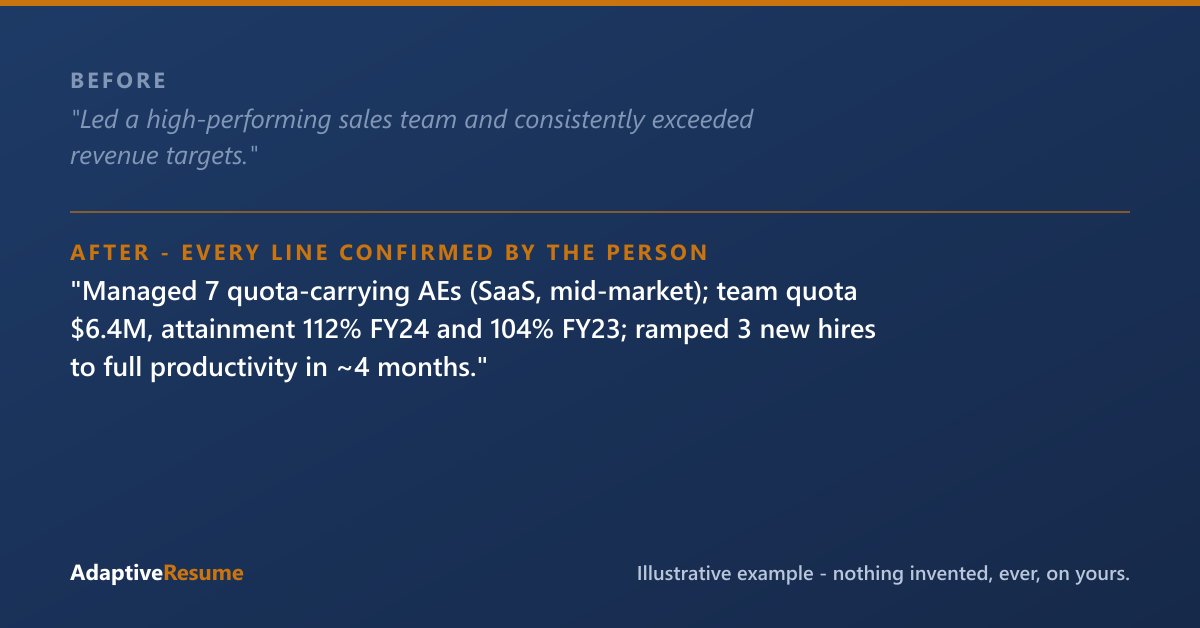
The second version is scannable in five seconds and answers what the first version leaves a reader guessing at: how many people, against what target, how they did, and how well you onboard. Notice it does not claim the biggest possible number — it states two years so a reader can see consistency, which is more convincing than a single record year.
The parts of the job that carry the most weight
Quota and attainment are the center of the resume. Show team quota and your team’s attainment as a percentage, ideally across more than one year. If you personally still carried a bag alongside managing — common in smaller orgs — split it out honestly: state the quota-carrying portion and the management portion separately rather than blending them into one figure a reader can’t decode.
Team size and structure tell a reader the scope you can handle. Say how many reps you managed and what kind — account executives, SDRs (sales development reps), inside sales, field, or a mix. Managing eight inside-sales reps and managing three enterprise field AEs are different jobs; name which one you did.
Ramp time is a genuine differentiator and many resumes leave it off. How fast did your new hires reach full productivity? A manager who ramps reps in four months instead of nine is worth real money, and that is exactly the kind of operational result hiring leaders look for.
Pipeline and forecast accuracy separate a manager from a cheerleader. Pipeline coverage ratio, forecast accuracy against actuals, and how you ran the forecast cadence are all legitimate lines. Forecast accuracy is the responsibility senior leaders most fear getting wrong, so demonstrated reliability there is genuinely valuable.
Hiring, coaching, and retention are the durable part of the job. Reps hired, ramp programs built, promotions from within, and voluntary retention on your team all count. If your reps got promoted or stayed while the market churned, that is evidence of leadership no adjective can replace.
Coming up from IC: AE, SDR, and inside sales
Many sales managers were closers first, and the transition from individual contributor to manager is a real turning point a resume has to handle carefully.
If you are still making the jump, lead with the IC results that earned you the shot — attainment, President’s Club, ranking, average deal size, new-logo count — and then show the management-adjacent work you already owned: mentoring new hires, running the SDR-to-AE handoff, owning a slice of the forecast, or covering for your manager. That reads as ready. Claiming a “manager” title you did not hold does not; it is the kind of thing a reference check exposes in one call.
If you already made the jump, keep the strongest IC line or two for credibility, then let the management numbers lead. A reader wants to know you can still smell a real deal and that you can run a team — one line of each does that.
A note on down years. Territories get cut, quotas get raised mid-year, a product gets sunset, a market turns. If attainment dropped for a reason a sales leader will recognize, state the number and the context in the same line. A true 78% in a year the whole team missed reads far better than a record that looks too clean to be real, and attainment is precisely what a backchannel confirms.
CRM and tools, named honestly
Name the CRM you actually ran the team in — commonly Salesforce or HubSpot — and say whether you used it, built reporting in it, or administered it, because those are three different skill levels. Then list the tools you used enough to be productive in on day one: outreach and cadence tools (Outreach, Salesloft), conversation intelligence (Gong, Chorus), forecasting or revenue platforms (Clari), and sales enablement. Skip the logo wall. A padded tool list reads as noise; the CRM you genuinely operated in reads as how fast you will be useful.
Format notes
Length follows your history, not a page rule. The “keep it to one page” advice gets repeated far past the point where it helps a sales leader with a real track record. If you have carried a bag as an AE, moved into management, and run more than one team, that history is exactly what puts you ahead of the other candidates — cramming it onto one page to satisfy a convention throws away your advantage.
The honest rule: two pages is normal and expected once you have more than one substantive role to describe. What matters is that every line earns its space. A tight two pages beats a padded one, and it beats a two-pager where the second page is filler. Cut duties everyone in the role shares; keep quota, attainment, team scope, ramp, and forecast numbers.
One genuine exception worth knowing: federal applications through USAJOBS cap at two pages as of the September 2025 OPM change. That is a hard requirement, not a style preference.
Otherwise: reverse chronological, single column, a scope line under every role, and a clearly labeled tools block. Conservative formatting is the right call — skip the graphics and let the numbers do the work.
A bullet bank you can adapt — keep only what’s true
- “Managed [N] quota-carrying [AEs/SDRs/inside-sales reps] in [segment]; team quota $[X], attainment [%] FY[YY]”
- “Delivered [%] of team quota across FY[YY] and FY[YY]; [ranking/detail] within [region/org]”
- “Ramped [N] new hires to full productivity in ~[N] months, vs. [N]-month prior baseline”
- “Ran weekly forecast at [%] accuracy against actuals; maintained [N]x pipeline coverage”
- “Built and ran [ramp/enablement] program for [N] reps; [N] promoted to [role]”
- “As AE prior to management: [%] of quota, $[X] average deal, [N] new logos in FY[YY]”
- “Carried personal quota of $[X] at [%] attainment while managing [N] reps”
- “Administered [Salesforce/HubSpot]; built [reports/dashboards] adopted by [team/org]“
What screening software looks for on a sales manager resume
Filters commonly read for: quota attainment, revenue growth, sales quota, pipeline management, forecasting, forecast accuracy, territory management, account executive, SDR, inside sales, new business development, key account management, sales cycle, deal size, win rate, retention, upsell, cross-sell, coaching, sales enablement, ramp, Salesforce, HubSpot, CRM, and P&L or revenue responsibility. O*NET’s Sales Managers profile has the full task and skill list.
The highest-risk lines are the ones that overstate scope — a team you did not manage, a quota you did not carry, or an attainment number the base doesn’t support. Sales leaders check, and attainment is one of the few resume claims a reference call confirms almost every time.
The Role Skills Checklist below helps you inventory what your track record actually proves, which is often more than the resume currently says. Our build does it with you: we work backwards from your real quotas, teams, and systems, propose the metrics and tools that a role like yours normally involves, and ask you to confirm every line before it appears. We never add a number, a team, or a quota you didn’t tell us about.
Common questions
What numbers do I actually need on a sales manager resume?
At minimum: quota and attainment as a percentage, the size of the team you managed, and the period each covers. Beyond that, whatever is true and material — ramp time for new reps, pipeline coverage, forecast accuracy, renewal or retention rate. A reader who sees a percentage without a quota, or a big dollar figure with no context, discounts it. Show the base you are measuring against so the number can be trusted.
I'm an AE moving into management for the first time. What do I lead with?
Lead with the individual-contributor results that made you a candidate — attainment, ranking, deal size — and then show the management-adjacent work you already did: mentoring new hires, running the SDR handoff, owning a segment of the forecast, standing in for your manager. Do not claim a manager title you did not hold. Describe the real scope. A strong closer who already coaches reads clearly as ready without any inflation.
How do I put a down year on a sales manager resume without it sinking me?
Honestly and in context. Territories get cut, markets turn, quotas get raised mid-year, products get sunset. If attainment dropped for a reason a sales leader will recognize, you can state the number and the context in the same line. Hiding a down year is riskier — attainment is exactly what a reference call and a backchannel confirm. A true 78 percent in a year the whole team missed reads better than a suspiciously perfect record.
Do I list every CRM and tool, or just the main one?
Name the CRM you actually ran the team in — Salesforce, HubSpot, or whatever it was — and the tools you used enough to be productive in on day one. Skip the long logo wall. A hiring manager reads your CRM as a proxy for how fast you will be useful, and reads a padded tool list as noise. If you administered or built in the CRM rather than just used it, say so, because that is a different and more valuable skill.
Role Skills Checklist
Pop your email in and the download unlocks right here — and being on the list before launch day locks in 25% off your first build. We'll also send the occasional useful note and tell you the moment AdaptiveResume goes live. No spam.
Download: Role Skills ChecklistThanks — you're on the launch list, your 25% is locked in, and your download is ready below.
That email didn't look right — mind trying it again?
Ready to do this on your own resume?
We'll find what you've left off and you approve every line — nothing made up.
Build your resume — $49Try the demo first — a sample review, no sign-up · See how the service works
Paid a resume service and got a template back? Start at Fix my resume.