Guides · For job seekers
Phlebotomist Resume: Draws, Specimen Integrity, and Certification
Lab managers read a phlebotomist resume for volume and quality: how many sticks a shift, how hard they were, whether your specimens arrived usable, and which certification you hold written exactly right. Here's how to write yours honestly.
Published 09/18/2026 · Updated 10/30/2026
A phlebotomist resume is read by a lab supervisor or a patient services manager, and they read for two things: volume and quality. Volume means how many draws you performed, in what setting, and how difficult they were. Quality means whether the specimens you sent arrived labeled, in the right tubes, in the right order, and usable — because a redraw costs the lab time and costs the patient a second stick. Generic language — “drew blood from patients and processed samples” — says nothing about either. The specifics do.
The other thing that sinks phlebotomist resumes is the credential written loosely. There are several national phlebotomy certifications from different bodies, plus state licensure in a few states, and “certified phlebotomist” doesn’t tell a reader which one you hold. This guide is about writing all of it exactly.
The draw line: your scope in one sentence
Under each role, give one line another phlebotomist or a lab lead would recognize instantly.
Before: “Phlebotomist responsible for drawing blood from patients and processing samples.”
After: “CPT (NHA), [hospital] inpatient rounds and outpatient draws, [60]-[80] venipunctures per shift including pediatric and hard-stick patients; CLSI order of draw, [0.8]% blood culture contamination rate against a [3]% threshold; accessioned and processed in [Epic Beaker].”
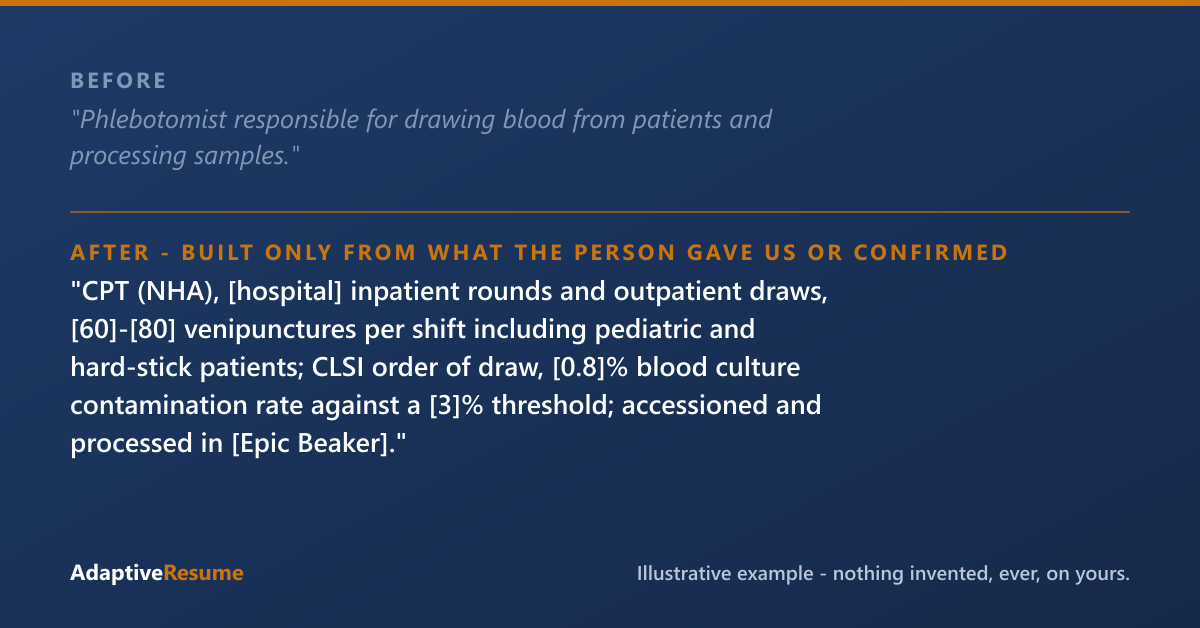
Illustrative example. Everything on your resume is yours: the experience you listed, plus the skills, tools, responsibilities, and credentials your work already involved, each added only after you confirm it’s true.
The second version answers what the first leaves out: which credential, which setting, how many draws, how hard they were, whether your specimens were clean, and which system you worked in. It invents nothing. Fill the brackets from the draw counts and quality results you know from your own work — not from what a “typical” shift looks like.
Credentials, exactly as held
Our guide on how to list certifications on a resume covers placement; here is what belongs in a phlebotomist’s block, and how to name each one.
- CPT (NHA) — Certified Phlebotomy Technician, from the NHA (National Healthcareer Association). NHA’s eligibility runs through a training program or supervised work experience, and either way you document at least 30 venipunctures and 10 capillary sticks on live people.
- PBT (ASCP) — Phlebotomy Technician, from the ASCP Board of Certification (American Society for Clinical Pathology). ASCP publishes several eligibility routes — an accredited phlebotomy program, a year of full-time clinical experience, or prior allied-health or laboratory credentials among them — and hospital lab postings often name it.
- RPT (AMT) — Registered Phlebotomy Technician, from AMT (American Medical Technologists). Note the “R” — it is not “CPT (AMT),” and writing it wrong is a small tell.
- NCPT (NCCT) — National Certified Phlebotomy Technician, from the NCCT (National Center for Competency Testing).
- State license or certification — four states add a state credential on top of any national one, and each names it differently: California’s CDPH (Department of Public Health) issues the LPT (Limited Phlebotomy Technician), CPT I, and CPT II; Louisiana licenses phlebotomists through its State Board of Medical Examiners; Nevada certifies them as laboratory assistants through its state laboratory program; Washington issues the MA-P (Medical Assistant-Phlebotomist) credential. If you hold one, write it as the state issues it, with the status. If you don’t work in one of those states, this line doesn’t exist for you, and that’s normal.
- BLS — Basic Life Support. Most labs ask for the American Heart Association course; write the issuer and the current-through date either way.
Write the abbreviation and the body together, because each body’s rules are its own and a manager checking on you needs to know where to look. If you passed a national exam but your state license is still pending, say exactly that: “CPT (NHA), [year]; California CPT I application pending.” That’s honest and reads fine.
The parts of the job that carry the most weight
Volume and mix. Draws per shift or per day, with the setting. Inpatient rounds, outpatient draw station, emergency department, reference lab, plasma or donor center, and mobile or in-home draws are different paces with different patients. Say which, and give a real range.
Difficult draws. Pediatric, geriatric, oncology, dialysis, and dehydrated patients; patients with poor access; butterfly and syringe draws; capillary sticks including heel sticks. If you were the one called for hard sticks, that’s a line worth its own bullet.
Order of draw and tube handling. The CLSI (Clinical and Laboratory Standards Institute) order of draw, tube additives, fill volumes, inversions, and special handling — chilled, protected from light, timed draws. Naming these tells a lab you protect the specimen, not just the stick.
Identification and labeling. Two patient identifiers at the bedside, labeling at the point of collection, and chain of custody where you did drug or forensic collections. A line like “zero mislabeled specimens in [N] months” is real and checkable if your lab tracks it.
Blood culture contamination. This is the quality number a hospital lab watches most closely, and if you know yours, it’s the strongest figure this role can put on a page. Write it with the lab’s threshold beside it: “[0.9]% against a [3]% threshold.” CLSI’s published benchmark is a rate under 3%, with 1% the goal when best practices are followed, so a real number in that range says a great deal.
Point-of-care and processing. Glucose and other point-of-care tests you performed, centrifuging, aliquoting, and accessioning. Name the LIS (laboratory information system): Epic Beaker, Sunquest (now Clinisys), or Oracle Health (formerly Cerner) — screening software keys on the product name.
Where the line sits with other roles. If you drew blood as a medical assistant, that was one delegated task inside a clinic day, and it belongs on our medical assistant resume guide as a line; this page is for the person whose whole shift is the stick and the specimen. On the other side of the lab door, a medical laboratory scientist runs the analyzers on what you collected — our medical technologist resume guide covers that page. You collect; they analyze. Write yours accordingly.
Phlebotomist resume skills: the list, and how to make it true
List a skill only if you’ve performed it on a real patient and could explain it to a lab lead. The ones postings ask for, in their own words: venipuncture, capillary collection, heel stick, butterfly and syringe technique, order of draw, tube additives, specimen labeling, two-identifier check, chain of custody, blood culture collection, contamination prevention, pediatric and geriatric draws, difficult venous access, point-of-care testing, glucose testing, centrifuge and specimen processing, accessioning, LIS by name, standard precautions, PPE (personal protective equipment), and patient communication with anxious or fainting patients.
Two things keep the list honest: sticks you logged on a real shift rather than the checklist from class, and the setting beside the number wherever it changes the meaning — [80] draws in a donor center and [80] draws on a pediatric floor are the same number in very different days.
Format notes
Length follows your history, not a page rule. One page is right for a new phlebotomist or for a few years in one setting. Two pages is normal and expected once you have more than one substantive role to describe — a hospital and a reference lab, say, each with its own volume, patients, and systems. Order matters more than length: certification and any state license near the top in their own labeled section (screening software keys on them), then experience with a draw line atop each role. If you’re trimming to fit, cut older unrelated detail before you cut a number.
One genuine exception worth knowing: federal applications through USAJOBS cap at two pages as of the September 2025 OPM (Office of Personnel Management) change. VA (Department of Veterans Affairs) and military hospital phlebotomy postings run through USAJOBS, so if that’s where you’re headed, that’s a hard requirement.
Otherwise: reverse chronological, single column, standard headings, real text rather than graphics or tables — applicant systems parse plain layouts most reliably. Skip the graphics.
A bullet bank you can adapt — keep only what’s true
- “CPT (NHA), [year]; [hospital inpatient / outpatient draw station / reference lab]; [N]-[N] venipunctures per shift”
- “Performed pediatric, geriatric, and difficult-access draws including butterfly and capillary collections; called for hard sticks across [N] units”
- “Maintained a [N]% blood culture contamination rate against a [N]% laboratory threshold over [N] months”
- “Collected in CLSI order of draw with correct additives, fill volumes, and special handling ([chilled / light-protected / timed]) for [N] specimens per shift”
- “Labeled at point of collection with two patient identifiers; zero mislabeled specimens in [N] months of tracked quality data”
- “Accessioned, centrifuged, and aliquoted specimens in [Epic Beaker / Sunquest]; ran point-of-care [glucose] testing”
- “Completed a [N]-hour phlebotomy program at [school] with [N] documented venipunctures and [N] capillary sticks at [site]”
Each bullet is a frame, not a claim. If a line isn’t true of your draws, it doesn’t go on the page — a reference check will find it.
What screening software looks for on a phlebotomist resume
Lab filters read for the vocabulary of collection, and a supervisor reads for the same words minutes later. The terms that typically matter: phlebotomist, phlebotomy, CPT, NHA, PBT, ASCP, RPT, AMT, NCPT, NCCT, venipuncture, capillary, butterfly, order of draw, specimen collection, specimen processing, accessioning, blood culture, contamination rate, chain of custody, two patient identifiers, point-of-care testing, centrifuge, LIS, Epic Beaker, Sunquest, standard precautions, BLS, and, where relevant, your state license.
One honesty note on job codes: O*NET profiles this work under Phlebotomists (31-9097.00), and its own sample titles include Patient Service Technician and Mobile Examiner — which is why naming your actual setting matters more than the title on your badge. Every number in this guide follows the same rule; our quantify your resume bullets guide covers how to find the real figure when you’re not sure you have one.
The highest-risk lines overstate the credential or the quality — a state license you don’t hold, a contamination rate you never measured, a certification body written wrong. Labs are a small, tracked world; every one of those is a lookup or a report away.
The Role Skills Checklist below helps you inventory what your draws and your quality data actually prove, which is often considerably more than the resume currently says. Our build does it with you: we work backwards from your real settings, volumes, systems, and certification, propose the lines that history supports — each one offered as a question, not a decision made for you — and ask you to confirm every item before it appears. We never add a credential, a number, or a skill you didn’t tell us about.
Common questions
There are several phlebotomy certifications. How do I write mine so a lab knows which one it is?
Write the credential and the body together: 'CPT (NHA)', 'PBT (ASCP)', 'RPT (AMT)', or 'NCPT (NCCT)'. They're issued by different organizations with different eligibility rules and they don't transfer, so a lab manager checking your status needs to know where to look. Add the year and 'current through [year]' if it's active. Don't shorten it to 'certified phlebotomist' — that reads as a description, not a credential.
Do I need a state license to be a phlebotomist?
In a handful of states, yes — California, Louisiana, Nevada, and Washington require a state license or certification on top of any national credential, and California's has its own tiers (LPT, CPT I, and CPT II). Everywhere else, national certification is what employers ask for, not a license. If you hold a state license, list it with the state and its status; if you're applying into one of those states from outside, be clear about where you stand rather than silent.
How do I put my draw volume on the resume when it varied by day?
Give a real range with the setting: '[60]-[80] venipunctures per shift, hospital inpatient rounds' or '[120]+ draws per day, outpatient draw station'. A range is honest and a lab manager knows what each setting produces. Never round up to a number that sounds better — your former lead can be asked, and the LIS logs every accession under your ID.
I just finished my program and my only sticks were in the externship. What goes on the page?
The certification first, if you've passed it, then the externship written as work: the site, the weeks, the number of successful venipunctures and capillary sticks you logged, and the settings you drew in. Then any prior work that shows you can handle people who are anxious or unwell. Keep it to one page. Don't pad with skills you haven't performed on a real patient; the logbook from your program is what the number should come from.
Role Skills Checklist
Pop your email in and the download unlocks right here. Joining our list also takes 25% off your first purchase within 30 days of joining, when you create your account with this same email. We'll also send the occasional useful note. No spam.
Download: Role Skills ChecklistThanks, you're on our list, and your download is ready just above. Your 25% off a first purchase is good for 30 days from the day this email joined our list.
That email didn't look right — mind trying it again?
Ready to do this on your own resume?
We'll find what you've left off, and nothing goes on your resume that you didn't give us or confirm.
Get your resume build — $29Every purchase is one payment, and nothing renews. A single resume build can be used any time within 12 months of buying it, and AR Pass builds you don't use end when its 90 days end.
Try the demo first — a sample review, no sign-up · See how the service works
Paid a resume service and got a template back? Start at Fix my resume.