Guides · For job seekers
How to Translate Military Experience (MOS) into a Civilian Resume
A step-by-step way to turn your MOS, rank, and duties into civilian language a recruiter and their screening software actually understand — without inflating anything.
Published 07/26/2026 · Updated 08/12/2026
You did the work. The problem is that a civilian recruiter — and the screening software in front of them — doesn’t speak in MOS codes, rank, or unit acronyms. The job of a transition resume isn’t to inflate what you did. It’s to translate it into words the hiring side recognizes. Here’s how to do that honestly.
Start a military to civilian resume with what you did, not your title
“Platoon Sergeant, 11B” tells a civilian almost nothing. Before you touch wording, list the real, concrete things you were responsible for:
- How many people did you lead or train?
- What equipment or budget were you accountable for?
- What did you plan, coordinate, or maintain?
- What standards or safety requirements did the job run under?
This list — not your rank — is what you’re translating.
Translate the title
Map your role to the closest civilian function, without claiming a job you didn’t hold:
- Platoon Sergeant → “Operations / team lead, 30–40 personnel”
- Logistics NCO (92A) → “Supply & inventory management”
- Combat Medic (68W) → “Emergency medical technician / patient care (confirm civilian licensure separately)”
- Wheeled Vehicle Mechanic (91B) → “Fleet maintenance technician — diagnostics, repair, preventive maintenance”
- Motor Transport Operator (88M) → “Commercial driving and transport operations (civilian CDL required separately — see below)”
- IT Specialist (25B) → “IT support / network administration”
The honest rule: describe the scope and responsibility in civilian terms. Don’t claim a civilian certification or license you haven’t actually earned — that’s the one line you never cross.
Translate the duties
Turn military phrasing into plain, results-oriented civilian language:
- “Led a 40-soldier platoon” → “Managed a 40-person team across daily operations”
- “Accountable for $5M in property” → “Asset & inventory management for $5M of equipment, zero losses”
- “Conducted PMCS” → “Performed scheduled preventive maintenance and inspections”
Notice none of this adds anything. It re-states the same true work in language a civilian manager understands.
Scrub the acronyms — all of them
After translating titles and duties, sweep the whole page once more for anything a civilian reader has to decode: unit designations, installation names used as shorthand, program acronyms, evaluation-report language. The test for every term is brutal and simple — would a hiring manager who never served know what this means? If not, either translate it or cut it. A resume that needs a glossary doesn’t get one; it gets skimmed past.
Two that deserve special care:
- Deployments — name the transferable fact, not the operation: “led logistics for a 120-person unit in an austere environment, 9 months” says more to a civilian reader than any named operation.
- Evaluations — “rated top performer among peers” translates; NCOER shorthand doesn’t.
Be careful with training and certifications
Military training is a real asset — but only claim what genuinely transfers:
- Training you completed → list it plainly (“Hazardous materials handling — completed military certification”).
- Skills you used but were never formally certified in → describe the experience, not a credential you don’t hold.
- Civilian licenses (CDL, medical, electrical) → only if you actually hold the civilian version. Military experience can help you earn it; it isn’t the same as holding it.
Quantify — truthfully
Numbers make a resume convincing, but only real ones. If you genuinely know the figure, use it (“supervised 12 vehicles,” “trained 50+ soldiers”). If you don’t, leave it qualitative rather than guessing. A true, un-quantified line beats an impressive, invented one. Our quantifying guide shows how to find honest numbers when nobody handed you a report — and military roles are usually rich in them: personnel counts, equipment values, readiness rates you actually knew.
Don’t over-translate
The opposite mistake is inflation — turning “squad leader” into “senior operations director.” Recruiters spot it, and it erodes the trust your service earned you. Translate to the nearest honest equivalent, and stop there.
Where TAP leaves off
If you went through the Transition Assistance Program, you already have a resume draft — and if you’re reading this, it probably feels generic. That’s not a knock on TAP: it’s a free program teaching fundamentals to everyone at once. What a class can’t do is sit with your MOS, your additional duties, and your target role, and translate them line by line. That last mile — from “a correct resume” to “your resume, aimed at a specific civilian job” — is exactly the work this guide and the worksheet below walk you through.
If you’re also applying federal
Many transitioning service members run a two-track search: private-sector and federal. Know that they want different documents — the private resume is the short, impact-first translation this guide builds; a federal (USAJOBS) resume follows its own conventions and, as of the September 2025 OPM change, is capped at two pages. Don’t send either one to the other audience. If the federal-to-private direction is your move, that conversion guide is here.
Use the worksheet
The free Military-to-Civilian Skills Translator below walks you through this for your own MOS and duties, line by line — so you end up with civilian wording that’s accurate, not inflated.
When you’re ready, our targeted build does this with you: it finds the standards and skills your roles involved, asks you to confirm each one, and translates them toward the civilian role you want — without making anything up.
The before-and-after, at a glance
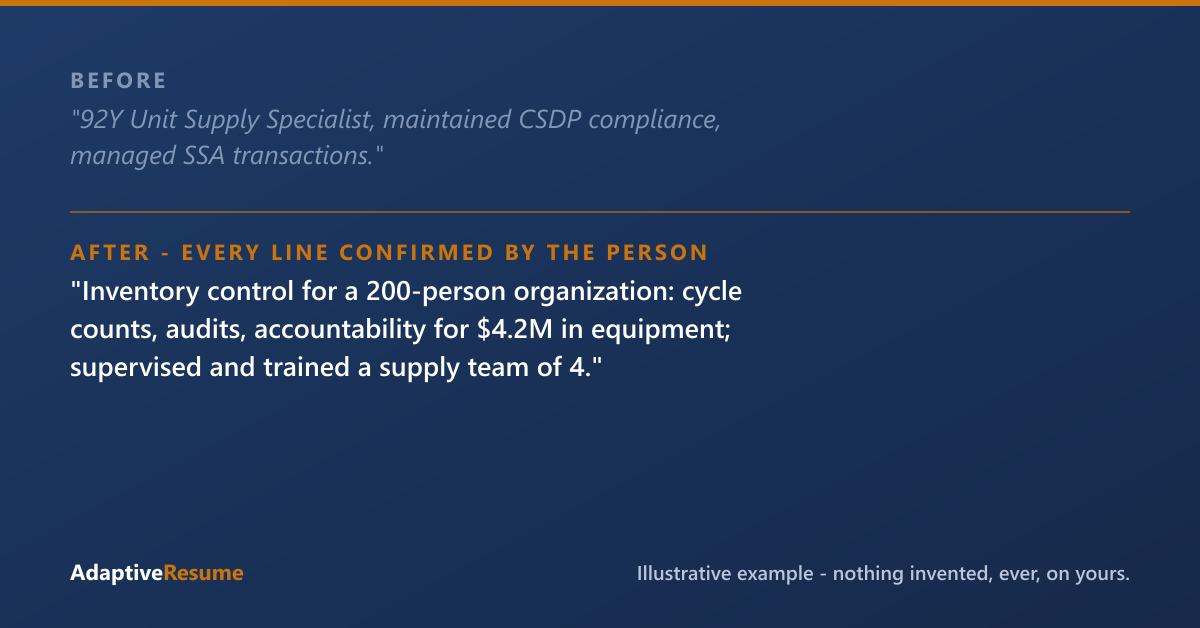
Illustrative example. On your resume, every line comes from your real history - proposed as a question, added only when you confirm it.
Common questions
Should I include my rank on a civilian resume?
Translate it rather than lead with it: 'E-7 / Sergeant First Class' means little outside; 'led a 40-person platoon' is the same fact in civilian scope. Rank can appear once, in context, translated.
How do I handle a security clearance?
If it's active and relevant to the roles you want, list level and status exactly ('Secret clearance, active') - nothing more. Never state a lapsed clearance as current; it's checkable.
Do military awards belong on the resume?
The ones that translate to scope or performance, translated: a meritorious service medal becomes the achievement it recognized. Ribbons-as-a-list means nothing to a civilian reader; the accomplishment behind one might.
Military-to-Civilian Skills Translator
Pop your email in and the download unlocks right here — and being on the list before launch day locks in 25% off your first build. We'll also send the occasional useful note and tell you the moment AdaptiveResume goes live. No spam.
Download: Military-to-Civilian Skills TranslatorThanks — you're on the launch list, your 25% is locked in, and your download is ready below.
That email didn't look right — mind trying it again?
Ready to do this on your own resume?
We'll find what you've left off and you approve every line — nothing made up.
Start your targeted build — $149Try the demo first — a sample review, no sign-up · See how the service works
Paid a resume service and got a template back? Start at Fix my resume.