Guides · For job seekers
Pharmacy Technician Resume: Certification, State Registration, and the Work Behind the Counter
A pharmacy reads a technician resume for three things: your national certification and state registration written exactly right, the volume and setting you worked in, and the tasks your shifts actually prove. Here's how to write yours honestly.
Published 09/26/2026 · Updated 09/29/2026
A retail chain, a hospital, or a mail-order pharmacy reads a pharmacy technician resume in a few seconds, and it reads for three things. Is your national certification current, and is your state registration written the way your board of pharmacy issues it? What volume and setting did you work in? And do the tasks on the page match what a pharmacist would confirm if someone called? “Detail-oriented pharmacy technician with excellent customer service skills” answers none of that. The specifics do.
The other thing that sinks technician resumes is leaving off the work. Technicians do a great deal that never makes the page: data entry at hundreds of scripts a day, insurance rejections and prior authorizations, controlled-substance counts and perpetual inventory, nonsterile and sterile compounding, cart fills and automated-cabinet restocking, and the audits behind every one of them. Nearly all of it is what a pharmacy manager screens for, and this guide is about getting it on the page without inflating a single line.
The shift line: your scope in one sentence
Under each job, give one line another technician or a pharmacy manager would recognize instantly.
Before: “Pharmacy technician responsible for filling prescriptions and assisting the pharmacist.”
After: “CPhT (PTCB, active), [Texas] Registered Pharmacy Technician; [400]-script-a-day retail pharmacy, [3]-tech team; data entry and fill in [PioneerRx], insurance rejections and prior authorizations through [CoverMyMeds], CII (Schedule II) perpetual inventory, [immunization-trained].”
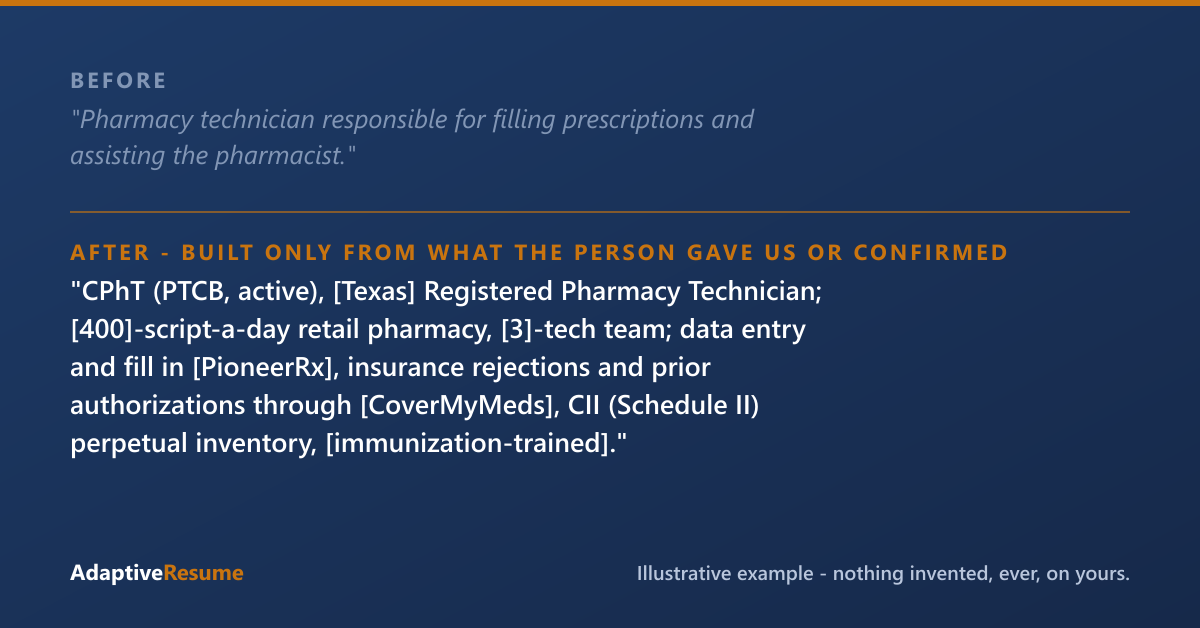
Illustrative example. Everything on your resume is yours: the experience you listed, plus the skills, tools, responsibilities, and credentials your work already involved, each added only after you confirm it’s true.
The second version answers, in one line, what the first leaves a reader guessing at: what you hold, where you worked and at what pace, what you actually did, and what system you did it in. It invents nothing. Fill the brackets from your real store or department and your real duties, not from what a “typical” technician does.
Credentials, exactly as held
A pharmacy technician usually holds two separate credentials, and pharmacies check both. Our guide on how to list certifications on a resume covers placement; here is what belongs in yours.
- National certification, by issuer. Two credentials carry the CPhT (Certified Pharmacy Technician) title. The PTCB (Pharmacy Technician Certification Board) credential requires either a PTCB-recognized education or training program or at least 500 hours of work experience as a pharmacy technician, plus full disclosure of any criminal or board actions. Candidates then pass the PTCE (Pharmacy Technician Certification Exam), a 90-question exam at a Pearson test center. The NHA (National Healthcareer Association) credential comes through the ExCPT (Exam for the Certification of Pharmacy Technicians) and requires a training program completed within the last five years or one year of work experience with at least 1,200 supervised hours in the last three. Both renew every two years on 20 hours of continuing education, including at least one hour each in pharmacy law and patient safety. Write which one you hold: “CPhT, PTCB, current through [month year]” or “CPhT, NHA (ExCPT), current through [month year].” Don’t write “PTCB certified” if your exam was the ExCPT.
- State registration or license, by its real name. Nearly every state registers or licenses technicians through its board of pharmacy, and the names differ. Texas registers a Pharmacy Technician Trainee and, after a passing PTCB or ExCPT exam, a Registered Pharmacy Technician. Georgia registers technicians with its Board of Pharmacy and does not require national certification to register, though certification changes how many technicians a pharmacist may supervise there, so pharmacies ask for it. California licenses technicians through its Board of Pharmacy on one of four pathways under Business and Professions Code section 4202: an associate’s degree in pharmacy technology, a board-specified training course, graduation from a recognized pharmacy school, or a board-approved national certification. Write the credential as your state prints it, with status: “[State] Board of Pharmacy, Registered Pharmacy Technician, active.” If you’re registered in more than one state, list each.
- Sterile compounding. PTCB’s CSPT (Certified Compounded Sterile Preparation Technician) credential requires an active CPhT plus either a recognized sterile compounding program and one year of full-time compounded sterile preparation experience, or three years of that experience in the last eight. If you hold it, it’s a line inpatient and infusion pharmacies look for first. If you completed a program but haven’t certified, write the program and the hours, not the credential.
- Immunization. By the American Disease Prevention Coalition’s count, as of December 2024, 47 states and the District of Columbia allow trained pharmacy technicians to administer vaccines under a pharmacist; check your own board’s current rule before you write it. If you did, name the training and the certificate: PTCB’s Immunization Administration assessment-based certificate requires a CPhT, a recognized program with a live demonstration of intramuscular and subcutaneous technique, and an exam. Write “immunization-trained, [program], [year]” and, if you hold the certificate, its name.
- BLS (Basic Life Support) or CPR (cardiopulmonary resuscitation). Write the issuer and the course exactly as the card reads: “BLS Provider, American Heart Association, current through [month year].” Most immunization roles require it.
- Program and other certificates. An ASHP/ACPE-accredited (American Society of Health-System Pharmacists and Accreditation Council for Pharmacy Education) technician program, with the school and the year. PTCB’s other assessment-based certificates, such as Medication History or Hazardous Drug Management, by name. A 340B or a specialty pharmacy certificate if you earned one.
List exactly what you hold, with real status. A certification that lapsed is a “was,” not an “is,” and the issuer’s lookup says so to anyone who checks.
The parts of the job that carry the most weight
Volume and setting. The number means nothing without the where. “[400]-script-a-day retail store” and “[300]-bed hospital, central pharmacy, [evening] shift” are both honest and both tell a manager what pace you’ve handled. Give the volume, the setting, the shift, and the size of the technician team.
Data entry and fill. Prescription intake, data entry, DUR (drug utilization review) alerts routed to the pharmacist, filling, and the counting or dispensing automation you ran. Name the system: PioneerRx, QS/1, Epic Willow, or your chain’s own platform. “Entered and filled [250] scripts a shift in [system] with [zero] pharmacist-caught entry errors in [year]” is a line a manager can picture.
Insurance and prior authorizations. Third-party rejections, rebilling, prior authorization submissions, and the portal you used. “Resolved [30] insurance rejections a day; submitted [N] prior authorizations a week through [CoverMyMeds]” says far more than “handled insurance issues.”
Controlled substances. Schedule II counts, perpetual inventory, CII ordering through the DEA’s (Drug Enforcement Administration) system where you were the one entering it, discrepancy reports, and the audits you were part of. Write it precisely: “maintained the CII perpetual inventory and monthly counts; [zero] unresolved discrepancies in [N] years.”
Inventory. Ordering, receiving against invoices, returns and expired-drug processing, recalls, and shortages. Name the wholesaler system if you worked in it.
Compounding. Nonsterile compounding under USP <795> (United States Pharmacopeia general chapter 795), sterile under USP <797>, and hazardous drugs under USP <800>. Write what you compounded and the standard you worked under: “prepared [IV admixtures / TPNs (total parenteral nutrition) / chemotherapy] in a [cleanroom / biological safety cabinet] under USP <797> and <800>; media-fill and gloved-fingertip tests passed [dates].” Never write sterile compounding from a classroom lab as work experience.
Inpatient operations. Unit-dose cart fill, automated dispensing cabinet restocking and discrepancy resolution in Pyxis or Omnicell, PAR (periodic automatic replenishment) levels, crash-cart and kit checks, medication delivery, and code-cart exchange. Name the cabinet system and the pharmacy system, because both are filters.
Patient-facing work. Pickup and counseling handoffs, medication histories in a hospital admissions role, adherence packaging, and the immunization support described above. If you worked the register, say so once; if you handled HIPAA (Health Insurance Portability and Accountability Act) complaints or privacy incidents, say what you did.
Notice what isn’t in this list: final verification, clinical judgment, and counseling, which are the pharmacist’s. A technician works under a pharmacist’s supervision, and the resume should read that way. If you’re moving toward a different clinical role, our medical assistant resume guide covers that page; this one covers yours.
Pharmacy technician resume skills: the list, and how to make it true
Put a skill on a pharmacy technician resume only if you did it on a real shift and could walk a pharmacist through it. Here are the ones postings name most, in their own words: prescription data entry, filling and dispensing, insurance adjudication and rejections, prior authorizations, controlled-substance inventory, DEA compliance, inventory management and returns, nonsterile compounding, sterile compounding, USP <797> and <800>, automated dispensing cabinets, unit-dose cart fill, medication histories, immunization support, HIPAA, and the pharmacy systems you used.
Two rules keep it honest. First, list only what you’ve done, not what your program covered; a compounding lab in school is training, not a skill from work. Second, put the setting next to the skill where it changes the meaning: inventory in a 400-script store and inventory in a hospital central pharmacy are the same word in very different weeks.
Format notes
Length follows your history, not a page rule. One page is right for a new technician or for a few years in one store. Two pages is normal once you have more than one substantive role to describe, retail and inpatient, say, each with its own volume and systems. Order matters more than length: your CPhT and your state registration near the top in their own labeled section, because screening software keys on them, then experience with a shift line atop each role.
There is one hard exception. Since the Office of Personnel Management (OPM) change that took effect on September 27, 2025, USAJOBS accepts resumes of two pages or fewer. Department of Veterans Affairs and military hospital pharmacy technician postings run through USAJOBS, so if that is where you are headed, two pages is the limit.
Otherwise: reverse chronological, single column, standard headings, real text rather than graphics or tables; applicant systems parse plain layouts most reliably.
Pharmacy technician resume examples: a bullet bank you can adapt — keep only what’s true
- “CPhT ([PTCB / NHA], current through [month year]); [State] Board of Pharmacy, Registered Pharmacy Technician (active); [N]-script-a-day [retail / mail-order] pharmacy, [N]-tech team”
- “Entered and filled [N] prescriptions a shift in [system]; routed DUR alerts to the pharmacist; [zero] pharmacist-caught entry errors in [year]”
- “Resolved [N] third-party rejections a day and submitted [N] prior authorizations a week through [portal]”
- “Maintained the CII perpetual inventory and monthly counts; [zero] unresolved discrepancies across [N] audits”
- “Restocked and reconciled [N] Pyxis stations on [N] units per shift; resolved discrepancies with nursing the same day”
- “Prepared [IV admixtures / TPNs / chemotherapy] under USP <797> and <800> in a [cleanroom]; media-fill and gloved-fingertip tests current”
- “Immunization-trained ([program], [year]); prepared and administered [N] vaccines under pharmacist supervision, as [state] allows, during [season]”
- “Completed [ASHP/ACPE-accredited program], [school], [year]; [N] externship hours at [site]”
Each bullet is a frame, not a claim. If a line isn’t true of your shifts, it doesn’t go on the page; your former pharmacist-in-charge is the reference.
What screening software looks for on a pharmacy technician resume
Pharmacy filters read for the vocabulary of technician work, and a pharmacy manager reads for the same words minutes later. The terms that typically matter: pharmacy technician, CPhT, PTCB, ExCPT, registered pharmacy technician, state board of pharmacy, data entry, dispensing, insurance adjudication, prior authorization, controlled substances, CII, DEA, inventory, compounding, sterile, USP 797, USP 800, Pyxis, Omnicell, Epic Willow, PioneerRx, unit dose, cart fill, immunization, HIPAA, retail, inpatient, and mail-order.
One honesty note on job codes: O*NET profiles this work under Pharmacy Technicians (29-2052.00), and its own sample titles include Certified Pharmacy Technician (CPhT), Compounding Technician, Chemotherapy Pharmacy Technician, and Registered Pharmacy Technician (RPhT), which is exactly why writing your state’s title and your certification each once covers you on every posting.
The highest-risk lines overstate standing or scope: a lapsed CPhT written as current, “PTCB certified” for an ExCPT exam, sterile compounding from a lab written as work, or a pharmacist’s task written as your own. Pharmacy credentials are public lookups and pharmacies are audited; each of those claims is one issuer search or one call to a pharmacist-in-charge from being checked.
The Role Skills Checklist below helps you inventory what your training and your shifts actually prove, which is often considerably more than the resume currently says; our skills you forgot, by trade guide is built around exactly that problem. Our build does it with you: we work backwards from your real settings, volumes, systems, and credentials, propose the lines that history supports, each one offered as a question rather than a decision made for you, and ask you to confirm every item before it appears. We never add a credential, a number, or a skill you didn’t tell us about.
Common questions
I'm registered with my state but not nationally certified. Am I a CPhT?
No, and the page should not say so. CPhT is the title that comes with passing the PTCB or the NHA exam and keeping the certification current. A state registration or license is a separate credential from your board of pharmacy. Write both, each by its real name: 'Registered Pharmacy Technician, [State] Board of Pharmacy, active' and, only if you hold it, 'CPhT, PTCB, current through [month year].' Pharmacies check both, and some states tie what a technician may do to which ones you hold.
How do I show what I did in a retail pharmacy without listing every task?
Lead with volume, then the parts of the job that a pharmacy manager filters for. '[400]-script-a-day store, [3]-tech team' tells them the pace. Then the specifics: data entry and fill in your system, insurance rejections and prior authorizations, controlled-substance counts, inventory and returns, and immunization support if you were trained for it. A manager reads 'resolved [30] insurance rejections a day' as a skill; 'excellent customer service' as filler.
I want to move from retail to a hospital pharmacy. What should the resume emphasize?
The parts of retail that transfer, named in hospital terms, and any inpatient exposure you have. Accuracy at volume, controlled-substance handling, and your certification transfer directly. If you did any nonsterile compounding, cart fill, or automated-cabinet work, say so with the system named. If you hold or are working toward the sterile compounding certification, that is the line an inpatient manager looks for first. Don't claim IV room experience from a classroom lab; write it as training.
Do I put my certification number on the resume?
No. The name of the credential, the issuer, and the expiration are enough: 'CPhT, PTCB, current through [month year].' The pharmacy verifies it through the issuer's own lookup during onboarding, and a certification number on a document that gets emailed around is one more piece of your identity in circulation. The same goes for your state registration: name, board, status, no number.
Role Skills Checklist
Pop your email in and the download unlocks right here. Joining our list also takes 25% off your first purchase within 30 days of joining, when you create your account with this same email. We'll also send the occasional useful note. No spam.
Download: Role Skills ChecklistThanks, you're on our list, and your download is ready just above. Your 25% off a first purchase is good for 30 days from the day this email joined our list.
That email didn't look right — mind trying it again?
Ready to do this on your own resume?
We'll find what you've left off, and nothing goes on your resume that you didn't give us or confirm.
Get your resume build — $29Every purchase is one payment, and nothing renews. A single resume build can be used any time within 12 months of buying it, and AR Pass builds you don't use end when its 90 days end.
Try the demo first — a sample review, no sign-up · See how the service works
Paid a resume service and got a template back? Start at Fix my resume.