Guides · For job seekers
Line Cook Resume: Stations, Volume, Ticket Times, and Food Safety
Chefs and kitchen managers read a line cook resume for the stations you can run, the volume you can handle, how fast your tickets go out, and your food safety training. Here's how to write each one with real numbers.
Published 10/28/2026 · Updated 10/30/2026
A line cook is hired on a handful of things a chef can picture: which stations you can run, how many covers you can handle on a busy night, how fast your tickets go out, whether you keep a clean and safe station, and whether you show up. A resume that says “cooked food and kept station clean” leaves every one of those questions open.
The fix is to name your stations, put the numbers from your own shifts on the page, and list your food safety training the way your card prints it.
Lead with your stations and your volume
Before: “Line cook. Cooked food and kept station clean.”
After: “Grill and Saute Cook, 180-seat steakhouse: ran the grill on 300-cover Friday and Saturday nights, held ticket times under 12 minutes, built the daily prep list for 2 stations, and trained 3 new cooks.”
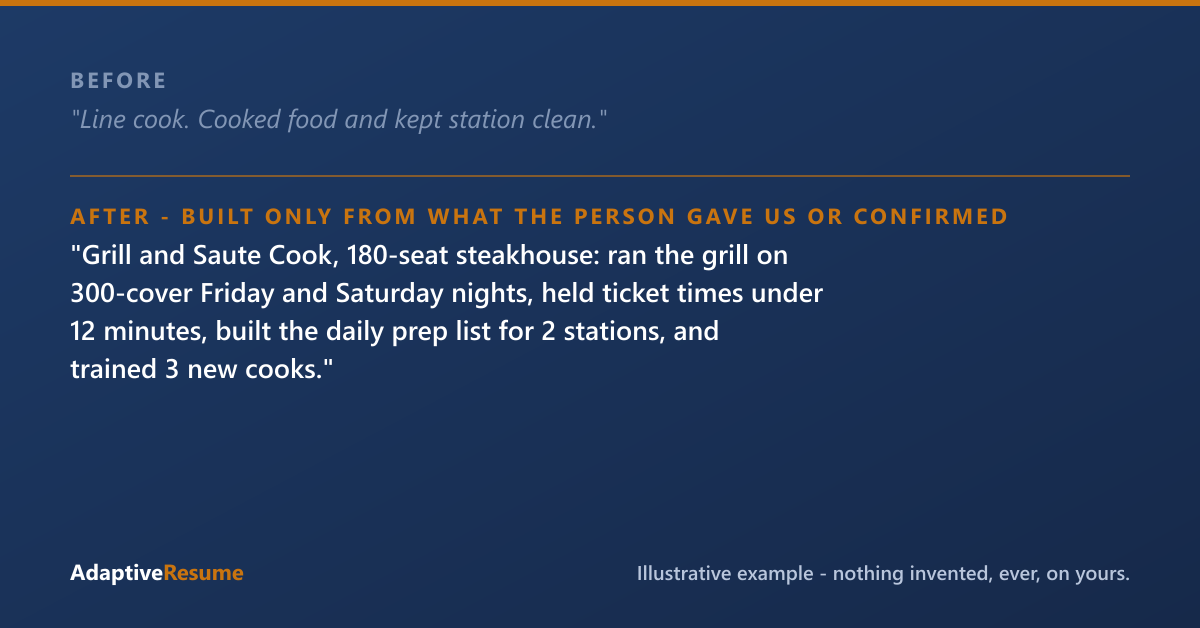
Illustrative example. Everything on your resume is yours: the experience you listed, plus the stations, equipment, and food safety training your work already involved, each added only after you confirm it’s true.
The second version tells a chef the stations, the size of the restaurant, and the volume in the first line, then shows speed, prep, and training. Every number in it comes from a normal week on the line.
Name your stations
Kitchens hire for stations, so list the ones you can run on a busy night without help:
- Grill or broiler, including the temperatures and cuts you cook to order.
- Saute, with the sauces and dishes you fire.
- Fry, including the oil changes and filtering you handle.
- Flat-top, for breakfast, burgers, and griddle work.
- Pantry or garde manger, for salads, cold apps, and desserts.
- Prep, with the volume you prep for a shift.
- Expo, if you call tickets and check plates before they leave the window.
If you have covered several stations, say so plainly: “Cross-trained on grill, saute, fry, and pantry; covered any station on the line.” That one sentence tells a chef you can fill a gap on a short-staffed night.
The numbers a chef reads
- Seats and covers. The size of the dining room and the covers on your busiest nights.
- Ticket times. Give your usual ticket time, or your target on a rush, if the kitchen display showed it during service.
- Tickets per hour on your station during peak service.
- Prep volume. How much you prepped for a shift, such as cases of produce or pounds of protein.
- Food cost and waste, only if the kitchen measured them and you had a part in the result.
- Health inspections. The kitchen’s inspection results, if you worked the line through them, written as the kitchen’s result, such as “Worked the line through 3 health inspections with no critical violations.”
- Attendance. Shifts covered, doubles worked, or a record with no missed shifts, if it is true.
Write the numbers you know. A chef will believe “about 250 covers on Saturdays” from a cook who worked those Saturdays.
Food safety, named exactly
Food handler training. Many states and counties require food workers to complete food handler training. The Texas Department of State Health Services, for example, says Texas requires many food service employees to complete an accredited food handler course within 30 days of getting a job. Write your card the way it prints: the course name, the issuer, and the expiration date.
Manager-level certification. If you hold a food protection manager certificate, such as the ServSafe Food Protection Manager Certification, list it too. It can matter more as you move toward lead cook or sous chef, and our restaurant general manager resume guide covers how that certificate is written.
Allergen and other training. Some places require allergen awareness training (the restaurant general manager guide names two states that do), and many kitchens train on it anyway. List any training you completed with the provider and the year.
Daily safety work. Temperature logs, labeling and dating, first in, first out stock rotation, and cleaning and sanitizing schedules are part of the job, and naming them shows a chef you already work that way.
Equipment and skills
Name the equipment you run, especially anything a posting asks for: flat-top, char-broiler, salamander, fryers, convection and combi ovens, steam kettles, slicers, and the kitchen display system. Add skills that set you apart, such as butchery, fish breakdown, sauces, baking, or plating to the chef’s spec.
Knife skills belong on the page as specifics, such as “breaks down 20 pounds of onions and peppers for service in under an hour,” rather than “excellent knife skills.”
The kitchen you worked in
Write the format and the size next to each restaurant name, because kitchens run very differently:
- fine dining, with a small menu and exact plating
- high-volume casual or diner, with big covers and fast tickets
- quick-service, with speed and consistency
- banquet and catering, with hundreds of plates at once
- hotel kitchens, often with room service and banquets
- hospital, school, and military kitchens, with set menus, diets, and large batches
If you are moving between formats, your summary can name the format you want and the skills that carry over.
Moving up
The usual path is prep cook, line cook, lead line cook, then sous chef. To show you are ready for the next step, list the work you already do beyond your station: running the line on the sous chef’s day off, writing prep lists, placing orders, counting inventory, training new cooks, and closing the kitchen.
Format notes
- Use the title your kitchen used, such as Line Cook, Grill Cook, or Lead Line Cook, and name the stations right after it.
- Name each restaurant with its city and its format.
- Keep short jobs honest. Restaurant jobs often run a few months; list them with real dates, and group seasonal or event work under one heading if there are many.
- Say when you can work in your summary or header if it helps, such as “Available nights, weekends, and holidays.” Kitchens schedule around the busiest shifts, and a chef filling a Saturday line looks for it.
- Keep the layout plain, with standard headings, so screening software reads every line.
Line cook resume bullets you can adapt — keep only what’s true
- “Ran the [station] on [number]-cover [nights] at a [number]-seat [format] restaurant.”
- “Held ticket times under [number] minutes during peak service.”
- “Prepped [amount] of [items] per shift to the chef’s specs.”
- “Cross-trained on [stations]; covered any station on the line.”
- “Trained [number] new cooks on [station] and kitchen safety.”
- “Kept temperature logs and labeling for [station] through [number] health inspections.”
What screening software looks for on a line cook resume
Filters commonly read for: line cook, prep cook, grill cook, fry cook, saute, broiler, flat-top, pantry, garde manger, expo, cook, kitchen, food prep, knife skills, recipes, portion control, plating, ticket times, high volume, food safety, food handler card, ServSafe, sanitation, temperature logs, FIFO, stock rotation, inventory, prep lists, banquets, catering, and kitchen display system. O*NET’s profile for restaurant cooks has the full task list.
The lines a chef can check fastest are the ones most worth getting right: a station you have never worked, a card that has expired, or a volume you never cooked for. Write what you actually did.
The Role Skills Checklist below helps you list what your kitchen history actually proves, which is usually more than the resume currently says. Our build does it with you: we work backwards from the kitchens you worked in and the stations you ran, and we ask you about the equipment, the volume, and the training that work like yours normally involves. Nothing goes on your resume that you didn’t give us or confirm, so a station, a number, or a card you never told us about stays off the page.
Common questions
What should a line cook put on a resume with little experience?
Start with any kitchen or food work you have done, such as prep, dish, catering, a school or hospital kitchen, or military food service. Name the stations you trained on, the volume of the kitchen, and your food handler card. A chef hiring for the line wants to see that you can keep up, keep clean, and show up, so give a number for each when you can.
Do I need a food handler card on my resume?
If you have one, list it with the issuer and the expiration date. Many states and counties require food workers to complete food handler training; Texas, for example, requires many food service employees to complete an accredited course within 30 days of getting a job. Rules differ by place, so check your state or county health department.
How do I show speed on a line cook resume?
Use the numbers you know from your own shifts: covers on your busiest nights, tickets you worked in an hour, and your ticket times if the kitchen display showed them during service. "Held ticket times under 12 minutes on 300-cover Saturdays" tells a chef more than "fast-paced environment" ever will.
Should I list the type of restaurant I worked in?
Yes. A steakhouse, a high-volume diner, a banquet kitchen, and a hospital kitchen run differently, and a chef reads your format to judge how quickly you will fit in. Write the format and the size next to the restaurant name, such as "180-seat steakhouse" or "hotel banquet kitchen, events up to 400 guests."
How do I show I'm ready to move up to sous chef?
Show the work you already do beyond your own station: running the line when the sous chef is off, writing prep lists, placing orders, counting inventory, training new cooks, and closing the kitchen. Give each one a number, such as the cooks you trained or the stations you covered.
Role Skills Checklist
Pop your email in and the download unlocks right here. Joining our list also takes 25% off your first purchase within 30 days of joining, when you create your account with this same email. We'll also send the occasional useful note. No spam.
Download: Role Skills ChecklistThanks, you're on our list, and your download is ready just above. Your 25% off a first purchase is good for 30 days from the day this email joined our list.
That email didn't look right — mind trying it again?
Ready to do this on your own resume?
We'll find what you've left off, and nothing goes on your resume that you didn't give us or confirm.
Get your resume build — $29Every purchase is one payment, and nothing renews. A single resume build can be used any time within 12 months of buying it, and AR Pass builds you don't use end when its 90 days end.
Try the demo first — a sample review, no sign-up · See how the service works
Paid a resume service and got a template back? Start at Fix my resume.