Guides · For job seekers
Medical Assistant Resume: Certification, Scope, and Both Sides of the Clinic
Practice managers read a medical assistant resume for the credential written exactly as held, the clinic you ran in, and whether you carried the clinical side, the front office, or both. Here's how to write yours honestly.
Published 09/18/2026 · Updated 09/29/2026
A medical assistant resume is read by a practice manager or a clinic lead who is staffing one specific seat, and they read for three things. Which credential do you hold, written exactly? What kind of clinic did you run in, and at what pace? And did you carry the clinical side, the front office, or both? A resume that says “medical assistant responsible for patient care and administrative duties” answers none of that. The specifics do.
The medical assistant (MA) is unusual in that the job genuinely has two halves — the exam room and the front desk — and many postings are filtering for a particular balance of them. A resume that names both halves with real scope competes well. One that blurs them into “assisted providers and patients” doesn’t.
The clinic line: your scope in one sentence
Under each role, give one line a practice manager would recognize instantly.
Before: “Medical assistant responsible for patient care and administrative duties in a busy clinic.”
After: “CMA (AAMA), [family medicine] clinic, [3] providers, [30]-[40] patients per day; rooming and vitals, injections, EKGs, and specimen collection under provider delegation; scheduling, referrals, and prior authorizations in [Epic].”
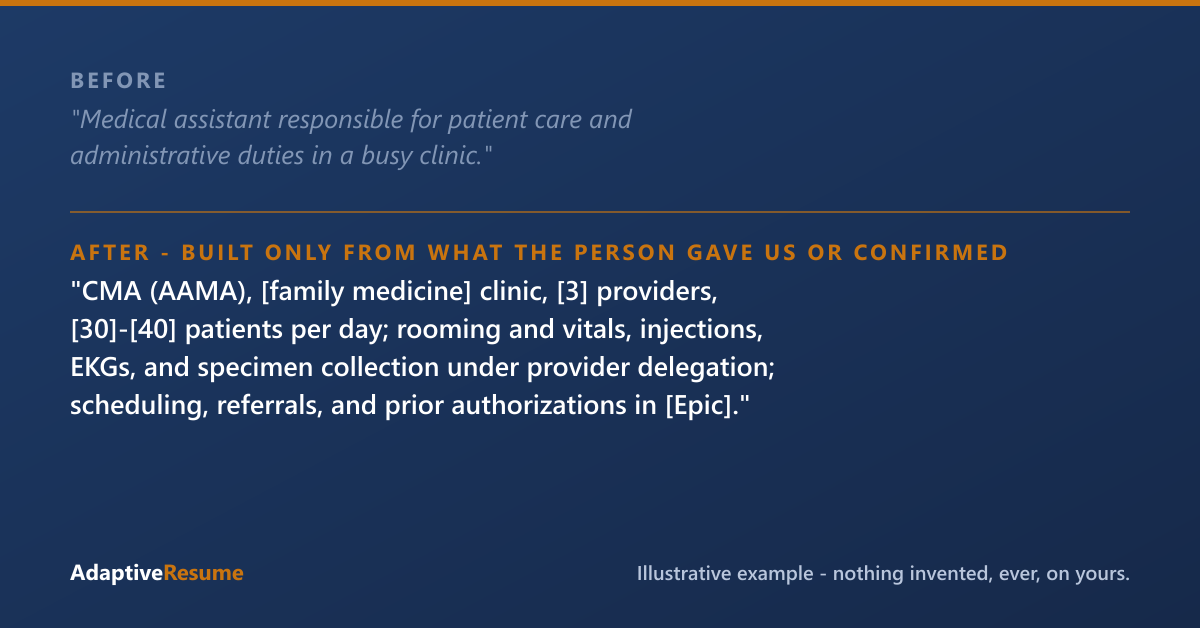
Illustrative example. Everything on your resume is yours: the experience you listed, plus the skills, tools, responsibilities, and credentials your work already involved, each added only after you confirm it’s true.
The second version answers what the first hides: the credential and its body, the specialty, the size of the practice, the daily pace, what you did in the exam room, what you did at the desk, and the system you did it in. It invents nothing. Fill the brackets from your real schedule and your real task list.
Credentials, exactly as held
There are four national medical assistant credentials, all accredited by the NCCA (National Commission for Certifying Agencies), and none of them transfers to another body. Our guide on how to list certifications on a resume covers placement; here is how to write each one.
- CMA (AAMA) — Certified Medical Assistant, from the AAMA (American Association of Medical Assistants). The main eligibility route is graduation from a medical assisting program accredited by CAAHEP (Commission on Accreditation of Allied Health Education Programs) or ABHES (Accrediting Bureau of Health Education Schools); AAMA also lists an educator category and an alternative pathway. Name your program and its accreditor — many postings look for it. AAMA recertifies on a 60-month cycle, by continuing education or by re-examination.
- RMA (AMT) — Registered Medical Assistant, from AMT (American Medical Technologists). AMT has an education route and a work-experience route, among others (military, instructor); write which one you qualified through only if it helps your case, otherwise the credential and the year are enough.
- CCMA (NHA) — Certified Clinical Medical Assistant, from the NHA (National Healthcareer Association). NHA also has education and experience routes and recertifies on a two-year cycle with continuing education.
- NCMA (NCCT) — National Certified Medical Assistant, from the NCCT (National Center for Competency Testing).
- BLS — Basic Life Support, typically through the American Heart Association, with current-through dates. Some clinics accept American Red Cross CPR; write the issuer you actually hold.
- Additional certificates — phlebotomy, EKG (electrocardiogram), or specialty-specific training (ophthalmic, podiatric, orthopedic) each get a line with the issuer and year if you hold them separately.
Write the abbreviation and the body together — “CMA (AAMA)”, “RMA (AMT)” — because each body’s rules are its own, and because a hiring manager checking your status needs to know where to look. If you hold none of the four, say nothing rather than something vague; a “certified” with no body behind it is the first thing a careful reader questions.
The parts of the job that carry the most weight
The setting and the pace. Specialty, number of providers, and patients per day. “[Pediatrics], [4] providers, [45] patients per day” is a real line; “fast-paced clinic” is not.
The exam room. Rooming, vitals, chief complaint and history intake, medication reconciliation, and patient education on the provider’s instructions. Write what you did per visit and per day.
Delegated clinical tasks. Injections (name the routes — IM (intramuscular), subcutaneous, intradermal), medication administration, EKGs, ear lavage, wound care assistance, suture and staple removal, point-of-care tests such as urinalysis, strep, glucose, and rapid flu (the CLIA-waived tests — Clinical Laboratory Improvement Amendments — a clinic logs), and specimen collection including venipuncture. What an MA may do is set by state law and by the supervising provider, and it varies — so write these with “under provider delegation,” which is accurate everywhere and shows you understand the line. Never list a task your state doesn’t allow.
Sterile processing and infection control. Instrument cleaning and autoclave use, sterile field setup for minor procedures, and OSHA (Occupational Safety and Health Administration) bloodborne pathogens training. Name the equipment.
The front office. Scheduling and recalls, check-in and check-out, insurance check and eligibility, referrals, prior authorizations, and charge entry. Give the volume: “[20]-[30] prior authorizations per week across [Aetna, UnitedHealthcare, Medicare Advantage] plans.” If you split time, say the split: “[60]% clinical, [40]% front desk.”
Systems. Name the EHR (electronic health record): Epic, athenahealth, eClinicalWorks, NextGen, or Oracle Health (formerly Cerner). Name the practice management system if it’s separate. Screening software keys on product names, not on “proficient in medical software.”
Specialty depth. Dermatology, orthopedics, OB/GYN, cardiology, and ophthalmology each have procedures and instruments an MA learns on the job. Name them — “assisted with [joint injections / punch biopsies / stress tests]” tells a specialty practice you already know its procedures.
Where the line sits with other roles. A medical assistant works under a provider in an ambulatory setting; a nursing assistant works under nursing supervision in a facility and carries a resident assignment, which is a different page. A phlebotomist’s page is about draw volume and specimen integrity across a shift; for an MA, venipuncture is one delegated task among many, so give it a line, not a section. And if your MA role was entirely administrative — no rooming, no vitals — our administrative assistant resume guide covers that page with the right vocabulary; the test is whether you ever took a patient back.
Medical assistant resume skills: the list, and how to make it true
A skills section works when every item is something you did in a real clinic and could describe if asked. The skills that typically matter, in the words postings use: rooming, vital signs, patient intake, medication reconciliation, injections, IM and subcutaneous administration, EKG, venipuncture, specimen collection, point-of-care testing, urinalysis, rapid strep and flu testing, sterile technique, autoclave, minor procedure setup, scheduling, insurance check, prior authorization, referrals, charge entry, ICD-10 (International Classification of Diseases, 10th revision) and CPT (Current Procedural Terminology) coding familiarity, HIPAA (Health Insurance Portability and Accountability Act) compliance, and your EHR by name.
Two rules keep it honest. First, list only what you’ve done in a clinic, not what your program covered — an externship skill checklist is not the same as a year of visits. Second, mark delegated clinical tasks as delegated; a reader in a strict-scope state will notice if you don’t, and a reader in a permissive one won’t mind that you did.
Format notes
Length follows your history, not a page rule. One page is right for a new graduate or for a few years in one practice. Two pages is normal and expected once you have more than one substantive role to describe — a primary care clinic and a specialty practice, say, each with its own procedures and systems. Order matters more than length: credential and BLS near the top in their own labeled section (screening software keys on them), then experience with a clinic line atop each role. If you’re trimming to fit, cut older non-clinical detail before you cut a procedure.
One genuine exception worth knowing: federal applications through USAJOBS cap at two pages as of the September 2025 OPM (Office of Personnel Management) change. VA (Department of Veterans Affairs) and military treatment facility postings run through USAJOBS, so if that’s where you’re headed, that’s a hard requirement.
Otherwise: reverse chronological, single column, standard headings, real text rather than graphics or tables — applicant systems parse plain layouts most reliably. Skip the graphics.
A bullet bank you can adapt — keep only what’s true
- “CMA (AAMA) in a [specialty] practice with [N] providers; roomed [N] patients per day with vitals, intake, and medication reconciliation in [EHR]”
- “Administered [IM / subcutaneous] injections and immunizations and performed 12-lead EKGs under provider delegation”
- “Collected specimens including venipuncture under provider delegation and ran point-of-care tests ([urinalysis, rapid strep, glucose]); maintained CLIA-waived testing logs”
- “Prepared sterile fields and instruments for [minor procedures]; ran autoclave cycles and spore testing on a [weekly] schedule”
- “Processed [N] prior authorizations and [N] referrals per week across [payers]; checked eligibility at check-in for [N] patients per day”
- “Split [N]% clinical and [N]% front office; covered scheduling and recalls in [practice management system]”
- “Completed a CAAHEP-accredited medical assisting program at [school] with a [N]-hour externship at [practice]”
Each bullet is a frame, not a claim. If a line isn’t true of your clinic, it doesn’t go on the page — the practice manager is one phone call from your last one.
What screening software looks for on a medical assistant resume
Clinic filters read for the vocabulary of MA work, and a practice manager reads for the same words minutes later. The terms that typically matter: medical assistant, CMA, AAMA, RMA, AMT, CCMA, NHA, NCMA, NCCT, rooming, vital signs, injections, EKG, venipuncture, phlebotomy, specimen collection, point-of-care testing, sterile technique, autoclave, scheduling, insurance check, prior authorization, referrals, Epic, athenahealth, eClinicalWorks, NextGen, HIPAA, BLS, and the specialty by name.
One honesty note on job codes: O*NET profiles this work under Medical Assistants (31-9092.00), and its own sample titles include both Certified Medical Assistant and Registered Medical Assistant — which is exactly why the body behind your credential belongs on the page. If your target posting is really a specialty coordinator or intake role, our tailor your resume to the job description guide covers how to shift the emphasis without changing the facts.
The highest-risk lines overstate the credential or the scope — a “CMA” with no body behind it, a task listed that your state doesn’t permit, a program written as accredited when it wasn’t. Clinics check credentials against the issuing body’s own lookup, and they ask your last supervising provider what you actually did.
The Role Skills Checklist below helps you inventory what your clinic work actually proves, which is often considerably more than the resume currently says. Our build does it with you: we work backwards from your real settings, procedures, systems, and credential, propose the lines that history supports — each one offered as a question, not a decision made for you — and ask you to confirm every item before it appears. We never add a credential, a procedure, or a system you didn’t tell us about.
Common questions
I'm a CMA. How exactly do I write that so it doesn't get confused with the others?
Write the credential and the body together, every time: 'CMA (AAMA)'. There are four national medical assistant credentials — CMA from the AAMA, RMA from AMT, CCMA from the NHA, and NCMA from the NCCT — and they don't transfer between bodies, so a hiring manager needs to know which one you hold. Add the year and, if it's current, 'current through [year]'. A bare 'certified medical assistant' reads as a job description, not a credential.
I've worked as an MA for years but never got certified. Is that a problem on the resume?
It's a fact, and the resume should be honest about it. In many states certification isn't legally required, and years of real clinic work count for a great deal. Write the work with full scope — patients per day, the procedures you performed under delegation, the EHR you ran — and leave the credential line out rather than writing something vague. If you're eligible through experience for one of the exams and you've scheduled it, '[CCMA / RMA / NCMA] exam scheduled [month year]' is honest and reads fine.
Can I list injections and other clinical tasks if my state has rules about what MAs can do?
List what you actually did, and let the wording show it was delegated: 'administered IM and subcutaneous injections under provider delegation'. What a medical assistant may do is set by each state's law and by the supervising provider, so the same task can be routine in one state and off-limits in another. Writing 'under provider delegation' is accurate everywhere and tells the reader you understand the boundary.
My MA job was almost all front desk. Is this still the right resume?
Yes, if the title was medical assistant and you were in a clinical setting — scheduling, insurance check, referrals, and prior authorizations are half of what many MA postings ask for. Write that half with the same precision: patients per day, the practice management and EHR systems, the payers you worked with. If the role was purely administrative with no clinical piece at all, our administrative assistant resume guide may fit better; the difference is whether you ever roomed a patient.
Role Skills Checklist
Pop your email in and the download unlocks right here. Joining our list also takes 25% off your first purchase within 30 days of joining, when you create your account with this same email. We'll also send the occasional useful note. No spam.
Download: Role Skills ChecklistThanks, you're on our list, and your download is ready just above. Your 25% off a first purchase is good for 30 days from the day this email joined our list.
That email didn't look right — mind trying it again?
Ready to do this on your own resume?
We'll find what you've left off, and nothing goes on your resume that you didn't give us or confirm.
Get your resume build — $29Every purchase is one payment, and nothing renews. A single resume build can be used any time within 12 months of buying it, and AR Pass builds you don't use end when its 90 days end.
Try the demo first — a sample review, no sign-up · See how the service works
Paid a resume service and got a template back? Start at Fix my resume.