Guides · For job seekers
Logistics Coordinator Resume: Shipments, Carriers, Costs, and the Paperwork You Got Right
Logistics coordinator resumes are read for shipment volume, on-time and cost results, carrier work, and documentation accuracy. Here's how to write yours with your real numbers, the systems you ran, and the training you completed.
Published 10/13/2026 · Updated 10/30/2026
A logistics coordinator resume is read by a logistics manager, a supply chain manager, or a recruiter for a manufacturer, distributor, retailer, or third-party logistics company. They are looking for proof that you can keep freight moving: how many shipments you handled, how often they arrived on time, what they cost, and whether the paperwork was right the first time. A resume that says “coordinated shipments and communicated with carriers” gives them none of it.
Much logistics work is measured step by step, from the booking to the delivery receipt, so you likely know your own numbers well. Put them on the page.
Lead with volume, service, and cost
Before: “Logistics coordinator responsible for coordinating inbound and outbound shipments and communicating with carriers.”
After: “Logistics coordinator for a [regional distributor]: booked about [120] outbound truckload and LTL shipments a week across [15] carriers in [TMS], kept on-time delivery at [96]%, and cut freight cost per order by [8]% by consolidating LTL lanes; [0] customs holds on [N] import entries in [year].”
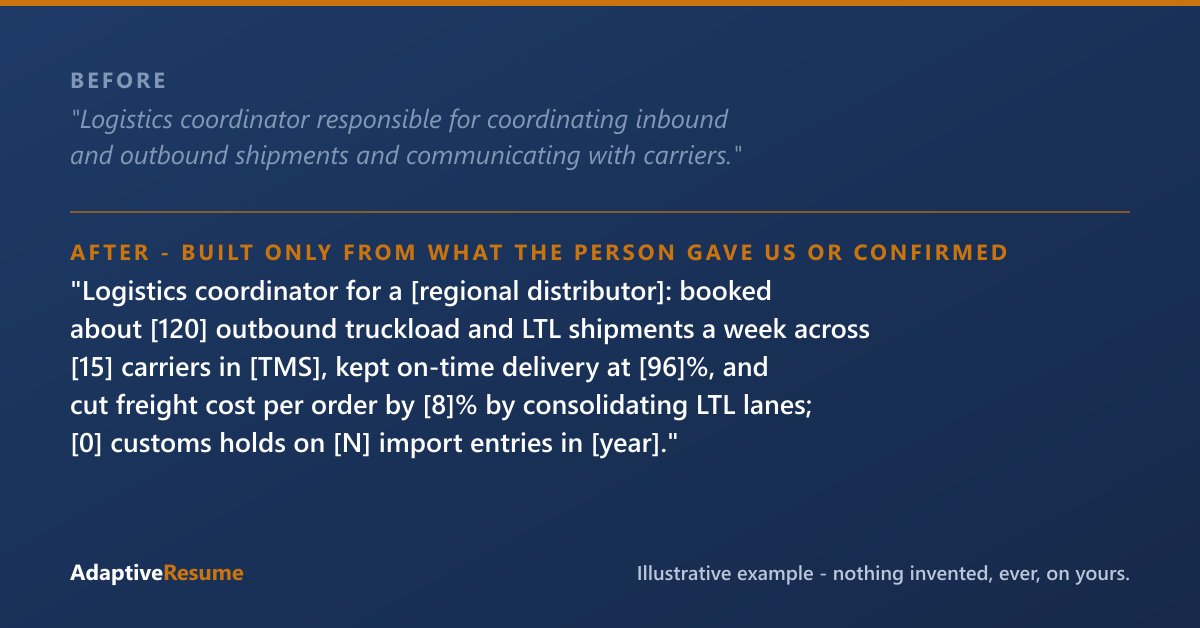
Illustrative example. Everything on your resume is yours: the experience you listed, plus the systems, documents, and training your work already involved, each added only after you confirm it’s true.
The second version tells the manager the volume, the modes, the carriers, the system, the service level, and a cost result in two lines.
The numbers a logistics manager reads
Volume. Give shipments, loads, or containers per week or month, and the modes you handled: truckload, less-than-truckload (LTL), parcel, intermodal, ocean, or air. Name inbound, outbound, or both, and the number of sites or customers you supported.
Service. Write on-time pickup and delivery rates, on-time in-full (OTIF) results if your company measured them, and how you handled late or damaged freight. A retailer or a large customer may have scored your shipments, and that score is a strong line.
Cost. If you booked freight, compared quotes, audited freight bills, or moved volume to better lanes or modes, write the result as a percentage or a dollar figure you can explain. Saving money on freight is one of the clearest wins a coordinator can show.
Accuracy and claims. Write your documentation accuracy, the freight claims you filed and recovered, and the billing errors you caught. Clean paperwork helps keep freight out of holds and invoices out of disputes.
Documents and rules, named exactly
Shipping documents. Name the documents you prepared or checked: bills of lading, packing lists, commercial invoices, certificates of origin, and delivery receipts. For international work, add booking confirmations, the entry documents your customs broker filed, and the export records your company kept.
Incoterms. If you worked on international shipments, say you applied the Incoterms rules on your company’s contracts. The International Trade Administration explains that Incoterms define who handles and pays for each step, such as transport, insurance, and customs clearance. Name the terms your company used most, such as FOB, FCA, or DAP.
Hazardous materials. If you prepared, packaged, or offered hazardous materials for shipment, the federal hazmat rules required your employer to train and test you, and that training must be repeated at least once every three years. Write the training with its date. It tells an employer you already know the rules, and a new employer can count a current record of that training toward its own requirement.
Security programs. If your company took part in CBP’s Customs Trade Partnership Against Terrorism (CTPAT) and you kept the records or followed the procedures it requires, say what you did. Do not describe your company’s status as your own credential.
Systems and certifications
Systems. Name the transportation management system (TMS), the warehouse management system (WMS), and the ERP you worked in, such as SAP, Oracle, NetSuite, or Microsoft Dynamics. Add carrier portals, freight-bill audit tools, tracking platforms, and Excel work such as pivot tables or lookups if you built reports. Recruiters often search for these names.
Certifications. A widely recognized logistics credential is ASCM’s Certified in Logistics, Transportation and Distribution (CLTD). ASCM also offers supply chain and planning certifications, such as CSCP and CPIM. Write each one you hold with its issuer and year. Hazmat training, forklift training, and a customs broker license, if you hold one, belong in the same section.
Moving up
Lines that point upward matter: training a new coordinator, owning a carrier relationship or a set of lanes, building a report your manager used every week, or leading a project such as a new carrier rollout or a TMS change. If you are aiming at a supervisor, analyst, or manager job next, add the scope of what you owned and the result. Our operations manager resume guide covers how that role is read, and our warehouse supervisor guide covers the building side.
Format notes
Length follows your history. A coordinator with one or two jobs usually fits on one page. Two pages is normal and expected once you have more than one substantive job to describe, such as a third-party logistics company plus a shipper, or a military logistics history. Keep the numbers, the documents, the systems, and the certifications; cut the duties every logistics job shares.
Use reverse chronological order and a single column, and leave out graphics and photos. Many large shippers and logistics companies run applications through hiring software, and a two-column template can scramble the read.
Gaps get one plain dated line.
Logistics coordinator resume examples: a bullet bank you can adapt — keep only what’s true
- “Booked about [N] truckload and LTL shipments a week across [N] carriers in [TMS]”
- “Kept on-time delivery at [N]% across [N] customers; resolved late or damaged freight within [N] days”
- “Cut freight cost per [order/pallet] by [N]% by consolidating LTL lanes and moving [N] lanes to truckload”
- “Audited [N] freight bills a month and recovered $[N] in billing errors in [year]”
- “Prepared bills of lading, packing lists, and commercial invoices for [N] export shipments a month with [N] documentation errors”
- “Coordinated [N] import containers a month with our customs broker and forwarder under [FOB/FCA] terms”
- “Completed DOT hazmat shipper training, [month/year]; prepared [N] hazmat shipments a month”
- “Trained [N] new coordinators on carrier booking and [TMS]“
What screening software looks for on a logistics coordinator resume
Filters commonly read for: logistics coordinator, transportation coordinator, shipping coordinator, freight, truckload, LTL, parcel, intermodal, ocean freight, air freight, carrier management, freight audit, TMS, WMS, ERP, SAP, bills of lading, commercial invoice, Incoterms, customs, import, export, hazmat, on-time delivery, OTIF, cost savings, inventory, and supply chain. O*NET’s profile for logisticians has the planning side of the job, and cargo and freight agents have their own profile for the booking and documentation side.
The highest-risk lines are the ones a former manager can check in a phone call: a saving you cannot explain, a certification you are still studying for listed as earned, or a system you only watched someone else use. Write what you actually did and how it was measured.
The Role Skills Checklist below helps you inventory what your logistics history actually proves, which is usually more than the resume currently says. Our build does it with you: we work backwards from your real jobs, shipments, and systems, and we ask you about the documents, certifications, and training that work like yours normally involves. Nothing goes on your resume that you didn’t give us or confirm, so a certification, a system, or a number you never told us about stays off the page.
Common questions
What is the difference between a logistics coordinator and a logistics analyst?
The difference is mostly the balance of the work. A coordinator moves shipments every day: booking carriers, tracking loads, fixing problems, and keeping the paperwork right. An analyst studies the data behind those shipments to find savings and set plans. Many coordinators do some analysis, and if you built reports or found cost savings, put those on your resume with their numbers.
Should I list a certification I am still studying for?
List it only as in progress with the expected date, for example "CLTD candidate, exam scheduled for [month/year]." Do not list it as earned until you have passed.
I don't know our freight spend. What numbers can I use?
Use the numbers you handled directly: shipments or loads a week, the carriers you booked, the lanes you managed, on-time results, and the claims or errors you resolved. If you negotiated or found a saving, write the percentage or the dollar figure you can explain. You do not need the company's total spend to show your impact.
I'm coming from a warehouse or dispatch job. How do I make the move?
Lead with the parts of your current job that already are logistics: receiving against paperwork, scheduling pickups, talking with carriers, tracking shipments, or solving delivery problems. Write them with their numbers, name the systems you used, and add any logistics training with its issuer and date.
Role Skills Checklist
Pop your email in and the download unlocks right here. Joining our list also takes 25% off your first purchase within 30 days of joining, when you create your account with this same email. We'll also send the occasional useful note. No spam.
Download: Role Skills ChecklistThanks, you're on our list, and your download is ready just above. Your 25% off a first purchase is good for 30 days from the day this email joined our list.
That email didn't look right — mind trying it again?
Ready to do this on your own resume?
We'll find what you've left off, and nothing goes on your resume that you didn't give us or confirm.
Get your resume build — $29Every purchase is one payment, and nothing renews. A single resume build can be used any time within 12 months of buying it, and AR Pass builds you don't use end when its 90 days end.
Try the demo first — a sample review, no sign-up · See how the service works
Paid a resume service and got a template back? Start at Fix my resume.