Guides · For job seekers
Paramedic Resume: License, Call Type, and Scope
Paramedic resumes are read license-first, then for the scope you actually run — 911, interfacility, or critical-care transport. How to show ALS scope, call volume, and the certifications agencies verify — plus the EMT-to-paramedic step written honestly.
Published 08/30/2026
Paramedic hiring starts with two facts an agency confirms before anything else: your state paramedic license and your National Registry status. Everything else on the resume supports them. Put both where they can’t be missed, then describe the scope you actually run — 911, interfacility transport, critical-care transport — because that scope is what separates one medic resume from the next at the same certification level.
The second thing that carries weight is honest specifics about your calls. EMS resumes are unusually vague about volume and acuity; plenty say “provided advanced life support to patients” and never say the call type, the system, or the procedures the medic actually performed. Call type and acuity are exactly what a training officer is reading for.
Lead with license and National Registry status
Give the credential block up top, exactly as held, with real dates. This is the fastest read on the page and the first thing verified.
Before: “Certified paramedic with ACLS and PALS. Experienced in advanced life support and patient care.”
After: “Licensed Paramedic, [State] (Lic. #[number], current through [date]); NRP (National Registry, current through [date]). ACLS, PALS, PHTLS (current through [dates]); NIMS ICS-100/200/700/800.”
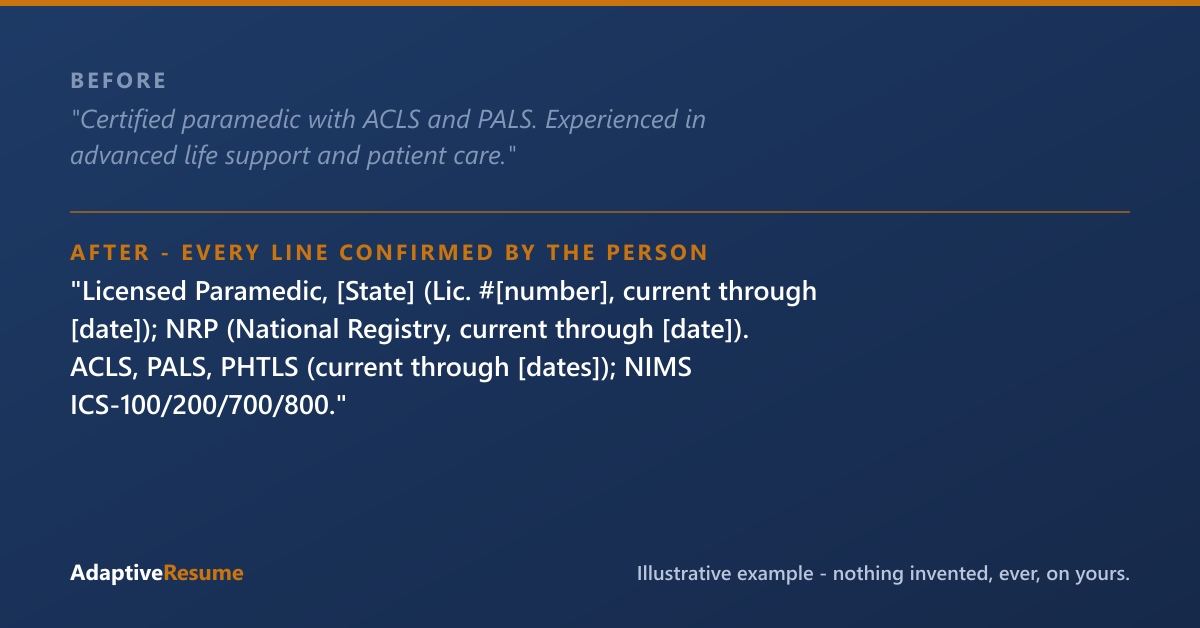
The second version is scannable in four seconds and answers what the first leaves a reader guessing at: which state, which registry, and whether the cards are current. The National Registry credential is formally the NRP (Nationally Registered Paramedic) — many people write it “NREMT-Paramedic,” and either is understood, but the license and the registry are two separate lines and both get verified.
Show the scope you actually run
Paramedic is an advanced-life-support role, so the resume should read at the ALS level — not a list of duties every provider shares.
Advanced airway and breathing: supraglottic airways, endotracheal intubation where your protocols allow, CPAP, needle decompression, waveform capnography. Name what’s in your scope and what you actually perform; if you work in a system with rapid-sequence protocols, describe your role in them accurately rather than implying more than you run.
Cardiac: 12-lead ECG acquisition and interpretation, STEMI recognition and field activation, cardioversion, pacing, and the ACLS medications you push. Field STEMI activation that shortens door-to-balloon time is a genuinely valuable line — say it plainly.
Vascular and medications: IV and IO access, and the drug box you run under standing orders and medical direction. You don’t need to list every medication; naming the categories and the fact that you operate under protocols with online medical control tells a training officer what they need.
Assessment and documentation: patient assessment, field impressions, and clean, defensible ePCR documentation. Charting quality is the responsibility agencies most fear getting wrong, so demonstrated reliability there is worth a line.
Write your setting honestly — 911, IFT, critical-care transport
The call type is the shorthand a hiring agency reads for what you’ve handled. Name it clearly under each employer.
911 / emergency response: system type (municipal, county, fire-based, third-service, private), call volume, and typical acuity. If you run in a busy urban system or a rural service with long transports, the setting explains the strengths you built.
Interfacility transport (IFT): the acuity you carried between facilities — stable transfers versus monitored patients on drips. Be precise, because IFT covers a wide range and an employer needs to know where on it you sat.
Critical-care transport (CCT): this is a distinct step up, and it deserves to be named as such. Ventilator management, multiple drips, invasive monitoring, and the additional certification or training your program required. If you hold a critical-care credential, list it exactly; if your CCT work was under an FP-C, CCP-C, or equivalent, name it. Don’t call routine IFT “critical care.”
If you’re a flight or fire-based medic, or you’re an EMT stepping up to paramedic, write that transition plainly. A recent medic who names the license date and the ALS scope honestly reads far stronger than one who blurs BLS experience into ALS language.
Format notes
Length follows your history, not a page rule. The “keep it to one page” advice gets repeated far past where it helps. If you’ve run at more than one agency, moved from EMT to medic, added critical-care or flight work, or came in from another field that gives you an edge, that’s the material that puts you ahead — cramming it onto one page throws the advantage away.
The honest rule: two pages is normal and expected once you have more than one substantive role to describe. Every line should earn its space. A tight two pages beats a padded one page. Cut the duties every medic shares; keep license, scope, call type, volume, and anything that shows judgment.
One genuine exception worth knowing: federal applications through USAJOBS cap at two pages as of the September 2025 OPM change. That’s a hard requirement, not a style preference — relevant if you’re applying to a VA, military, or federal EMS position.
Otherwise: reverse chronological, single column, a clear credential block up top with real expiration dates, and a setting line under every employer. Conservative formatting is the right call — skip the graphics, the columns, and anything that hides text from a scanner.
A bullet bank you can adapt — keep only what’s true
- “Ran [911 / IFT / critical-care transport] as a licensed paramedic; ~[N] calls per [month/year] in a [system type] system”
- “Performed ALS interventions including [advanced airway / IV-IO access / 12-lead acquisition and interpretation] under [system] protocols and online medical control”
- “Recognized field STEMI on 12-lead and activated [cath lab / receiving facility]; [N] activations over [period]”
- “Managed [ventilated / multi-drip] patients during critical-care transport under [FP-C / CCP-C / program] protocols”
- “Documented [N] patient care reports in [ePCR platform]; maintained [QA/QI] compliance”
- “Precepted [N] EMT/paramedic students or new hires; served as [FTO / preceptor]”
- “Maintained NRP and state license plus ACLS, PALS, and [PHTLS/ITLS] without lapse across [N] years”
- “Held [NIMS ICS-100/200/700/800]; deployed on [MCI / mutual-aid / event standby] as [role]“
What screening software looks for on a paramedic resume
Filters commonly read for: paramedic, ALS, advanced life support, NRP, National Registry, state paramedic license, ACLS, PALS, PHTLS, ITLS, NIMS, ICS, advanced airway, endotracheal intubation, IV, IO, 12-lead, ECG, STEMI, cardioversion, ePCR, patient assessment, medical direction, standing orders, 911, interfacility transport, critical-care transport, and FTO or preceptor. O*NET’s paramedic profile (29-2043.00) has the full task and skill list agencies pull from.
The highest-risk lines are the ones that overstate scope — a procedure you’re cleared for but rarely run written as routine, IFT described as critical care, or a card listed as current when it lapsed. EMS is a small, verified field: agencies confirm every license and certification, and they check informally too.
The Role Skills Checklist below helps you inventory what your calls actually prove, which is often considerably more than the resume currently says. Our build does it with you: we work backwards from your real license, your call types, and the scope you run, propose the certifications and skills that work like yours normally involves, and ask you to confirm every line before it appears. We never add a certification, a procedure, or a call type you didn’t tell us about.
Common questions
What's the difference an employer looks for between an EMT and a paramedic resume?
Scope of practice. An EMT resume is read at the BLS level; a paramedic resume is read for ALS — the medications, the advanced airway, the 12-lead interpretation, and the protocols you run under standing orders. If you recently moved up from EMT to medic, say so plainly and let the ALS scope carry the difference. Don't describe BLS work as if it were ALS.
How do I list paramedic certifications that expire?
With their real status and date: 'NRP (National Registry, current through [date]); ACLS, PALS (current through [date]).' An expired card stated as expired is a renewal task an employer can plan around. One listed as current when it lapsed is a background-check failure — agencies verify every card before a start date.
Does my call volume or setting matter if the numbers were low?
Say what's true and let the setting explain it. A rural service with 45-minute transports builds extended patient contact and autonomous decision-making; a busy urban 911 system builds speed and high call turnover. Name the strength your setting actually built rather than chasing a number that makes it look like something it wasn't.
Should I put every skill and procedure I'm cleared for on the resume?
List the scope you actually run, not the full protocol book. Advanced airway, IV/IO access, 12-lead acquisition and interpretation, and the medications you push under your protocols are worth naming. If a skill is in your scope but you've rarely performed it, don't imply it's routine. Precision reads as competence to a training officer; padding reads as a red flag.
Role Skills Checklist
Pop your email in and the download unlocks right here — and being on the list before launch day locks in 25% off your first build. We'll also send the occasional useful note and tell you the moment AdaptiveResume goes live. No spam.
Download: Role Skills ChecklistThanks — you're on the launch list, your 25% is locked in, and your download is ready below.
That email didn't look right — mind trying it again?
Ready to do this on your own resume?
We'll find what you've left off and you approve every line — nothing made up.
Build your resume — $49Try the demo first — a sample review, no sign-up · See how the service works
Paid a resume service and got a template back? Start at Fix my resume.