Guides · For job seekers
Special Education Teacher Resume: Caseload, IEPs, Real Scope
Special education teacher resumes are read caseload first — setting, IEP count, behavior plans, the paraprofessionals you direct. How to put real scope on the page, with certification stated exactly as your state grants it.
Published 09/04/2026
Special education teacher resumes are read by people who know the job is two jobs: the teaching, and the caseload. A principal or special education director skims for the setting — resource, self-contained, inclusion co-teaching, itinerant — and then for the compliance work: how many IEPs (individualized education programs) you write and manage, whether your documentation holds up, whether you can run a meeting where the family and the district want different things. “Taught special education, grades 3–5” answers none of that.
The gap costs you twice. Postings for these roles use unusually precise language — IEP goals, functional behavior assessments, co-teaching models, specially designed instruction — and screening software matches words before a person ever reads the file. A sped teacher resume that stays vague loses at the software stage and again at the skim.
Lead with the setting and your caseload
Under each school, give one line of context before the bullets — grade band, setting, caseload, and the scope you actually carried.
Before: “Taught special education and supported students with IEPs.”
After: “Case manager for [N] students with IEPs in a [resource/inclusion] setting, grades [X–Y]; wrote and led [N] annual IEP meetings a year, progress-monitored [N] goals each grading period, and directed [N] paraprofessionals.”
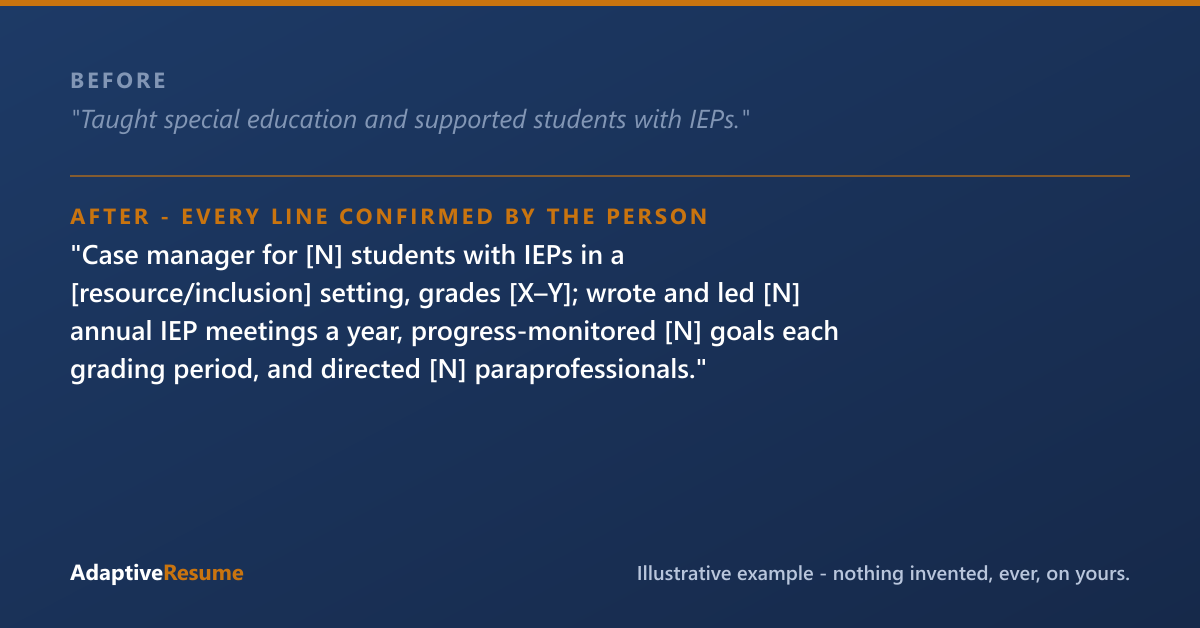
Illustrative example. On your resume, every line comes from your real history — proposed as a question, added only when you confirm it.
The second version is scannable in four seconds: setting, caseload, the meeting load, the data work, and the adults you directed. It also uses the words a special education director thinks in, because those are the words in the posting.
Certification, exactly as your state grants it
There is no universal special education credential, so don’t write your certification line as if there were one. Every state licenses special education teaching its own way: a standalone certificate in some states, an endorsement added to a general teaching license in others, often split by grade band and sometimes by disability category. Write the credential the way your state names it — state, area, grade band, and any endorsements — and put it where it can be found in two seconds.
Many states use a Praxis Special Education exam from ETS (Educational Testing Service) as part of licensure; the current core exam is Special Education: Foundational Knowledge (5355). The exam belongs to the licensure story, not to a credentials list of its own — the certificate it earned you is the line that matters.
Crisis training earns its own line because districts pay for it. If you are trained in CPI’s Nonviolent Crisis Intervention program or in Safety-Care from QBS, name the program and the year. Write “trained,” and keep the wording the program itself uses.
The work hiding inside “special education teacher”
IEP writing and progress reporting. Present levels, measurable annual goals, accommodation pages, and progress reports every grading period — writing done under IDEA (the Individuals with Disabilities Education Act) that has to stand up if the file is ever audited or contested. Count it: IEPs written and amended per year, meetings led, evaluations and reevaluations coordinated.
Behavior work. If you have taken part in an FBA (functional behavior assessment) or written and run a BIP (behavior intervention plan), say so, and say with whom — school psychologist, Board Certified Behavior Analyst (BCBA), the full team. Training other staff to run a plan consistently is its own line.
Specially designed instruction and data. Adapting content, methodology, and delivery to a student’s needs is the legal core of the job — and it produces data. Frequency counts, work samples, curriculum-based measures, graphed progress on goals. Name what you collected, how often, and what decisions it fed.
MTSS and RTI. If you sat on the building’s multi-tiered system of supports or response to intervention team, ran Tier 2 or Tier 3 interventions, or helped weigh referrals, that is building-level scope beyond your caseload.
Assistive technology. AAC (augmentative and alternative communication) devices, text-to-speech, adapted materials. Programming a device or modeling its use daily is more than “familiar with.”
Co-teaching, paraprofessionals, and transition planning
Co-teaching and inclusion. Name the model — station teaching, parallel teaching, team teaching, one-teach-one-support — plus the subjects and how many general education partners you worked with. Districts building inclusion programs look for exactly this experience. For the general-education side of the skill set, the teacher resume skills guide covers what classroom work proves on its own.
Directing paraprofessionals. Scheduling, training them on behavior plans and instructional programs, giving feedback — that is supervision without the manager title, and it belongs on the page as scope: how many people, across how many rooms. If you started as a paraprofessional yourself, that history is an asset, not filler; the paraprofessional resume guide covers how to write it.
Transition planning. At the secondary level, IDEA requires transition planning to be in effect by age 16, and some states start earlier. If you wrote transition plans, coordinated with vocational rehabilitation or community agencies, or ran student-led IEP meetings, those are lines that separate a secondary special education teacher resume from an elementary one.
Format notes
Length follows your history, not a page rule. The “keep it to one page” advice gets repeated past the point where it helps. If you’ve taught in two settings, hold endorsements in more than one area, or carried building-level roles alongside your caseload, that material is your case — don’t cram it away.
The honest rule: two pages is normal once you have more than one substantive role to describe. Every line still has to earn its space — cut the duties every special education teacher shares and keep caseload, settings, plans, data, and the adults you led.
One genuine exception worth knowing: federal applications through USAJOBS cap at two pages as of the September 2025 OPM change. That’s a hard requirement rather than a style preference.
Otherwise: reverse chronological, single column, a certification block findable in two seconds, a settings-and-caseload line under every school. Skip the graphics — this is a field where the file gets read by software before people.
A bullet bank you can adapt — keep only what’s true
- “Case manager for [N] students with IEPs, grades [X–Y], in a [resource/self-contained/inclusion] setting”
- “Wrote and led [N] annual IEP meetings per year; drafted present levels, measurable goals, and accommodation pages for each”
- “Collected and graphed progress data on [N] goals [weekly/biweekly]; reported progress to families every [grading period]”
- “Took part in [N] FBAs and wrote [N] BIPs with the [school psychologist/behavior team]; trained staff on each plan”
- “Co-taught [subject] with [N] general education teachers in a [station/parallel/team] model serving [N] students”
- “Directed and scheduled [N] paraprofessionals across [N] classrooms; trained each on behavior and instructional plans”
- “Wrote transition plans for [N] students; coordinated services with [vocational rehabilitation/community agency]”
- “Delivered specially designed instruction in [reading/math] using [program] to groups of [N]“
What screening software looks for on a special education teacher resume
Filters commonly read for: IEP, individualized education program, caseload, case management, specially designed instruction, functional behavior assessment, behavior intervention plan, progress monitoring, data collection, accommodations and modifications, co-teaching, inclusion, IDEA, Section 504, MTSS, RTI, assistive technology, transition planning, de-escalation, and paraprofessional supervision.
One wording note: teachers say “sped,” and a sped teacher resume that never spells out “special education” can miss the exact-phrase filters districts set up. Spell it out on the page and save the short form for the hallway. O*NET publishes separate profiles by grade band; the Special Education Teachers, Secondary School profile carries a full task list that maps closely to the other bands too.
The highest-risk lines are the ones that overstate scope — a certification area you don’t hold, an FBA you observed rather than took part in, a “supervised” that was really “shared a room with.” Districts check certificates against state databases, and the field is small enough that they check informally too.
The Role Skills Checklist below helps you inventory what your caseload actually proves, which is often considerably more than the resume currently says. Our build does it with you: we work backwards from your real settings, plans, and meeting load, propose the frameworks and scope your work normally involves, and ask you to confirm every item before it appears. We never add a credential, a training, or a caseload number you didn’t tell us about.
Common questions
Do I need special education certification before I can apply?
Requirements vary by state, and there is no single national license. States grant special education certification differently — some as its own certificate, some as an endorsement on a general teaching license, sometimes split by grade band or disability category. Many states also run alternative routes and provisional permits for hard-to-fill special education openings. List exactly what you hold, in the state that granted it, with its true status — including 'provisional' or 'in progress' if that's the truth.
How do I show results without exposing student information?
Describe your work, never a student. Caseload size, settings, the number of IEP meetings you led, goals you progress-monitored, plans you wrote — all yours to share. Names, diagnoses tied to a person, and anything that could identify a child are protected under FERPA (the Family Educational Rights and Privacy Act) and IDEA's confidentiality rules. Aggregate scope reads as professionalism; a specific student's story reads as a problem.
Should I list crisis intervention training?
Yes, by its real program name and current status — for example, the Crisis Prevention Institute's (CPI) Nonviolent Crisis Intervention program or Safety-Care from QBS. Districts pay to put staff through these programs, so arriving already trained is worth a line. Write the program and the year; if it has lapsed, say so or leave it off.
I'm leaving special education. Does any of this translate?
A great deal of it. Caseload management is project management with legal deadlines. IEP writing is documentation under regulation that has to survive an audit. De-escalation, meetings where the family and the district disagree, directing a team of paraprofessionals — those are real, nameable skills well beyond the classroom. The work translates when you name it plainly instead of leaving it folded inside a job title.
Role Skills Checklist
Pop your email in and the download unlocks right here — and being on the list before launch day locks in 25% off your first build. We'll also send the occasional useful note and tell you the moment AdaptiveResume goes live. No spam.
Download: Role Skills ChecklistThanks — you're on the launch list, your 25% is locked in, and your download is ready below.
That email didn't look right — mind trying it again?
Ready to do this on your own resume?
We'll find what you've left off and you approve every line — nothing made up.
Build your resume — $49Try the demo first — a sample review, no sign-up · See how the service works
Paid a resume service and got a template back? Start at Fix my resume.