Guides · For job seekers
Loan Processor Resume: Pipeline, Turn Times, and Clean Files to Close
Loan processor resumes are read for the size of the pipeline, how fast files reach clear to close, and how clean they are when they get there. Here's how to write yours with real file counts, the systems you work in, and the compliance steps you keep on schedule.
Published 10/11/2026 · Updated 10/30/2026
A loan processor resume is read by a processing manager, an operations lead, or a branch manager who needs files to close on time without coming back from underwriting covered in conditions. They want to know how big a pipeline you can carry, how fast you get a file to clear to close, how clean the file is when it gets there, and which systems you already know. A resume that says “detail-oriented processor responsible for processing loan files” answers none of those questions.
Processing is measured closely, so you likely know your own pipeline, your closings, and your turn times well. Those numbers belong on the page.
Lead with the pipeline, the speed, and the systems
Before: “Loan processor responsible for reviewing loan documents and working with borrowers and underwriters.”
After: “Mortgage loan processor, [retail lender]: [45]-[55] files in the pipeline, [18]-[22] closings a month across conventional, FHA, and VA; average [21] days from submission to clear to close, [97]% closed on schedule; Loan Estimates and Closing Disclosures tracked to TRID deadlines in [Encompass].”
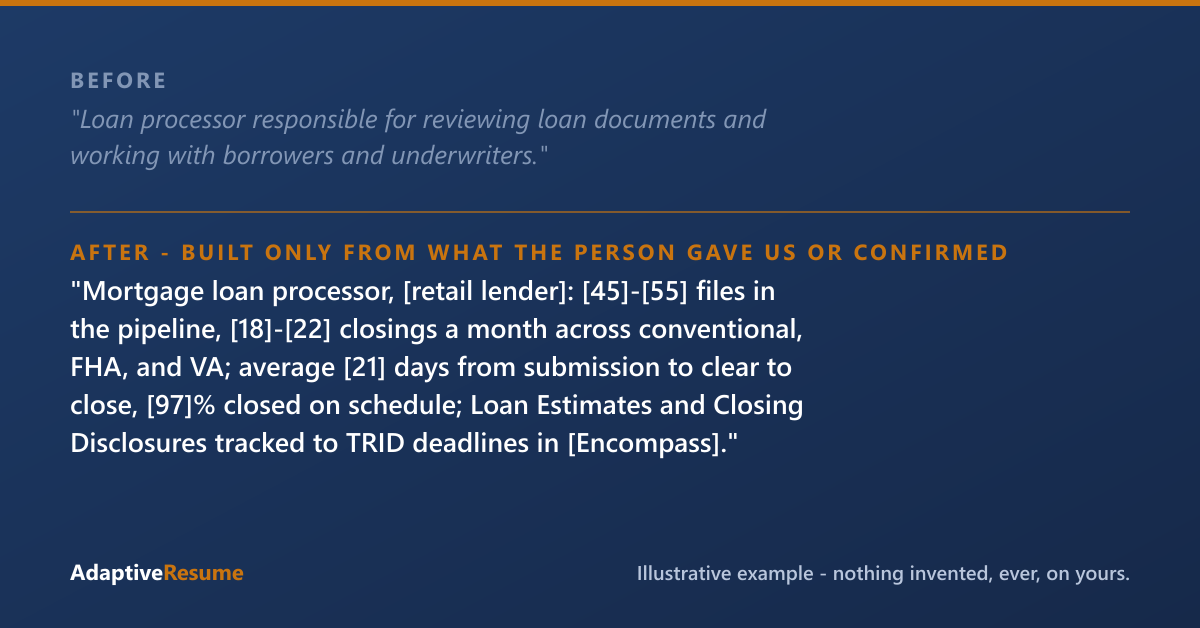
Illustrative example. Everything on your resume is yours: the experience you listed, plus the loan types, systems, and compliance steps your work already involved, each added only after you confirm it’s true.
The second version gives the manager the workload, the loan types, the speed, the reliability, and the system. Use the numbers you know from your own pipeline and can explain, and never copy reports out of an employer’s systems.
The numbers a processing manager reads
Pipeline and volume. Give the number of files you carry at once and the number that close each month. Say whether you processed purchases, refinances, or both, because purchase files run on a contract deadline.
Turn times. Write the average days from application or submission to clear to close, and the share of files that closed on the scheduled date. If you cut a turn time by changing how you ordered third-party items or chased conditions, that change is worth its own bullet.
File quality. Show how often your files went to underwriting complete, how many conditions came back, and any post-closing or quality-control findings. “Fewer than [N] underwriting conditions per file on average” tells an underwriter you send clean work.
Loan types. Name the programs you process: conventional, FHA, VA, USDA, jumbo, non-QM, construction, or home equity. Government loans have their own documentation rules, so experience with them is worth naming.
The work itself, in the terms the industry uses
Disclosures and deadlines. Under the TRID rules, the Loan Estimate goes out within three business days of the application, and the borrower must receive the Closing Disclosure at least three business days before closing. If you track those dates, prepare or review the disclosures, or watch for changes that require a new disclosure, say so.
Verifications and third-party items. Describe the items you order and review: verification of employment, bank statement review, IRS Form 4506-C tax transcripts, the appraisal (through the channel your lender uses to keep the appraiser independent), title, flood certification, and homeowner’s insurance.
Underwriting and conditions. Name the automated underwriting systems you read findings from, such as Fannie Mae’s Desktop Underwriter or Freddie Mac’s Loan Product Advisor, and describe how you cleared prior-to-document and prior-to-funding conditions. Income calculation for self-employed or commission borrowers is a skill worth naming if you do it.
Systems. Name the loan origination system (Encompass, Byte, Calyx, MeridianLink, or your bank’s own), the document and e-signature tools, and the pricing or product tools you use. A processor who already knows the system needs less training.
Communication. Show the people you keep moving: borrowers, loan officers, real estate agents, title and escrow, appraisers, and underwriters. A line about how you set expectations and kept the closing date is worth more than “excellent communication skills.”
Licensing and certifications, as held
Under the federal SAFE Act rules, a processor who works as an independent contractor generally needs a state loan originator license, while one who does only clerical and support work under the actual supervision of a licensed or registered originator does not. If you hold a license, list your NMLS ID and the states. If you do not, you do not need to mention licensing.
Processing certifications are voluntary. If you hold one, such as the National Association of Mortgage Processors’ Certified Mortgage Processor (NAMP-CMP), list it with the year. Training on a specific system or loan program can be listed as training, with the provider.
Bank, credit union, and commercial processing
Not every processor works on mortgages. Consumer loan processors at banks and credit unions handle auto loans, personal loans, and home equity lines, often with higher volume and shorter turn times. Commercial loan processors gather financial statements, tax returns, and collateral documents for the credit team and track closing items. Write the loan types, the volume, and the system, and keep the mortgage terms off the page if you never worked with them.
Format notes
Length follows your history. A processor with one or two lenders usually fits on one page. Two pages is normal and expected once you have more than one substantive job to describe, such as several lenders, a move from consumer to mortgage lending, or contract work. Keep the pipeline, the turn times, the loan types, and the systems; cut the duties every processor shares.
Use reverse chronological order and a single column, and leave out graphics and photos. Many lenders take applications through hiring software, and a two-column template can scramble the read. If you moved from loan officer assistant or processor to a senior or lead role, show it as separate entries under the same employer.
A bullet bank you can adapt — keep only what’s true
- “Carried a pipeline of [N]-[N] files; closed [N] loans a month across [conventional/FHA/VA/USDA]”
- “Brought files from submission to clear to close in an average of [N] days; [N]% closed on the scheduled date”
- “Tracked Loan Estimate and Closing Disclosure timing to TRID deadlines on every file in [LOS]”
- “Ordered and reviewed appraisals, title, flood certifications, VOEs, and 4506-C transcripts”
- “Read [DU/LPA] findings and cleared prior-to-document conditions; averaged fewer than [N] underwriting conditions per file”
- “Calculated income for self-employed and commission borrowers from tax returns and pay records”
- “Coordinated with [N] loan officers, agents, and title companies to keep closing dates on schedule”
- “Trained [N] new processors on the LOS, the disclosure calendar, and the condition checklist”
What screening software looks for on a loan processor resume
Filters commonly read for: loan processor, mortgage processor, processing, pipeline, conventional, FHA, VA, USDA, jumbo, TRID, Loan Estimate, Closing Disclosure, clear to close, conditions, underwriting, Desktop Underwriter, DU, Loan Product Advisor, LPA, Encompass, Byte, Calyx, MeridianLink, VOE, 4506-C, appraisal, title, flood certification, income calculation, self-employed income, NMLS, and customer service. O*NET’s profile for loan interviewers and clerks covers much of the processing task list.
The highest-risk lines are the ones a lender confirms in a reference call or a license lookup: a pipeline or closing count your last manager will not confirm, an NMLS license you do not hold, or underwriting authority you never had. Write the work at its real level.
If you are moving on from processing, our underwriter resume guide and loan officer resume guide cover how those jobs are read. The Role Skills Checklist below helps you inventory what your lending history actually proves, which is usually more than the resume currently says. Our build does it with you: we work backwards from your real lenders, loan types, and systems, and we ask you about the compliance steps, tools, and verifications that work like yours normally involves. Nothing goes on your resume that you didn’t give us or confirm, so a loan count, a system, or a license you never told us about stays off the page.
Common questions
Do loan processors need an NMLS license?
That depends on how you work. Under the federal SAFE Act rules, a processor who only does clerical and support work under the actual direction and supervision of a licensed or registered loan originator does not need a loan originator license. A processor who works as an independent contractor generally does. Write your status exactly: if you hold a license, give the NMLS ID and the states; if you do not, there is no need to mention it unless the posting asks.
Which numbers matter most on a loan processor resume?
The numbers that matter most are the ones your manager reports: how many files you carry at once, how many close a month, the average days from application or submission to clear to close, and the share that closed on time. If your company tracked suspended or declined files or post-closing defects, a low rate is worth a line.
I'm a contract processor. How do I list the clients?
List your own business or the processing company as the employer, with the dates, and name the types of lenders or brokers you processed for, along with the volume. If your contracts allow it, name the clients; if not, describe them, such as 'three mortgage brokers and one credit union.' Your license status belongs in the same entry.
How do I move from processing into underwriting or origination?
Show the parts of the next job you already do. For underwriting, that is income calculation, reading automated underwriting findings, and catching issues before the file goes in. For origination, it is borrower communication and product knowledge. Our underwriter and loan officer guides cover how each of those roles is read.
Role Skills Checklist
Pop your email in and the download unlocks right here. Joining our list also takes 25% off your first purchase within 30 days of joining, when you create your account with this same email. We'll also send the occasional useful note. No spam.
Download: Role Skills ChecklistThanks, you're on our list, and your download is ready just above. Your 25% off a first purchase is good for 30 days from the day this email joined our list.
That email didn't look right — mind trying it again?
Ready to do this on your own resume?
We'll find what you've left off, and nothing goes on your resume that you didn't give us or confirm.
Get your resume build — $29Every purchase is one payment, and nothing renews. A single resume build can be used any time within 12 months of buying it, and AR Pass builds you don't use end when its 90 days end.
Try the demo first — a sample review, no sign-up · See how the service works
Paid a resume service and got a template back? Start at Fix my resume.