Guides · For job seekers
Radiologic Technologist Resume: ARRT, Modalities, Scope
Radiologic technologist resumes are read credential-first, then by modality and setting. How to write yours with your real ARRT credential, the equipment you actually run, and the radiation-safety and image-quality proof that carries weight — whether your badge says rad tech or x-ray tech.
Published 09/04/2026
Radiologic technologist hiring is read credential-first. Before a lead tech or imaging director reads a single bullet, they look for the ARRT (American Registry of Radiologic Technologists) credential, the state license, and the modalities you actually run. A resume that says “performed diagnostic imaging procedures” without naming the credential, the equipment, or the setting competes badly against one that says exactly what its owner is registered to do and where they’ve done it.
The naming itself trips people up. The same job is posted as radiologic technologist, rad tech, radiographer, and x-ray tech — sometimes at the same hospital. You don’t have to pick a side: use the title your employer gave you, and let your credential block and headline carry the formal term so both a human reader and a screening filter find what they’re looking for.
Lead with your credential and your scope
Under each employer, give the context in one line before the bullets — your credential, the setting, the modalities you covered, and the volume.
Before: “Performed X-ray exams on patients as ordered by physicians.”
After: “R.T.(R)(ARRT) in a [N]-bed Level [II] trauma center; [N] exams per shift across general radiography, portable/ED imaging, and C-arm fluoroscopy in the OR; images pushed to [PACS system] and documented in Epic.”
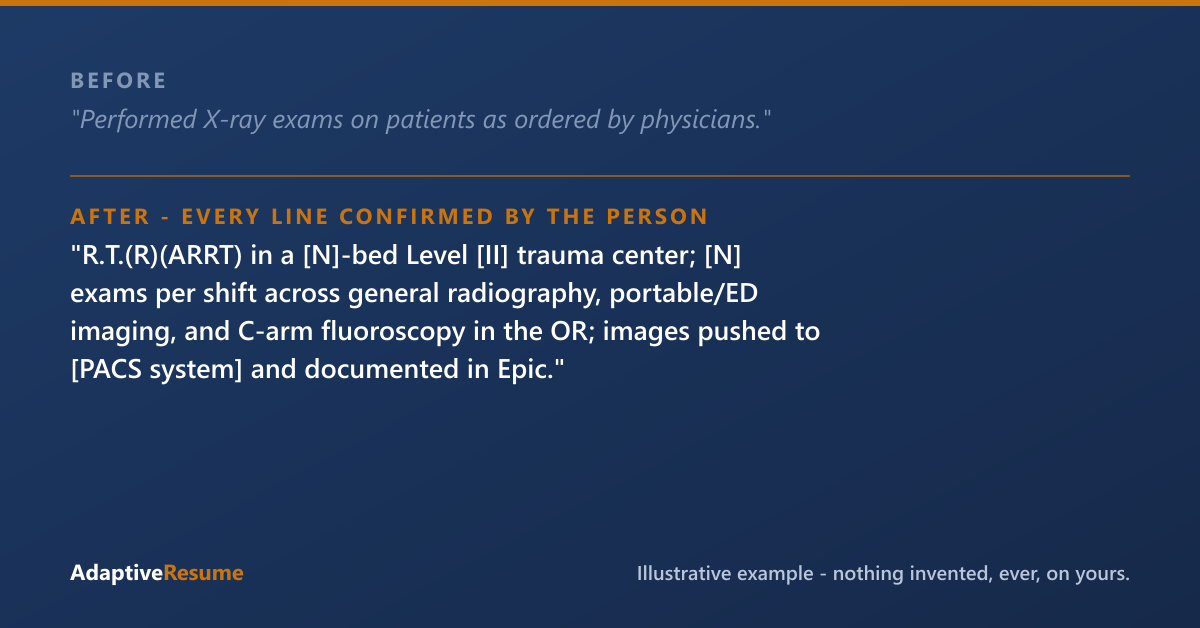
Illustrative example. On your resume, every line comes from your real history — proposed as a question, added only when you confirm it.
The second version is scannable in a few seconds and answers what the first leaves a reader guessing at: registration, acuity, modalities, volume, and systems. It also matches how imaging departments describe their own openings — postings name the modalities and shifts they need covered, so naming yours lines you up against the requirement directly.
ARRT certification and registration, exactly as held
This is the part a department checks first, so get it exactly right.
The primary credential. ARRT certification in Radiography — written as R.T.(R)(ARRT) — is the standard credential for the role. Certification and registration are two linked things: you earn certification once, and you keep your registration current year to year. List both as active, with the year you earned the credential if you have it.
Post-primary credentials. ARRT’s post-primary pathway lets a registered technologist add disciplines — CT (Computed Tomography), MRI (Magnetic Resonance Imaging), and Mammography are the ones you’ll see named in imaging postings — by documenting structured education and a logged list of clinical procedures, then passing that discipline’s exam. Each one you hold is a separate, checkable credential: write it as issued, for example R.T.(R)(CT)(ARRT). If you’re partway down a pathway, say so honestly — “completing clinical requirements toward ARRT CT eligibility” is a real and useful line.
If you hold the Mammography credential, note your qualification under MQSA — the FDA’s Mammography Quality Standards Act, which sets the training and continuing-education requirements every mammography technologist works under. Departments that read a mammography resume know exactly what that line means.
State licensure varies — say where you’re licensed. Many states license radiologic technologists; the requirements, titles, and exemptions differ state to state, and a few states don’t license the role at all. List each state license you hold with the state and its real status. If a posting is in a state that licenses the role and you’re not yet licensed there, be clear about that rather than silent.
Continuing education. ARRT requires 24 approved continuing-education credits every two-year biennium for registered technologists, and its Continuing Qualifications Requirements (CQR) run on a separate ten-year cycle for eligible credentials. You don’t need to recite the rules — but a line noting your CE is current, or naming a substantial course like a trauma-imaging or CT-registry review, tells a reader you maintain the credential rather than merely holding it.
Name the modalities and the equipment
Imaging work is concrete, and the strongest resumes are the concrete ones. Name what you run:
General radiography — the room work: chest, abdominal, extremity, and spine exams, and the patient population (adult, pediatric, bariatric).
Fluoroscopy — live studies with a radiologist, and C-arm operation in the OR (orthopedic, pain-management, and vascular cases each read differently, so name yours).
Portable and OR imaging — bedside chests in the ICU, ED portables, and intraoperative work. This is where positioning judgment shows, because you’re producing diagnostic images without the room’s alignment aids.
The systems. Name your PACS — the Picture Archiving and Communication System your images go to — and your EHR (electronic health record): Epic and Oracle Health are the ones that appear in postings by name. Departments read the systems line as a proxy for how fast you’ll be productive on day one, the same way medical technologist hiring reads the LIS (laboratory information system) line.
Radiation safety and image quality are resume material
This is the section that separates a technologist’s resume from a generic healthcare one.
ALARA — “as low as reasonably achievable,” the principle every dose decision runs through — belongs on the page in practical form: technique selection, collimation, gonadal and thyroid shielding where protocols call for it, and pediatric dose-reduction protocols. Dosimetry compliance is worth a line too: consistent badge wear and a clean exposure history are exactly what a safety officer hopes to see.
Positioning accuracy and repeat rate are the honest quality measures of this job. Every repeated exposure is extra dose, so departments track repeat rate directly — and a true line like “held a personal repeat rate of [N]% against a department target of [N]%” carries more weight than any adjective. Use only your real number.
Setting, acuity, and call
A trauma-center tech and an outpatient-clinic tech are doing recognizably different jobs, and a reader wants to know which one you’ve done — the same way a respiratory therapist resume is read for unit and acuity. Name the setting: Level I/II trauma center, ED, OR, inpatient floors, urgent care, orthopedic clinic, or outpatient imaging center. Trauma and ED work says you handle unstable patients, non-standard positioning, and speed under pressure; outpatient work says throughput, scheduling discipline, and patient experience. Both are real strengths — write the one that’s yours.
Call rotation deserves its own line. “[N] call shifts per month covering ED and OR after hours” tells a hiring manager two things at once: you’ve worked independently without a full department behind you, and you already live with the schedule the posting is asking about.
Format notes
Length follows your history, not a page rule. If you’ve worked two hospitals and an outpatient center, or you added CT mid-career, that history is your case — don’t cram it into one page to satisfy a convention. The honest rule: two pages is normal and expected once you have more than one substantive role to describe. Every line still has to earn its space — cut the duties every tech shares, keep credential, modality, volume, and systems.
One genuine exception worth knowing: federal applications through USAJOBS cap at two pages as of the September 2025 OPM change. That’s a hard requirement rather than a style preference — and VA and military-hospital imaging jobs post there.
Otherwise: reverse chronological, single column, a clearly labeled credentials block near the top, and a modality-and-setting line under every employer. Skip the graphics.
A bullet bank you can adapt — keep only what’s true
- “Performed [N] diagnostic exams per shift across general radiography, portables, and C-arm fluoroscopy in a [N]-bed [Level II trauma center / outpatient center]”
- “Operated C-arm for [N] OR cases per week ([orthopedic / pain management / vascular]), coordinating positioning with surgeons”
- “Held a personal repeat rate of [N]% against a department target of [N]% through positioning and technique selection”
- “Covered [N] portable exams per shift in the ED and ICU, including trauma activations”
- “Applied ALARA dose practices: collimation, shielding per protocol, and pediatric technique charts; [N] years of clean dosimetry readings”
- “Completed imaging documentation and orders in [Epic / Oracle Health]; pushed and QC’d studies in [PACS system]”
- “Cross-trained in [CT / MRI]; logged [N] supervised procedures toward ARRT post-primary eligibility”
- “Carried [N] call shifts per month covering after-hours ED and OR imaging”
What screening software looks for on a radiologic technologist resume
Filters commonly read for: radiologic technologist, x-ray technologist, radiographer, ARRT, R.T.(R), state license, radiography, fluoroscopy, C-arm, portable imaging, trauma, CT, MRI, mammography, PACS, Epic, patient positioning, radiation safety, ALARA, dosimetry, image quality, and quality control. O*NET’s radiologic technologists profile has the full task list.
The highest-risk lines are the ones that overstate a credential — CT listed as held when it’s in progress, registration written as active when it lapsed, a license implied in a state that never issued one. Imaging is a checkable field: ARRT registration and state licenses are looked up in minutes, and departments look.
The Role Skills Checklist below helps you inventory what your work actually proves — modalities, systems, safety practice, and scope that’s often considerably more than the resume currently says. Our build does it with you: we work backwards from your real settings, equipment, and credentials, propose the standards and systems that work like yours normally involves, and ask you to confirm every item before it appears. We never add a credential, a modality, or a system you didn’t tell us about.
Common questions
Should my resume say radiologic technologist or x-ray tech?
Use the title your employer actually gave you, and make sure the words 'radiologic technologist' appear somewhere on the page — in your headline, credential block, or summary — because screening filters read for both. If your badge said X-Ray Technologist, keep it; if it said Radiologic Technologist II, keep that. The credential line, R.T.(R)(ARRT), does the formal work either way.
How do I list my ARRT credential correctly?
Write it the way ARRT issues it: R.T.(R)(ARRT) for radiography, with additional letters for each post-primary credential you hold — for example R.T.(R)(CT)(ARRT). List certification and current registration together, since employers care that both are active, and add your state license separately with the state and its real status. If an exam is scheduled but not passed, say so plainly rather than implying you already hold the credential.
I've done CT scans on the job but don't hold the CT credential. Can I put CT on my resume?
Yes — as experience, never as a credential. 'Cross-trained in CT; [N] scans under supervision toward ARRT post-primary eligibility' is honest and genuinely useful to a reader, because documented clinical procedures are exactly what the post-primary pathway requires. What you can't do is list CT in your credential block before ARRT has issued it. The distinction takes one line and protects you completely.
Do numbers like repeat rate really belong on a resume?
If you know yours and it's good, yes. Repeat rate is the quality measure imaging departments actually track — every repeated exposure is extra dose to the patient — so a true line like 'maintained a repeat rate of [N]% against a department target of [N]%' says more about your positioning and technique than a paragraph of adjectives. Only use the real number. If you don't know it, volume and modality scope carry the line instead.
Role Skills Checklist
Pop your email in and the download unlocks right here — and being on the list before launch day locks in 25% off your first build. We'll also send the occasional useful note and tell you the moment AdaptiveResume goes live. No spam.
Download: Role Skills ChecklistThanks — you're on the launch list, your 25% is locked in, and your download is ready below.
That email didn't look right — mind trying it again?
Ready to do this on your own resume?
We'll find what you've left off and you approve every line — nothing made up.
Build your resume — $49Try the demo first — a sample review, no sign-up · See how the service works
Paid a resume service and got a template back? Start at Fix my resume.