Guides · For job seekers
Paraprofessional Resume: Setting, Scope, and Real Credentials
Paraprofessional resumes are read setting first — self-contained, inclusion, one-to-one — then for the support you actually gave: IEP goals, data collection, behavior plans, personal care. How to write yours with real numbers, the federal Title I rule stated plainly, and the credentials as you hold them.
Published 09/02/2026
Paraprofessional hiring is done by people who know the job is not “helping the teacher.” A special education case manager reading your resume wants the setting — self-contained, inclusion, resource, one-to-one — and the support you actually gave: which goals you collected data on, which behavior plans you ran, whether you handled personal care, whether you could hold a small group alone. “Assisted teacher with classroom activities” answers none of that.
The second thing that matters is the credentials block, stated exactly. Paraprofessional requirements are a patchwork — a federal rule for Title I programs, a state certificate in many states, district-required crisis training, CPR — and the posting will usually name two or three of them. Put the ones you hold where they can be found in two seconds, with their true status.
Lead with the setting and the support scope
Under each school, give one line of context before the bullets — grade band, setting, number of students, and the kind of support you provided.
Before: “Assisted the special education teacher with daily classroom activities and student needs.”
After: “One-to-one aide for a [grade]-grade student in an inclusion setting; ran the behavior intervention plan, collected daily data on [N] IEP goals, and supported [reading/math] instruction in small groups of [N].”
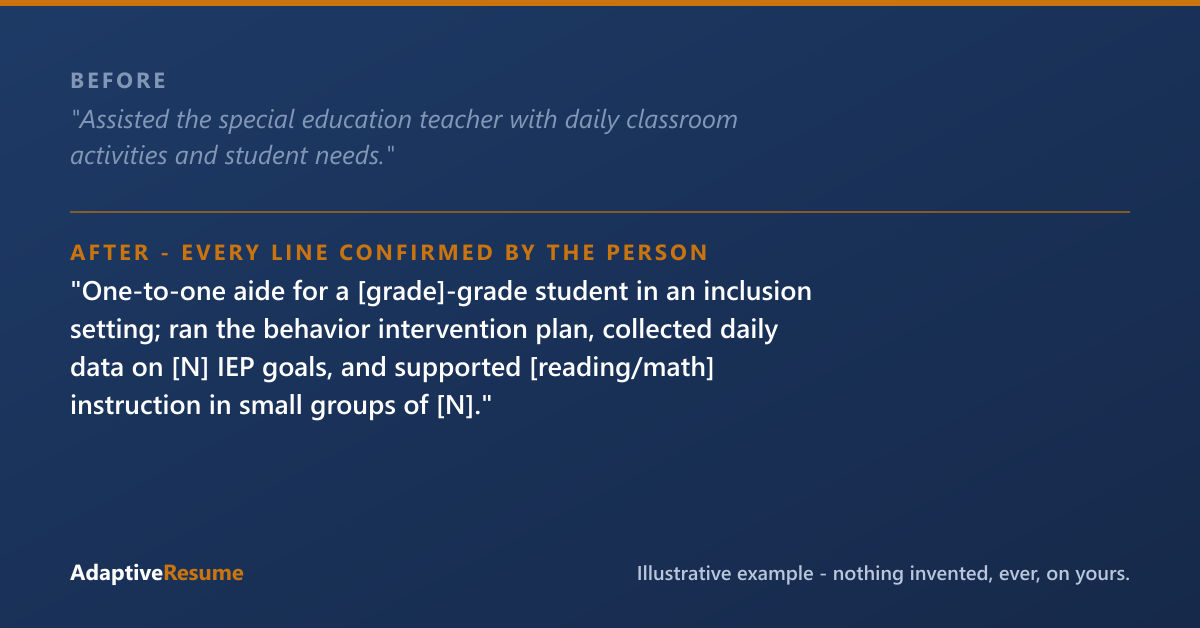
The second version is scannable in four seconds: setting, caseload, data work, and the instruction you could deliver on your own. It also uses the words a case manager put in the posting — “behavior intervention plan,” “IEP goals,” “small group” — because those are the words they think in.
Paraprofessional resume skills hiding inside “assisted the teacher”
Every one of these is a real, nameable skill the work builds. Name the ones that are true of you.
IEP and 504 support. You implemented accommodations written by someone else, every day. Say which kinds: extended time, read-aloud, sensory breaks, modified assignments, visual schedules. If you gave input at IEP meetings, that is a line.
Data collection. The skill most paraprofessional resumes leave off, and the one special education teams cannot run without. Frequency counts, duration data, ABC (antecedent-behavior-consequence) notes, progress-monitoring probes on academic goals. Name the goals in general terms and how often — “daily data on [N] goals.”
Behavior support. Running a behavior intervention plan, using its reinforcement system, de-escalating before a crisis, knowing when to call the team. If you ran programs under a BCBA — discrete trial, prompting hierarchies, token systems — say “ABA-based programs under BCBA supervision,” and only if that is what it was.
Small-group and one-to-one instruction. Name the subject, the group size, and the curriculum or program if there was one.
Assistive technology. AAC devices, speech-generating apps, picture exchange systems, text-to-speech. If you programmed the device or modeled its use, that is more than “familiar with.”
Personal care and medical support. Toileting, feeding, transfers, G-tube or diabetes support where the school nurse trained and delegated you. Real, often unlisted, and directly relevant to many postings. State it plainly. The same goes for supervision — bus duty, recess, the student who elopes.
Credentials, exactly as held
The federal Title I rule, stated plainly. Under the Elementary and Secondary Education Act as amended by the Every Student Succeeds Act (Section 1111(g)(2)(M), which carries forward the earlier requirements), a paraprofessional with instructional duties in a Title I program must have a high school diploma or its equivalent and one of the following: at least two years of college study (many states define this as 48 semester hours — check yours), an associate degree or higher, or a passing score on a state- or district-approved academic assessment in reading, writing, and math. In a Title I schoolwide school this applies to instructional paraprofessionals regardless of which budget pays them. If you meet the rule, say how: “Meets ESSA Title I paraprofessional requirements (associate degree)” or “(ParaPro Assessment, [score], [year]).”
The ParaPro Assessment is the assessment most states accept for that third path. It is run by ETS, covers reading, writing, and math, and each state sets its own passing score. List it with the year, and the score if the posting asks.
State paraprofessional certificates vary by state. Some states issue a paraprofessional certificate or license through the state education department; some require a permit or background clearance; some leave it to the district. Write yours by its real name and issuing body, with the expiration date. Never write “certified paraprofessional” as a generic phrase — write the actual credential or leave it off.
Crisis and behavior training. The two programs districts most often name are CPI Nonviolent Crisis Intervention (Crisis Prevention Institute) and Safety-Care (QBS). Both expire and renew; list the program by its exact name and the year you were last trained. Never list a program you were not trained in because it looks similar.
CPR and First Aid. American Heart Association or American Red Cross, with the expiration date. Many postings require it at hire. Mandated reporter training, where your state or district requires it, is worth one line with the year.
Education. High school diploma or GED; college hours with the count if you are using the two-year path; an associate or bachelor’s degree with the field. If you are in a teacher preparation program now, write it as in progress with the expected completion.
Titles and settings — write yours as it was
The same job carries different names in different districts. Teacher assistant and teacher’s aide are common in elementary and early-childhood rooms. Instructional aide usually signals academic support under a teacher’s direction. Special education paraprofessional (sometimes “paraeducator”) means an IEP-driven role, and one-to-one aide means you were assigned to a single student’s plan. Use the title your district used and add the common term in parentheses if another district might not recognize it.
Then name the setting, because settings tell a case manager what you have already handled: self-contained (life skills, autism, emotional/behavioral support), inclusion or co-taught, resource room, preschool, alternative program, residential or day-treatment school. Two settings across three years is a broader resume than most paraprofessionals realize they have.
If you are moving into teaching, or out of education altogether, our teacher resume skills guide covers the classroom-to-corporate translation.
Paraprofessional resume examples by setting
Lines that show the shape of a strong entry. Every number is a placeholder — yours go in, and anything that was not your work stays out.
Special education, self-contained: “Supported [N] students in a self-contained [autism/life skills] classroom, grades [K–2]; ran token systems and visual schedules from each student’s BIP; collected daily frequency and duration data on [N] behavior and academic goals; delivered toileting and feeding support for [N] students.”
One-to-one aide: “One-to-one aide for a student with [communication/mobility] needs, grade [N]; programmed and modeled an AAC device; implemented a BIP with [N] daily data points; communicated with the case manager and family through a daily log.”
Title I instructional aide: “Instructional aide in a Title I elementary school; ran [reading/math] intervention groups of [N] students, [N] sessions a week, using [program]; tracked progress-monitoring data and reported it to the classroom teacher and the MTSS team.”
Format notes
Length follows your history, not a page rule. One school and two years usually fits on one page. If you have worked in two or three settings, or held a role before this one that matters (health care, child care, a field with supervision), that is the material that separates you from the other candidates — cramming it into one page throws it away.
The honest rule: two pages is normal and expected once you have more than one substantive role to describe. Every line has to earn its space. Cut the duties everyone in the role shares; keep setting, caseload, data, programs, and anything that shows judgment.
One genuine exception worth knowing: federal applications through USAJOBS cap at two pages as of the September 2025 OPM change. That applies to federal education roles, not public school districts.
Otherwise: reverse chronological, single column, a setting line under every school, and a clearly labeled credentials block near the top — district hiring systems are older than most corporate ones and read plain text best. Skip the graphics, tables, and columns.
A bullet bank you can adapt — keep only what’s true
- “Supported [N] students on IEPs in a [self-contained/inclusion/resource] setting, grades [K–5]”
- “One-to-one aide for a student with [general need]; implemented the BIP and collected [N] data points daily”
- “Collected frequency, duration, and ABC data on [N] goals; reported weekly to the case manager”
- “Led small-group [reading/math] instruction, groups of [N], [N] sessions per week, using [program]”
- “Delivered accommodations from [N] IEP and 504 plans: [extended time, read-aloud, sensory breaks]”
- “Programmed and modeled an AAC device; supported [picture exchange/speech-generating app] use across the school day”
- “Provided personal care support ([toileting/feeding/transfers]) for [N] students per nurse delegation”
- “Trained in [CPI Nonviolent Crisis Intervention/Safety-Care] ([year]); de-escalated and documented incidents per district protocol”
What screening software looks for on a paraprofessional resume
District filters commonly read for: special education, IEP, 504 plan, behavior intervention plan (BIP), data collection, progress monitoring, small-group instruction, one-to-one support, inclusion, self-contained, accommodations and modifications, de-escalation, CPI, Safety-Care, ABA, BCBA, AAC, assistive technology, personal care, ParaPro, CPR/First Aid, mandated reporter, and Title I. O*NET’s profile for special education teaching assistants has the full task list; the general-education profile is Teaching Assistants, Except Special Education.
Use the exact term wherever it is true of you, and never plant one that is not. The highest-risk lines are a crisis certification you did not complete and an “ABA” claim for work that was ordinary behavior support. Special education is a small field within any district, and case managers check informally as well as formally.
The Role Skills Checklist below helps you inventory what your support work actually proves, which for most paraprofessionals is considerably more than the resume currently says. Our build does it with you: we work backwards from your real settings, students supported, and programs, propose the skills and credentials that work like yours normally involves, and ask you to confirm every item before it appears. We never add a credential, a training program, or a setting you didn’t tell us about.
Common questions
Do I need a degree to be a paraprofessional?
Not always, and it depends on the program and the state. For paraprofessionals with instructional duties in a Title I program, federal law (ESEA as amended by ESSA) requires a high school diploma or equivalent plus one of three things: two years of college study, an associate degree or higher, or a passing score on a state-approved assessment such as the ETS ParaPro. Districts outside Title I set their own bar, and many states add a certificate or permit on top. List whichever path you actually meet, exactly as you meet it.
Should I say teacher assistant, instructional aide, or paraprofessional?
Use the title your district used, and put the common term next to it if it helps a reader — 'Instructional Aide (Special Education Paraprofessional)'. Districts search for several of these words, and the one on your pay stub is the one a reference check will confirm. Never upgrade the title; describe the work instead.
Can I list the students I worked with?
Describe the support, never the student. Grade band, setting, number of students, disability categories in general terms, the kinds of goals you collected data on — all fine. Names, diagnoses tied to a person, and anything from an IEP that could identify a child are not. Student records are protected by FERPA, and hiring managers notice when a candidate handles that carefully.
I was a one-to-one aide for a single student for three years. Is that enough for a resume?
Yes, if you write what it involved. One-to-one work usually means a behavior plan, daily data, communication with a case manager and family, personal care, and de-escalation — sometimes assistive technology or ABA-style programs run under a BCBA. Three years of that is specialized experience. Name the pieces and the scope, and it reads as exactly that.
Role Skills Checklist
Pop your email in and the download unlocks right here — and being on the list before launch day locks in 25% off your first build. We'll also send the occasional useful note and tell you the moment AdaptiveResume goes live. No spam.
Download: Role Skills ChecklistThanks — you're on the launch list, your 25% is locked in, and your download is ready below.
That email didn't look right — mind trying it again?
Ready to do this on your own resume?
We'll find what you've left off and you approve every line — nothing made up.
Build your resume — $49Try the demo first — a sample review, no sign-up · See how the service works
Paid a resume service and got a template back? Start at Fix my resume.