Guides · For job seekers
Pipefitter Resume: Codes, Welds, and Scope Written Honestly
Pipefitter hiring reads for what you can fit, weld, and test to code. Here's how to write your apprenticeship, weld qualifications, ASME B31 experience, and real project scope so a superintendent trusts it.
Published 09/08/2026
Pipefitter hiring runs on trust. The superintendent or plant maintenance manager reading your resume wants to know one thing: can they hand you a set of isometrics and a spool, and trust the fit-up, the weld prep, and the test to pass inspection without rework? Generic language (“experienced pipefitter skilled in all aspects of piping installation”) doesn’t answer that. The specifics do — the codes you’ve worked to, the materials and joints you’ve fit, the systems you’ve tested.
The other thing that trips up pipefitter resumes is scope vagueness. Industrial process piping, power-plant steam, commercial mechanical piping, plant maintenance, and turnaround work are related but different jobs, and a resume that just says “pipefitter” competes badly against one that names the plant, the system, and the code.
The scope line: your work in one sentence
Under each role, give one line another fitter would recognize instantly.
Before: “Pipefitter responsible for installing and repairing piping systems on industrial and commercial projects.”
After: “Journeyman pipefitter, UA Local [N]; fabricated and installed carbon steel and stainless process piping to ASME B31.3 from isometrics and P&IDs; socket-weld and butt-weld fit-up, hydrostatic testing, and [N] valve installations on a [refinery] turnaround.”
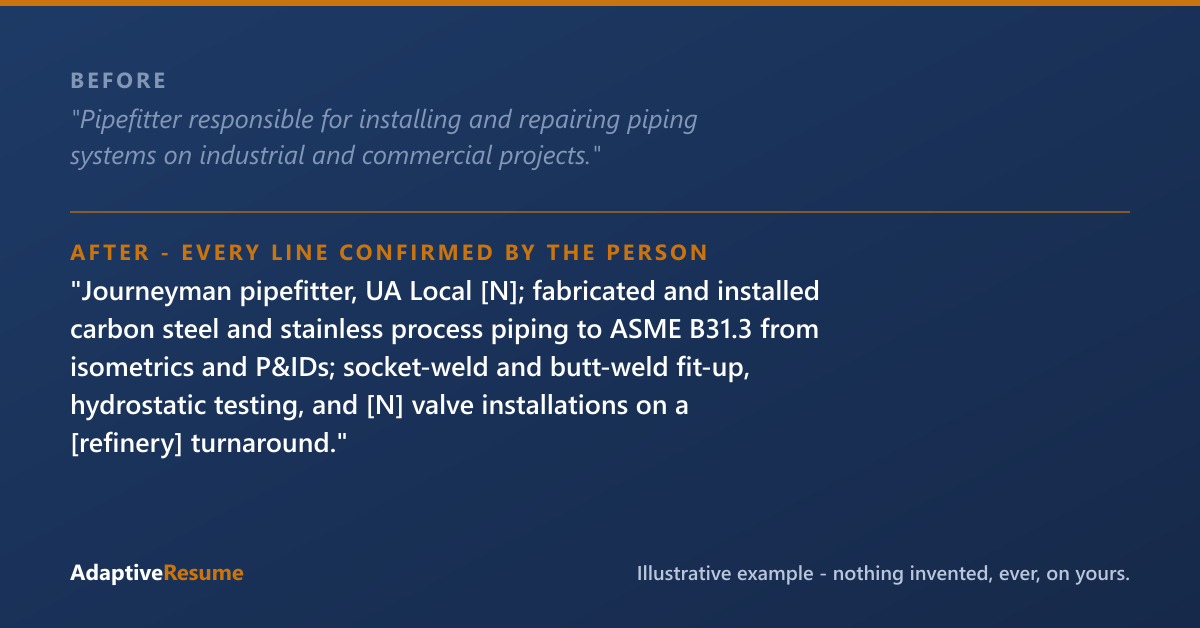
Illustrative example. On your resume, every line comes from your real history — proposed as a question, added only when you confirm it.
The second version is scannable in four seconds and answers what the first leaves a reader guessing at. Notice the rewrite invents nothing; it just says plainly what the vague version was hiding. Fill the brackets with your real local, systems, and numbers.
Credentials, exactly as held
Every item in this block gets checked by the hall or the contractor’s quality department, so it has to be exactly right. Our guide on how to list certifications on a resume covers placement and format; here is what typically belongs in a pipefitter block:
- UA apprenticeship and journeyman status. The UA (United Association of Journeymen and Apprentices of the Plumbing and Pipe Fitting Industry of the United States and Canada) runs a five-year registered apprenticeship, registered with the U.S. Department of Labor, that tops out as a journeyman pipefitter or steamfitter. List your local number and, if you’re still an apprentice, your year: “UA Local [N], pipefitter apprentice, year [N] of 5.”
- State license, where your state has one. Some states license pipefitters directly or under a plumbing or mechanical license; others don’t license the trade. List what you hold with the state, license type, and number; if your state doesn’t license pipefitting, say nothing.
- NCCER Pipefitting. NCCER (National Center for Construction Education and Research) publishes a four-level Pipefitting curriculum — threaded, socket-weld, and butt-weld fabrication, valves, hangers and supports, testing, hot taps, and more. List the highest level you completed: “NCCER Pipefitting, Level [N].”
- Weld qualifications, tied to who tested you. A welder performance qualification under ASME Section IX (the welding and brazing qualification section of the ASME Boiler and Pressure Vessel Code, from ASME, the American Society of Mechanical Engineers) is issued by the contractor or manufacturer that tested you, to a specific process and position, and has to be kept current. Write it that way: process, position, material, who tested you, year. The UA Welder Certification program runs its own numbered weld tests; list those by test number.
- OSHA 10-hour or 30-hour Construction. These are course-completion cards from the OSHA (Occupational Safety and Health Administration) Outreach Training Program. OSHA itself says the cards are not a certification or license, so list them as “OSHA 30-Hour Construction, [year]” — never as “OSHA certified.”
- Rigging and signal person. Under OSHA’s crane standard, a signal person has to be qualified by a qualified evaluator (29 CFR 1926.1428), and a qualification done in-house by one employer isn’t portable to the next — so name who qualified you. Crane rigging calls for a qualified rigger (29 CFR 1926.1404 and 1926.1425). The UA also offers a UA/EPRI Industrial Rigging Certification and a UA/NCCCO Crane Signalperson Certification, with EPRI (Electric Power Research Institute) and NCCCO (National Commission for the Certification of Crane Operators); list those by name if you hold them.
- ASSE 6010 Medical Gas Systems Installer, from ASSE International, where you install medical gas and vacuum piping in hospitals. An exam-based professional qualification with a brazing practical; only list it if you hold it.
List exactly what you hold, with real dates. A misnamed code or an expired weld qualification written as current is the fastest way to lose ground in a trade where every credential gets checked.
Pipefitter resume skills: the parts of the job that carry the most weight
Reading the drawings. Isometrics, P&IDs (piping and instrumentation diagrams), spool sheets, and general arrangements. A fitter who lays out a run straight from the iso is worth more than one who waits for a foreman to mark it.
Fit-up and fabrication. Name the joint types you fit: threaded, grooved, socket weld, butt weld, flanged. Name the prep: bevels, gaps, alignment, tack sequence. If you also fabricate spools in a shop, say so.
Codes worked to. ASME B31.1 (Power Piping) covers power-plant and district-heating steam, water, and related systems; ASME B31.3 (Process Piping) covers refineries, chemical plants, and most industrial process work. Name only the codes your jobs were actually built to.
Materials and pressures. Carbon steel, stainless, chrome-moly, copper, PVC and CPVC (plastic), HDPE (high-density polyethylene). Pipe sizes, schedules, and test pressures you’ve worked — “2 in. to 24 in., Schedule 40 through 160” beats “all pipe sizes.”
Testing. Hydrostatic and pneumatic testing, test-package walkdowns, punch lists, and turnover. If you’ve executed test packages, say so with volume.
Valves, steam traps, and in-line specialties. Valve installation and maintenance, steam trap installation and survey, strainers, expansion joints, instrumentation tie-ins. Plant maintenance fitters should give this its own line.
Hangers and supports. Layout and installation of hangers, spring cans, guides, and anchors from the support drawings.
Tie-ins, shutdowns, and turnarounds. Live-plant work is its own skill: lockout/tagout, hot work permits, confined space, isolation and blinding, and a shutdown schedule. Name the plant type and the duration.
Format notes
Length follows your history, not a page rule. Two pages is normal and expected once you have more than one substantive role to describe; one page is right for apprentices in the first year or two. Order matters more than length: credentials and weld qualifications near the top in their own labeled section (screening software keys on it), then experience with a scope line atop each job.
One genuine exception worth knowing: federal applications through USAJOBS cap at two pages as of the September 2025 OPM change. That’s a hard requirement, not a style preference.
Otherwise: reverse chronological, single column, standard headings, real text rather than graphics or tables — contractor and plant hiring systems parse plain layouts most reliably. Skip the graphics.
A bullet bank you can adapt — keep only what’s true
- “Journeyman pipefitter, UA Local [N]; [industrial/commercial/power] piping on [N] projects over [N] years”
- “Fabricated and installed [carbon steel/stainless] process piping to ASME B31.3 from isometrics and P&IDs”
- “Fit socket-weld and butt-weld joints, [N] in. to [N] in., Schedule [N] through [N]; prepped bevels and tacked for [GTAW/SMAW] welders”
- “Executed [N] hydrostatic test packages on a [plant type] turnaround; zero failed tests on turnover”
- “Installed and maintained [N] valves, steam traps, and strainers across [N] steam and condensate systems”
- “Laid out and installed pipe hangers, spring cans, and anchors from support drawings on a [N]-story mechanical build”
- “Performed live-plant tie-ins under lockout/tagout, hot work permits, and confined-space entry”
- “Rigged and signaled spool lifts up to [N] lb; qualified signal person under 29 CFR 1926.1428, evaluated by [employer/third party]”
Each bullet is a frame, not a claim. If a line isn’t true of your work, it doesn’t go on your page — an interviewer’s first follow-up question will find it.
What screening software looks for on a pipefitter resume
Contractor and plant filters read for the vocabulary of the trade, and a human reads for the same words minutes later. The terms that typically matter: pipefitter, steamfitter, journeyman, UA, apprenticeship, isometrics, P&ID, spool, fit-up, socket weld, butt weld, threaded, grooved, flanged, ASME B31.1, ASME B31.3, ASME Section IX, hydrostatic testing, valves, steam traps, hangers and supports, carbon steel, stainless, turnaround, shutdown, tie-in, lockout/tagout, rigging, signal person, OSHA 30, and NCCER.
One honesty note on job codes: O*NET profiles this work under Plumbers, Pipefitters, and Steamfitters (47-2152.00). The three trades share one code, so your scope line and the codes, materials, and systems you name have to carry what the occupation code can’t. If your work overlaps other trades, our guides for welders, HVAC technicians, and journeyman electricians cover them the same honest way.
The highest-risk lines are the ones that overstate scope — a code you’ve heard of but never built to, an expired weld qualification written as current, or a license your state doesn’t issue. Piping is a small world, and the hall and the quality department check.
The Role Skills Checklist below helps you inventory what your field work actually proves, which is often considerably more than the resume currently says. Our build does it with you: we work backwards from your real projects, systems, and qualifications, propose the lines and credentials that history supports — each one offered as a question, not a decision made for you — and ask you to confirm every item before it appears. We never add a code, a credential, or a system you didn’t tell us about.
Common questions
Do I need a license to work as a pipefitter?
It depends on the state and the work. Some states license pipefitters or fold the trade into a plumbing or mechanical license; others don't license pipefitting at all and leave it to the employer and the code inspector. Check your own state's licensing board, and list exactly what you hold with the state and number. If your state has no pipefitter license, don't invent one — your UA journeyman card, NCCER credential, or weld qualifications carry the page instead.
How do I list weld qualifications on a pipefitter resume?
As what they are, with the process, position, and who tested you. A welder performance qualification under ASME Section IX belongs to the employer or contractor that tested you and is tied to that procedure, so write it that way: 'Qualified to ASME Section IX, GTAW/SMAW (TIG and stick welding), 6G (the all-position pipe test), carbon steel, tested by [contractor], [year].' UA weld tests run through the UA Welder Certification program and can be listed by test number, for example 'UA-1' or 'UA-8'. Don't list an expired qualification as current — continuity is checked.
What's the difference between a pipefitter and a steamfitter on a resume?
Mostly the system. Steamfitting is high-pressure steam, hydronic, and power-plant piping; pipefitting is the broader industrial and commercial process-piping trade. Both come through the same UA apprenticeship track in most locals. Use the title your local and your employers used, and let the scope line — the systems, pressures, and materials you actually worked — show the rest.
I'm an apprentice. What goes on the page when I haven't topped out yet?
Your year and your local, honestly: 'UA Local [N] pipefitter apprentice, year [N] of 5.' Then the hands-on work you've actually done under a journeyman — fit-up, threading, grooving, hanger installation, hydrostatic test assists, rigging help. An apprentice resume that names real tasks and real systems reads far stronger than one that hides the apprentice status behind vague language.
Role Skills Checklist
Pop your email in and the download unlocks right here — and being on the list before launch day locks in 25% off your first build. We'll also send the occasional useful note and tell you the moment AdaptiveResume goes live. No spam.
Download: Role Skills ChecklistThanks — you're on the launch list, your 25% is locked in, and your download is ready below.
That email didn't look right — mind trying it again?
Ready to do this on your own resume?
We'll find what you've left off and you approve every line — nothing made up.
Build your resume — $49Try the demo first — a sample review, no sign-up · See how the service works
Paid a resume service and got a template back? Start at Fix my resume.