Guides · For job seekers
Property Manager Resume: Units, Occupancy, Budgets, and the Credentials Behind Them
Property managers and leasing agents are hired on the numbers owners track: occupancy, collections, renewals, turn times, and budget. Here's how to write those numbers, your license and credentials, and your software, exactly.
Published 10/28/2026 · Updated 10/30/2026
Property managers are hired on numbers that owners and regional managers watch every month: occupancy, collections, renewals, how fast units turn, and how close the property ran to budget. A resume that says “responsible for leasing, rent collection, and maintenance” hides every one of those numbers behind a job description.
The fix is to lead with the size of the property you ran and the results you can show, then name your license, your credentials, and your software the way a hiring manager will search for them.
Lead with your portfolio and your numbers
Before: “Property Manager responsible for leasing, rent collection, and maintenance.”
After: “Property Manager, 312-unit garden community: raised occupancy from 91% to 96% in 10 months, held delinquency under 2% of monthly rent, renewed 58% of expiring leases, and ran a $1.4M operating budget in Yardi.”
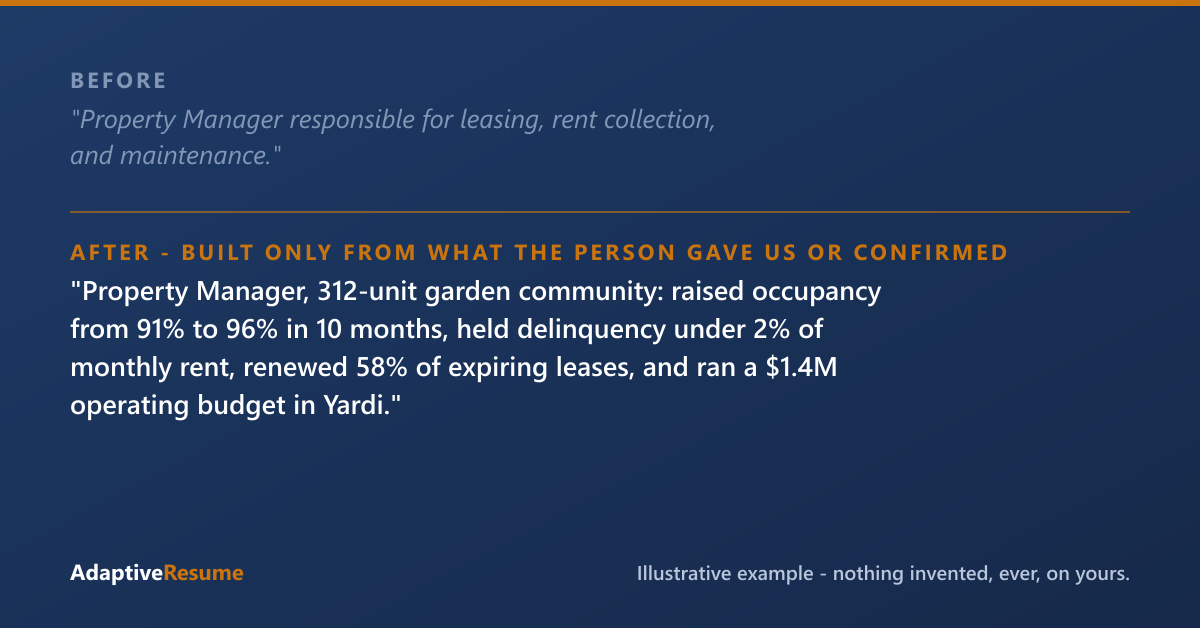
Illustrative example. Everything on your resume is yours: the experience you listed, plus the properties, credentials, and software your work already involved, each added only after you confirm it’s true.
The second version tells the reader the size and type of property in the first five words, then gives four numbers an owner recognizes. Each is a number a property manager tracks on the job, so use the figures you know from your own work.
The numbers an owner or regional manager reads
- Size and type. Units or doors for residential, square feet for commercial, and the property type: garden, mid-rise, single-family portfolio, student, senior, affordable, office, retail, or industrial. If you ran more than one site, give the count.
- Occupancy. Where it was when you started and where it was when you left, or your average across the year.
- Collections. Delinquency as a share of monthly rent, or the share of rent collected on time.
- Renewals. The share of expiring leases that renewed. A strong renewal rate saves an owner the cost of turning units.
- Turn time. How many days a unit sat between residents, and how many make-readies your team finished in a month.
- Maintenance. Work orders completed, how quickly urgent ones were handled, and any capital projects you oversaw, with the dollar amount if you know it.
- Budget. The operating budget you managed and how the property finished against it. Net operating income is useful too, but write the part you drove, such as cutting a contract cost, rather than claiming a market-wide rise in rents.
- People. The staff you supervised, the vendors you managed, and the residents or tenants you served.
Licenses and credentials, named exactly
State licensing. Whether a property manager needs a real estate license depends on the state and the work. The California Department of Real Estate has said there is no “property manager” license in California, and that leasing, renting, or collecting rent for an owner for pay requires a real estate broker license, or a salesperson working under a broker, unless a specific and narrow exemption applies. Owners managing their own property do not need a license, and state law has other narrow exemptions, so if you are unsure which rule covers your job, ask your employer’s broker of record or the Department of Real Estate. Other states set their own rules, so check with your state’s real estate commission, and if you hold a license, write it with the state: “Real Estate Salesperson License, California.”
Industry credentials. Name each one with its issuer, the way the certificate prints it:
- CALP (Certified Apartment Leasing Professional), from the National Apartment Association Education Institute (NAAEI). The CALP requirements are at least six months of on-site leasing experience, seven courses, and an exam within six months of becoming a candidate.
- CAM (Certified Apartment Manager), also from NAAEI. It requires at least 12 months of on-site property management experience, 40 hours of coursework, and an exam passed within six months.
- CPM (Certified Property Manager), from the Institute of Real Estate Management (IREM). It requires 36 months of qualifying real estate management experience, eight courses, and a two-part capstone that includes the certification exam.
- CMCA (Certified Manager of Community Associations), from the Community Association Managers International Certification Board (CAMICB), for managers of homeowners and condominium associations.
If you are working toward one, write it as in progress with an expected date: “CAM candidate, NAAEI, expected 06/2027.”
Fair housing training. The federal Fair Housing Act, enforced by the Department of Housing and Urban Development (HUD) and the Department of Justice, bars housing discrimination based on race, color, religion, sex, national origin, familial status, and disability, and many states and cities add protections of their own. Write the training you completed, the provider, and the year. It matters most for anyone who shows units or screens applications.
Leasing agents and leasing consultants
Leasing is often the first job in property management, and the resume should lead with leasing numbers:
- tours given per week or month
- applications processed
- leases signed, and the share of tours that became leases
- renewals you handled
- how quickly you followed up with prospects, if your system tracked it
Name your CALP if you have it, your fair housing training, and the software you used for leads and applications. If you are moving up to assistant manager, add the work you did beyond leasing: collections calls, move-in and move-out inspections, or covering the office when the manager was out.
Moving up from maintenance. If you are a maintenance technician or supervisor aiming for an assistant manager role, lead with the numbers you already own: work orders closed per month, make-readies finished, preventive maintenance schedules, and the vendor work you scheduled or checked. Name your CAMT (Certificate for Apartment Maintenance Technicians) from NAAEI if you hold it, along with any trade licenses or certifications.
Residential, commercial, and community associations
The numbers change with the property type, so match them to the jobs you want:
- Commercial property leans on square footage, lease administration, tenant improvement projects, and the yearly reconciliation of shared operating costs billed back to tenants.
- Community associations lean on board meetings, annual budgets and reserves, vendor contracts, and the rules and violation process the board sets.
- Affordable housing adds program compliance: income certifications, file audits, and inspections. Name the program, such as the Low-Income Housing Tax Credit program or HUD’s project-based Section 8 program, and your role in it.
If your experience is in hotels, our hotel manager resume guide covers that path; hotels use different numbers, such as average daily rate and revenue per available room.
Software and skills
Name the property management software you ran daily, such as Yardi, RealPage, AppFolio, Entrata, Buildium, Rent Manager, or MRI, and the parts of it you used: leasing, accounting, work orders, or reporting. Many postings ask for a specific system, and a recruiter’s search for that name finds the resumes that list it.
Skills worth naming, when they are true: budgeting and variance reports, lease enforcement, resident relations, vendor bidding and contracts, make-ready scheduling, rent collection, notices handled with the owner’s attorney, inspections, and staff training.
Format notes
- Use the title your employer used, and match the posting’s wording in your summary. “Community Manager” and “Property Manager” are often the same job, and O*NET lists both among the common titles for the work.
- Put the property size next to the title so a reader sees the scale before the bullets.
- Group several sites under one employer with the total, then a line for each site if the numbers differ.
- Keep the layout plain, with standard headings and no tables, so screening software reads every line.
Property manager resume bullets you can adapt — keep only what’s true
- “Managed a [number]-unit [type] community with [number] staff; raised occupancy from [X]% to [Y]% in [number] months.”
- “Held delinquency under [X]% of monthly rent by [your method, such as weekly collection calls and payment plans].”
- “Renewed [X]% of expiring leases over [period].”
- “Cut average turn time from [X] to [Y] days by [your change].”
- “Ran a $[amount] operating budget and finished [X]% under budget on [expense line].”
- “Leasing: gave [number] tours a month and signed [number] leases, a [X]% closing rate.”
What screening software looks for on a property manager resume
Filters commonly read for: property manager, community manager, assistant property manager, leasing consultant, leasing agent, occupancy, leasing, renewals, retention, delinquency, collections, rent roll, budget, variance, NOI, make-ready, turns, work orders, preventive maintenance, vendor management, fair housing, resident relations, lease enforcement, inspections, CAM, CALP, CPM, CMCA, real estate license, Yardi, RealPage, AppFolio, Entrata, Buildium, and MRI. O*NET’s profile for property, real estate, and community association managers has the full task list.
The lines most worth checking are the ones an owner can verify from a report: an occupancy figure you never reached, a budget you did not control, or a credential you have not finished. Write what you actually did.
The Role Skills Checklist below helps you list what your property management history actually proves, which is usually more than the resume currently says. Our build does it with you: we work backwards from the properties you ran and the roles you held, and we ask you about the numbers, the credentials, and the software that work like yours normally involves. Nothing goes on your resume that you didn’t give us or confirm, so a number, a credential, or a system you never told us about stays off the page.
Common questions
What numbers belong on a property manager resume?
Start with the size of what you ran: units or doors, square feet for commercial space, and the type of property. Then add the results an owner tracks: occupancy, collections or delinquency, lease renewals, how long a unit sat between residents, work orders, and the budget you managed. Use figures you know from your own work, never reports copied out of an employer's systems, and write the part you actually drove.
Do I need a real estate license to be a property manager?
It depends on your state and on what you do. In California, for example, the state's real estate regulator has said there is no separate property manager license, and that leasing or collecting rent for an owner for pay requires a real estate broker license or a salesperson working under a broker, unless a narrow exemption applies. If you are not sure which rule covers your job, ask your employer's broker of record or the California Department of Real Estate. Other states set their own rules, so check with your state's real estate commission. If you hold a license, name it and the state on your resume.
How is a leasing agent resume different from a property manager resume?
A leasing resume leads with leasing numbers: tours, applications, leases signed, the share of tours that turned into leases, and renewals. It also names your fair housing training and any leasing credential, such as the CALP. A property manager resume adds the budget, the staff, collections, and the condition of the property.
Which property management certifications matter most?
It depends on your path. The National Apartment Association Education Institute offers the CALP for leasing professionals and the CAM for apartment managers. The Institute of Real Estate Management offers the CPM for experienced managers. Community association managers often hold the CMCA from CAMICB. List the ones you have earned, with the issuer, the way your certificate prints them.
How do I show fair housing knowledge on a resume?
Name the training you completed, who gave it, and when, such as "Fair Housing Training, [provider], 2025." The federal Fair Housing Act bars discrimination based on race, color, religion, sex, national origin, familial status, and disability, and many states add more. A dated training line tells a hiring manager you know the rules before you show your first unit.
Role Skills Checklist
Pop your email in and the download unlocks right here. Joining our list also takes 25% off your first purchase within 30 days of joining, when you create your account with this same email. We'll also send the occasional useful note. No spam.
Download: Role Skills ChecklistThanks, you're on our list, and your download is ready just above. Your 25% off a first purchase is good for 30 days from the day this email joined our list.
That email didn't look right — mind trying it again?
Ready to do this on your own resume?
We'll find what you've left off, and nothing goes on your resume that you didn't give us or confirm.
Get your resume build — $29Every purchase is one payment, and nothing renews. A single resume build can be used any time within 12 months of buying it, and AR Pass builds you don't use end when its 90 days end.
Try the demo first — a sample review, no sign-up · See how the service works
Paid a resume service and got a template back? Start at Fix my resume.