Guides · For job seekers
Recruiter Resume: Reqs, Metrics, and Real Sourcing Proof
A recruiter resume gets read by another recruiter — the one audience that knows exactly which lines are filler. Lead with req load, time-to-fill, and offer-accept rate, name your ATS, and show sourcing you actually did.
Published 09/04/2026
A recruiter resume has the strangest audience in hiring: it gets screened by another recruiter, who writes these documents for a living and knows precisely which phrases carry no information. “Partnered with hiring managers to identify top talent” doesn’t survive that reader. Req load, fill numbers, and named tools do.
The good news is that recruiting is one of the few professions where the honest currency is already on your desk. You track requisitions carried, time-to-fill, offer-accept rate, and hires per quarter for your own reporting — the same numbers belong on the resume, stated truthfully, with the setting that gives them context.
Lead with the numbers you already track
Under each employer, give the desk in one line — setting, functions supported, req load — then let the bullets carry the metrics.
Before: “Responsible for full-cycle recruiting and sourcing candidates for open positions.”
After: “Carried [18-25] open reqs across engineering and product; filled [14] roles last quarter at a [38]-day average time-to-fill and a [92%] offer-accept rate.”
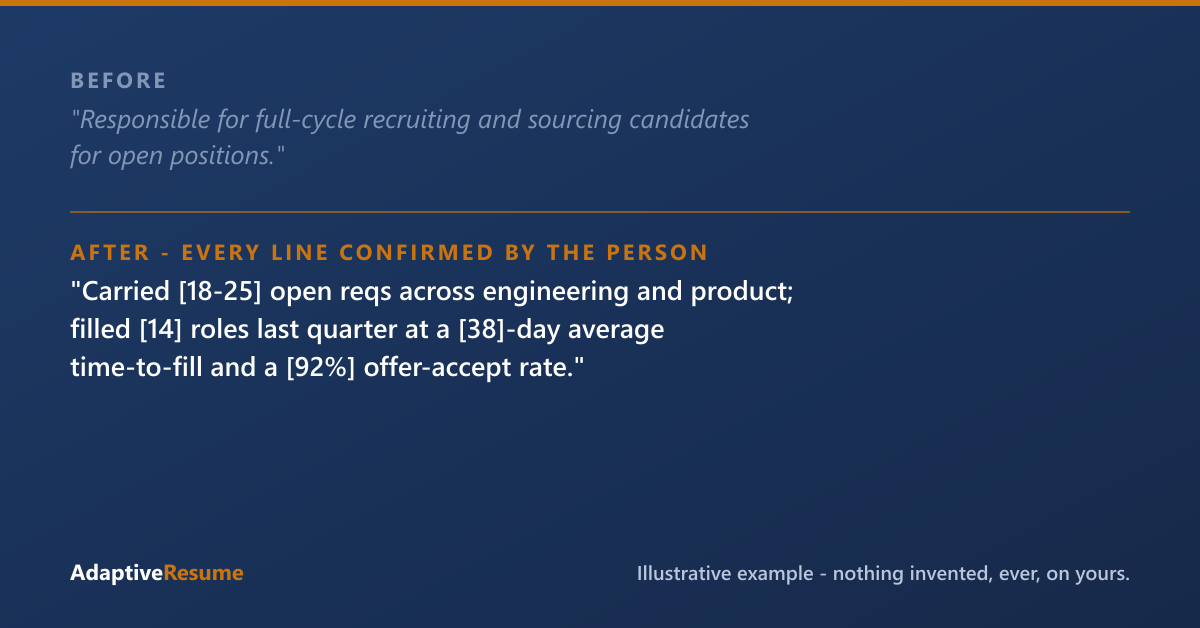
Illustrative example. On your resume, every line comes from your real history — proposed as a question, added only when you confirm it.
The second version answers in four seconds what the first leaves a reader guessing: how much you carry, how fast you close, and whether your offers stick. Every number is yours to fill in from your real reporting — and if you only have some of them, write the ones you have. Two true metrics beat five vague claims.
Agency, corporate, or RPO — name your setting first
The same title means different jobs in different settings, and the reader wants to know which one you did before anything else.
Agency recruiting is volume and speed: multiple clients, contingent or retained searches, submittals, and a fee number attached to your work. Honest agency lines name the desk (IT staffing, light industrial, executive search), the client mix, and submittal-to-interview ratios if you tracked them. If you work an agency desk and also care about the quality of the resumes you submit, our guide for staffing agencies covers that side of the work.
Corporate (in-house) recruiting is depth and partnership: fewer reqs, closer hiring-manager relationships, ownership of the process from intake to close, and accountability for quality of hire rather than placement count. Corporate bullets should show process ownership — intake meetings run, interview loops you built, debriefs you drove.
RPO — recruitment process outsourcing — sits between: you’re employed by a provider but embedded in a client’s process, often at high volume against service-level targets. Say the client’s industry, your req types, and the targets you worked against. RPO experience reads as both volume-capable and process-disciplined when it’s written concretely.
Full-cycle means stages — write the ones you owned
“Full-cycle recruiter” is a claim about scope, so back it with the stages: intake with the hiring manager, sourcing, screening, submittals, interview coordination, offer negotiation, and close. If you owned some stages and supported others, say which — a sourcer who writes “full-cycle” gets found out at the first interview question about comp conversations.
Sourcing is where craft shows. Name the real methods: Boolean search strings you build yourself, LinkedIn Recruiter (the paid product, with InMail response rates if you track them), niche boards for your vertical, referral programs you ran, and outreach sequences. “Sourced passive candidates” is a filler line; “built Boolean strings and LinkedIn Recruiter projects that produced [N] qualified submittals a week for niche engineering roles” is evidence.
Name your applicant tracking system (ATS) — the software that manages postings, candidates, and pipeline — because recruiting teams filter on it by name: Greenhouse, iCIMS, Workday Recruiting, or Bullhorn on the staffing side. State your true level, from daily pipeline work to owning configurations, reports, or an implementation.
The talent acquisition resume
Postings increasingly say “talent acquisition” where they used to say “recruiting,” and at some employers the phrase signals a broader mandate: workforce planning, employer brand, the EVP — employer value proposition, the honest pitch for why people join and stay — university programs, and recruiting operations. If you did that work, claim it specifically: career-site content you owned, hiring plans you built with finance, events you ran, metrics dashboards you stood up.
If your work was recruiting under a talent acquisition title, that’s fine too — write the recruiting truthfully and use both vocabularies where they’re accurate, because the screening software reads for the posting’s words. What you shouldn’t do is dress a sourcing seat as a strategy seat; the interviewer across the table runs the function and will ask exactly one question to check.
Certifications and compliance, exactly as held
Recruiting has real credentials, and they belong on the page precisely as issued:
- SHRM-CP and SHRM-SCP from SHRM (the Society for Human Resource Management) — the broad HR credentials, common in corporate seats.
- PHR (and the aPHR/SPHR ladder) from HRCI, the HR Certification Institute.
- AIRS certifications from AIRS, ADP’s recruiter-training arm — sourcing-focused credentials such as the Certified Internet Recruiter (CIR), the Professional Recruiter Certification (PRC), and the Certified Diversity and Inclusion Recruiter (CDR).
List the credential, the issuing body, and the real status — held, in progress with an exam date, or lapsed. The full HR credential ladder, and how it reads to HR screeners, is in our human resources resume guide.
Compliance awareness is legitimate resume material when you truly worked it: equal employment opportunity (EEO) requirements in your screening and interview process, and — if you recruited for a federal contractor — OFCCP (Office of Federal Contract Compliance Programs) obligations like applicant dispositioning and outreach records. State it as work you did (“maintained OFCCP-compliant dispositioning across [N] reqs”), not as legal expertise.
Niche and technical recruiting is a specialization — say yours
A recruiter who fills software engineers, travel nurses, or journeyman electricians has learned a vocabulary generalists don’t have, and it’s worth naming: the roles, the levels, the hard-to-fill titles you closed, and the market knowledge behind them (“recruited backend engineers through staff level; comfortable screening for distributed-systems experience”). Specialization is one of the strongest claims a recruiter resume can make, because it’s checkable in five minutes of conversation — which is exactly why it works when it’s true.
Format notes
Length follows your history, not a page rule. If you’ve run desks in two settings, built a function, or came into recruiting from the industry you now recruit for, that history is your edge — don’t crush it into one page to satisfy a convention. The honest rule: two pages is normal and expected once you have more than one substantive role to describe. Every line still has to earn its space — cut the duties every recruiter shares and keep load, metrics, tools, and scope.
One genuine exception: federal applications through USAJOBS cap at two pages as of the September 2025 OPM change. That’s a hard requirement, not a style preference.
Otherwise: reverse chronological, single column, a one-line desk description under each employer, and a labeled tools block for your ATS, sourcing platforms, and HRIS (HR information system) exposure. You know better than anyone what parsing does to a two-column resume with graphics — don’t submit the thing you’d flag.
A bullet bank you can adapt — keep only what’s true
- “Carried [N-N] open reqs across [functions/industries]; [N] hires per [quarter/year]”
- “Averaged [N]-day time-to-fill against a team benchmark of [N] days”
- “Maintained [N%] offer-accept rate across [N] offers extended”
- “Built Boolean and [LinkedIn Recruiter] pipelines producing [N] qualified submittals/week”
- “Achieved [N]:[N] submittal-to-interview ratio on [desk/client] roles”
- “Ran intake-to-close process for [N] hiring managers across [N] departments”
- “Administered [Greenhouse/iCIMS/Workday Recruiting/Bullhorn]: pipelines, reporting, [scheduling/configurations]”
- “Maintained EEO/OFCCP-compliant candidate dispositioning across [N] requisitions”
What screening software looks for on a recruiter resume
Filters commonly read for: full-cycle recruiting, talent acquisition, sourcing, Boolean search, LinkedIn Recruiter, passive candidates, pipeline development, applicant tracking system plus your specific ATS by name, requisitions, time-to-fill, offer negotiation, candidate experience, hiring manager partnership, interview coordination, employer brand, EEO, and OFCCP where relevant. O*NET’s Human Resources Specialists profile — the occupation that covers recruiters — lists the standard task set screening tools draw from.
The highest-risk lines are inflated ones: a “full-cycle” claim over a sourcing seat, a metric you can’t reproduce, a strategy mandate you didn’t hold. Recruiting is a small world with long memories, and your reader has caught every one of these before — on other people’s resumes and possibly while writing their own.
The Role Skills Checklist below helps you inventory what your desk actually proves — the reqs, tools, and process ownership that are probably underclaimed on your current resume. Our build does it with you: we work backwards from your real desks, systems, and metrics, propose what your history suggests one finding at a time, and ask you to confirm every item before it appears. We never add a credential, a metric, or a platform you didn’t tell us about.
Common questions
Do recruiter certifications actually matter on the resume?
Less than your numbers do, but they're never wasted. SHRM-CP or PHR reads well for corporate seats, and AIRS training shows sourcing craft. List exactly what you hold, with the issuing body, and let req load and fill history carry the argument. No certification substitutes for a real time-to-fill line.
How do I move from agency to corporate — does agency experience count against me?
No — it's evidence of volume and pace, and corporate teams hire out of agencies constantly. Write the agency work truthfully: desk type, industries, placements, fee or submittal metrics. Then let bullets show the parts corporate cares about — hiring-manager relationships, quality of hire, process ownership — not just the placement count.
My company never tracked my metrics. What do I put?
Reconstruct honestly from what you know: your ATS history, offer letters you moved, your own tracker. Approximations marked as approximations ("~[N] hires/year") are fine. What's not fine is inventing a number — a hiring leader who runs the same reports can smell an invented offer-accept rate in one question.
Should my resume say recruiter or talent acquisition?
Keep your real title, and use the posting's language in your summary and skills lines. If your title was Recruiter and the target posting says Talent Acquisition Partner, a summary line like "full-cycle recruiter (talent acquisition) across [functions]" honestly covers both vocabularies without inflating anything.
Role Skills Checklist
Pop your email in and the download unlocks right here — and being on the list before launch day locks in 25% off your first build. We'll also send the occasional useful note and tell you the moment AdaptiveResume goes live. No spam.
Download: Role Skills ChecklistThanks — you're on the launch list, your 25% is locked in, and your download is ready below.
That email didn't look right — mind trying it again?
Ready to do this on your own resume?
We'll find what you've left off and you approve every line — nothing made up.
Build your resume — $49Try the demo first — a sample review, no sign-up · See how the service works
Paid a resume service and got a template back? Start at Fix my resume.