Guides · For job seekers
How to List a GED on a Resume, and When to Leave It Off
A GED meets the "high school diploma or equivalent" line on a job posting. Here's the exact wording to use, where the line goes, when the year helps or hurts, and how to make the education section show everything you've earned since.
Published 10/28/2026
For a lot of jobs, the education line is a yes-or-no check: does this person have a high school diploma or the equivalent? A GED answers that question with a yes. The line only needs to be accurate, clear to screening software, and placed where a hiring manager or recruiter can find it in a glance.
For most people with work experience, the GED line itself is short. The real chance is everything you can put next to it: the licenses, certifications, trade training, and college credits you have earned since.
The education section, written the way a recruiter reads it
Before: “GED.”
After: “Education and Training: California High School Equivalency Certificate (GED). 12 college credits toward an associate degree in business, [Community College]. Commercial Driver’s License, Class A.”
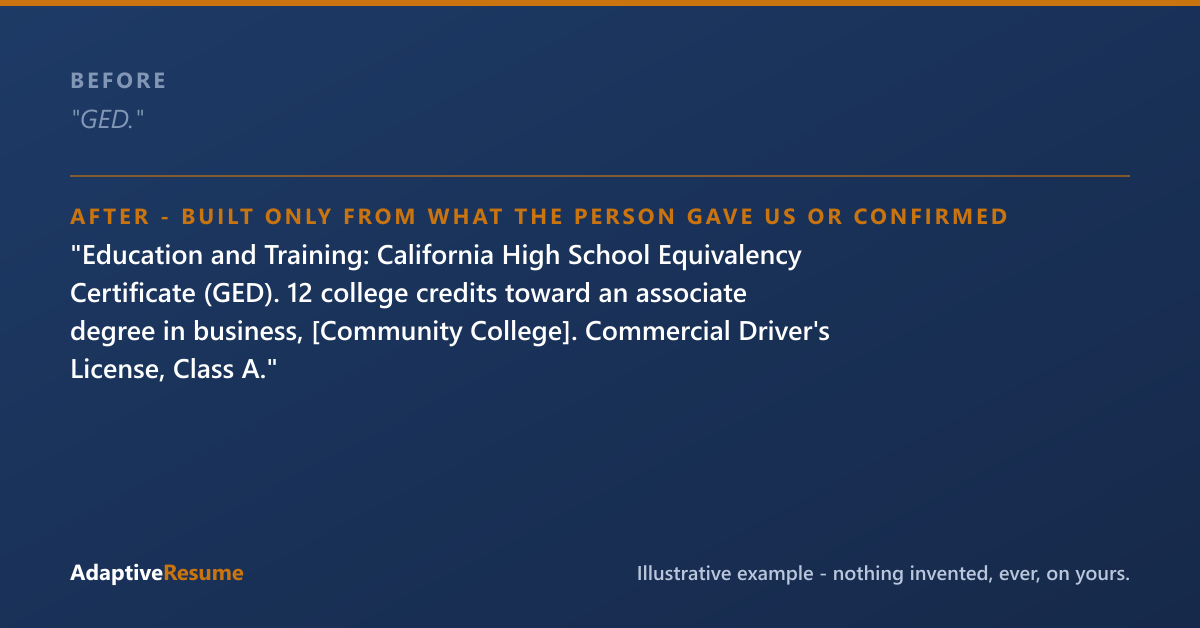
Illustrative example. Everything on your resume is yours: the experience you listed, plus the credentials and training your work already involved, each added only after you confirm it’s true.
The second version names the credential the way the certificate prints it, keeps “GED” in parentheses so a search for either term finds it, and shows the college work and the license that a single word left out.
Write what your credential actually is
“GED” is the name most readers know. The GED test has four subjects: Mathematical Reasoning, Reasoning Through Language Arts, Science, and Social Studies. Passing all four, and meeting your state’s age and residency rules, earns a high school equivalency credential, and you receive a diploma or certificate through your state’s program.
Your state may use its own name. California, for example, issues the California High School Equivalency Certificate. If your document has a name like that, you can write it out and add “(GED)” after it, which covers both the official wording and the term a recruiter searches for.
Some states offer a second exam. The California Department of Education approves two high school equivalency tests, the GED and the HiSET. If you passed the HiSET, write “High School Equivalency (HiSET)” or your state’s credential name, the same way.
Don’t write “High School Diploma” unless that is the name on your document. Writing a plain “High School Diploma” when your certificate says something else can turn a harmless line into a question about honesty when an employer checks. A few states do use the word diploma: New Jersey issues a state-issued high school diploma to people who pass the GED, and Pennsylvania issues the Commonwealth Secondary School Diploma. If yours does, write the full name and add “(GED)” after it.
Where the line goes
- If you have work experience, the education section goes near the bottom, after your experience and any licenses or certifications. A hiring manager reads your work first, and your work is the stronger part of the page.
- If you have little or no work history, education can sit higher, right after a short summary, so the reader sees your credential and any training up front.
- Give it a plain heading, such as “Education” or “Education and Training.” Screening software looks for standard headings, and our guide on what screening software reads shows why unusual ones can get missed.
The year: when it helps and when it doesn’t
The year you earned a GED is optional. The credential does not expire, so the date adds nothing a recruiter needs for most jobs.
Leave it off if you earned it a long time ago and your work history already shows your experience; leaving it off also keeps the focus on your experience rather than your age. Include it if you earned it recently and it explains why your work history is short, or if an online application asks for the year in a form field. Whatever you choose, keep it consistent with the rest of the resume: if your other education and training lines have years, this one can too.
Application forms and screening questions
Many online applications ask a yes-or-no question, such as “Do you have a high school diploma or equivalent?”, before anyone reads your resume. With a GED, the honest answer is yes. The US Department of Education lists the GED as a recognized equivalent of a high school diploma.
If a form gives separate choices, such as “High School Diploma” and “GED or High School Equivalency,” choose the equivalency option. It meets the same requirement, and it matches the document an employer may verify. If a form asks for a school name, enter the adult education center or testing center where you tested, or follow the form’s instructions for equivalency credentials, rather than leaving the field blank.
GED lines you can adapt
Keep only what is true of you, and write each credential the way your documents print it:
- “High School Equivalency (GED), [State]”
- “[State] High School Equivalency Diploma (GED)” if your certificate uses those words
- “High School Equivalency (HiSET), [State]”
- “GED, in progress: [number] of 4 subjects passed, expected [month/year]”
- “GED, [State]. [Number] college credits in [subject], [College]“
When to leave the GED off
If you have an associate, bachelor’s, or higher degree, the degree usually covers it, and the line is better spent on a license or a certification. Two exceptions are worth keeping:
- The posting or application asks for it. Some applications ask specifically about high school completion. Answer the form honestly; the resume line is optional in that case.
- Your college work did not end in a degree. “GED” plus “24 college credits in nursing prerequisites, [College]” tells a fuller story than either line alone.
Make the education section show what you’ve earned since
This is where most GED holders undersell themselves. The education section can hold more than a school name:
- Licenses and certifications, such as a CDL, a state trade license, a CNA certification, or a forklift card, each named the way the card prints it. Our guide on how to list certifications covers the format line by line.
- Trade and apprenticeship training, with the program name and the hours if you know them.
- College credits, with the count and the subject, even if you have not finished a degree.
- Military training, written in civilian terms.
- Workplace training that ended in a certificate, such as a safety course or a vendor certification.
If you have a lot of these, split them into two sections, “Licenses and Certifications” and “Education,” so each one is easy to find.
Still testing? Write it as in progress
If you are working toward a GED, you can list it honestly as in progress, with the subjects you have passed and a realistic expected date: “GED, in progress: 3 of 4 subjects passed, expected 03/2027.” Some postings require the credential before you start, so read the requirement before you apply, and update the line as soon as you pass.
Do GED scores belong on a resume?
For most jobs, no. Passing is what an employer checks. The GED Testing Service sets the passing score at 145 on each subject, and it describes two higher levels: 165 to 174 is GED College Ready, and 175 to 200 is GED College Ready + Credit, which it says could qualify you for up to 10 college credit hours, depending on the college.
Scores can help when you are applying to a college program, an apprenticeship, or a training program that looks at academic readiness. In that case, a short line such as “GED College Ready score level in Mathematical Reasoning” is accurate and useful. Write the level your transcript shows, and nothing higher.
If an employer checks
Employers that verify education can check a GED the same way they check a diploma. The official GED site lets a third party, such as an employer, order a transcript or verification on someone’s behalf. Your diploma or certificate shows that you earned the credential, and your transcript lists the subjects you took and your scores. Keep a copy of each where you can find it, because some employers ask for one before your first day.
How we help
When we build your resume with you, the education section gets the same attention as your work history. We ask about your credential and about the licenses, training, and college work that sit alongside it, and we help you write each one the way the document prints it. Nothing goes on your resume that you didn’t give us or confirm, so a course, a credit, or a certification you never told us about stays off the page. The Certification Section Cheat-Sheet below shows the format for each kind of line.
Common questions
Is a GED the same as a high school diploma on a resume?
For a job posting that asks for a high school diploma or equivalent, a GED meets the requirement, and the US Department of Education lists the GED as a recognized equivalent of a high school diploma. If a posting asks for a high school diploma with no "or equivalent," ask the employer. On the resume itself, write what your credential actually is. Writing a plain "High School Diploma" when your document says something else is the kind of detail an education check can catch. If your state's certificate uses its own name, such as the California High School Equivalency Certificate, you can use those words, because they are the words on your document.
Should I put the year I earned my GED?
You can leave it off. The credential does not expire, and many people leave graduation years off once they have years of work experience. Include the year if you earned it recently and it explains a short work history, or if an application form asks for it.
Do I list my GED if I have a college degree?
Usually not. Your highest credential covers it, and the space is better used for the degree, a license, or training. List the GED if a posting or application asks for it by name, or if your college work did not end in a degree and you want the reader to see both.
Can I list a GED I'm still working on?
Yes, if you are actively testing. Write it as in progress with the subjects you have passed and an expected month and year, such as "GED, in progress: 3 of 4 subjects passed, expected 03/2027." Update it as soon as you pass.
How does an employer check a GED?
Through the testing service or the state. The official GED site lets a third party, such as an employer, order a transcript or verification on someone's behalf, and the diploma or certificate is issued under the rules of the state where you tested. Keep your own copy ready in case an employer asks.
Certification Section Cheat-Sheet
Pop your email in and the download unlocks right here. Joining our list also takes 25% off your first purchase within 30 days of joining, when you create your account with this same email. We'll also send the occasional useful note. No spam.
Download: Certification Section Cheat-SheetThanks, you're on our list, and your download is ready just above. Your 25% off a first purchase is good for 30 days from the day this email joined our list.
That email didn't look right — mind trying it again?
Ready to do this on your own resume?
We'll find what you've left off, and nothing goes on your resume that you didn't give us or confirm.
Get your resume build — $29Every purchase is one payment, and nothing renews. A single resume build can be used any time within 12 months of buying it, and AR Pass builds you don't use end when its 90 days end.
Try the demo first — a sample review, no sign-up · See how the service works
Paid a resume service and got a template back? Start at Fix my resume.