Guides · For job seekers
How to List a Security Clearance on a Resume (Without Overstating It)
Where a security clearance goes on a resume, the exact line to write, what 'active' versus 'eligible' really means, why Public Trust and polygraphs are not clearances — and what never belongs on the page.
Published 09/08/2026
A clearance took months of your life — the SF-86 (Standard Form 86, the Questionnaire for National Security Positions), the interviews, maybe a polygraph. For cleared roles it is the first thing a recruiter checks. Then it shows up as “cleared for government work” in a skills list, or worded so loosely that a security officer reads it as a claim you cannot back.
Here is where the clearance goes, what the line should say, what “active,” “current,” and “eligible” actually mean, why Public Trust and polygraphs are not clearances, and what never belongs on the page. This topic is full of folklore — and a security officer will check.
Where a security clearance goes on a resume
Two places work, and both are near the top:
- Directly under your name and contact block, as a single line: “Active Secret clearance — DoD (Department of Defense), eligibility granted [month/year].” This is the standard placement for cleared contractor and defense roles, where the clearance is a requirement rather than a bonus.
- As the first line of a labeled section — Clearance & Credentials or Security Clearance — right after your summary, above Experience. Use this when you also hold licenses or certifications and want them in one block (see how to list certifications on a resume for those lines).
What does not work: burying it in a skills list or inside a job description on page two.
The clearance line: level, status, date
One line, in this shape:
Status + Level — Granting agency, investigation or eligibility date
- Active Secret clearance — DoD, eligibility granted [month/year]
- Active Top Secret/SCI — DoD, investigation completed [year]
- Top Secret eligibility current — last held access [month/year] at [employer]
- Interim Secret granted [month/year]; final adjudication (the government’s final decision) pending
The three clearance levels are set by Executive Order 13526: Confidential, Secret, and Top Secret, tied to the damage unauthorized disclosure could cause (damage, serious damage, exceptionally grave damage). Write the level exactly as it appears on your record. SCI (Sensitive Compartmented Information) is not a fourth level — it is access eligibility that sits on top of Top Secret, which is why the accepted shorthand is “TS/SCI” or “Top Secret/SCI.” Never write “SCI clearance” alone.
The date matters because clearances rest on an investigation, and an investigation ages. Background investigations for DoD and most federal agencies are run by DCSA (the Defense Counterintelligence and Security Agency). Job postings still name the legacy investigation tiers — Tier 3 (T3) for Secret, Tier 5 (T5) for Top Secret — and if your record shows one, you can write it: “T5 completed [year].” DoD clearance holders are also enrolled in Continuous Vetting (CV), the automated record-check program that replaced periodic reinvestigations under the Trusted Workforce 2.0 reform; “enrolled in Continuous Vetting” is a true, useful phrase if it applies to you.
If you are not sure of your eligibility date, ask an FSO (facility security officer) before you write one. Your record lives in a government system — for DoD it is DISS (the Defense Information System for Security, which replaced JPAS, the Joint Personnel Adjudication System, in 2021) — and the FSO can read it. You cannot. Guessing a year on a checkable line is the one mistake this section cannot survive.
Active, current, eligible: three words that mean different things
- Eligibility is the government’s adjudicated decision, on your record, that you may be granted access at a level.
- Access is being read in (formally briefed and given access) to classified information for a specific job. It ends when you leave that job.
- Active is the everyday word for holding access right now.
So: if you are in a cleared job today, “Active Secret clearance” is true. If you left that job, your access ended but your eligibility may still be current — write “Secret eligibility current, last held access [month/year].” That is the honest version, and exactly what a security officer wants to know.
You may have heard a fixed number of months after which eligibility “expires.” The number you have heard is probably “24 months,” and it is real but narrower than the folklore: DoD’s personnel security manual (DoDM 5200.02) treats a break in employment or access of more than 24 months as the point where your old eligibility is no longer simply carried forward and a new investigation may be needed. The contractor rule (32 CFR Part 117, the NISPOM — National Industrial Security Program Operating Manual — rule) and SEAD 7 (the Security Executive Agent Directive on reciprocity) set no month count; they look at the state of your record and the age of your investigation. State what your record shows and let the FSO confirm the rest.
What a clearance is not
Public Trust is not a clearance. A Public Trust position is a suitability designation under OPM (Office of Personnel Management) rules — 5 CFR Part 731 designates moderate- and high-risk positions as public trust. It governs fitness for the job, not access to classified information. List it truthfully, under its own label: “Public Trust (moderate risk) — [agency], [year].” “Public Trust clearance” reads as a misunderstanding to anyone who handles clearances for a living.
A polygraph is not a clearance level. Some agencies require a polygraph as a condition of access. SEAD 2 (Security Executive Agent Directive 2) distinguishes a counterintelligence-scope polygraph (CI — questions about espionage, sabotage, terrorism, unauthorized disclosure, foreign contacts, and misuse of government systems) from an expanded-scope polygraph (often called full-scope or lifestyle, which adds questions on criminal conduct, drug involvement, and falsification of security forms). If you passed one for an employer, add it to the line — “TS/SCI with CI polygraph ([year])” — and write only the type you actually took.
DOE uses different words. The Department of Energy grants Q and L access authorizations rather than Secret and Top Secret. DOE’s own guidance describes L as corresponding to Confidential and Secret access and Q to Top Secret access. If your record says Q, write “DOE Q access authorization — [site], [year],” not “Top Secret.”
“Clearable” is not a status. Only the government decides eligibility, and only a sponsoring employer can start the investigation. “Clearable” is a prediction about a decision no one has made. If a posting says “must be able to obtain a clearance,” state the real requirement you meet — “U.S. citizen” — and leave the prediction off.
What never goes on the page
The clearance line is about you. What you did under it is not yours to publish.
- No classified program names, code words, or compartments.
- No project details from a classified environment. Describe the skill (“led a [N]-person team maintaining a [system] network”), not the mission.
- No customer or contract names when the contract itself is classified. “[Agency] customer” is usually the ceiling — and if your FSO says the customer itself is not releasable, leave it off.
- Nothing from your SF-86. Foreign contacts, finances, and travel history belong to the investigation, not the resume.
When in doubt, ask your FSO whether a line is releasable.
Format notes
Reverse chronological, single column, no graphics, no photo. Two pages is normal once you have more than one substantive role, and cleared careers usually do. The one exception is federal: applications through USAJOBS cap at two pages as of the September 2025 OPM change, so a federal resume needs the clearance line on page one and nothing that pushes it past two.
Coming out of uniform? The clearance line pairs with the translation work in our military-to-civilian resume guide. Leaving a federal role for industry? See the government-to-private resume guide — your clearance is often the strongest thing you carry across.
A bullet bank you can adapt — keep only what’s true
- Active Secret clearance — DoD, eligibility granted [month/year]
- Active Top Secret/SCI — DoD, investigation completed [year]; enrolled in Continuous Vetting
- TS/SCI with CI polygraph ([year]) — [agency] customer
- Secret eligibility current — last held access [month/year] at [employer]
- Interim Secret granted [month/year]; final adjudication pending
- DOE Q access authorization — [site], [year]
- Public Trust (moderate risk) — [agency], [year] (listed under its own label, never as a clearance)
- U.S. citizen (only when a posting requires the ability to obtain a clearance)
What screening software looks for on a cleared resume
Recruiters for cleared roles filter on exact terms, so use them: Secret, Top Secret, TS/SCI, clearance, active, DoD, CI polygraph or full-scope polygraph (only if held), Q clearance or L clearance for DOE work, Public Trust (under its own label), T3 or T5 if your record shows it, eligibility, and Continuous Vetting. Write both “Top Secret/SCI” and “TS/SCI” — you cannot know which one the search uses.
The three classification levels and their definitions come from Executive Order 13526, hosted by the National Archives’ Information Security Oversight Office (ISOO): Executive Order 13526 — Classified National Security Information.
A before-and-after
Before: “Security clearance, cleared for government work.”
After: “Active Top Secret/SCI — DoD, investigation completed [year]; enrolled in Continuous Vetting.”
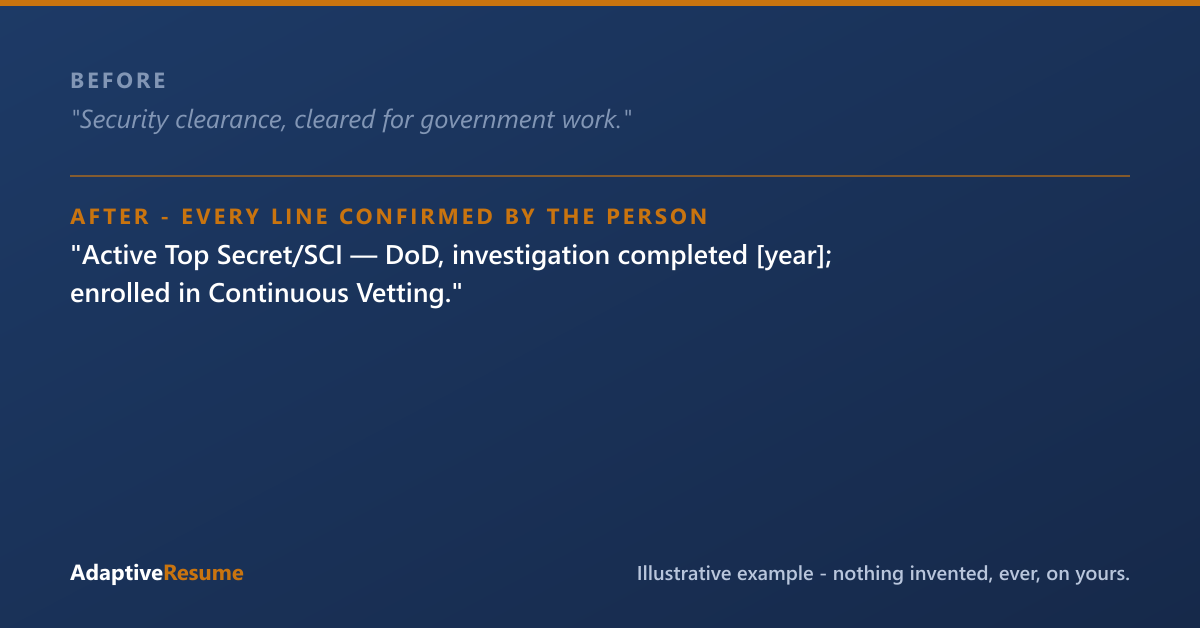
Illustrative example. On your resume, every line comes from your real history — proposed as a question, added only when you confirm it.
Same person, same clearance — no new facts added. The rewrite names the level exactly, states the status honestly, and gives the one date a security officer will check. The whole job of this line is to survive the question “can the FSO confirm that?”
How we handle clearances
When we build your resume, we work backwards from what your work actually involved — and a clearance gets the strictest treatment of anything on the page, because it is the most checkable. We ask what your record shows, exactly as it reads, and place it where it carries the most weight for the job you are after. We never guess a level, a date, or a polygraph, and we never write “clearable.” Nothing lands on the page without your say-so — and nothing goes on it that your FSO could not confirm tomorrow. Grab the Clearance Line Cheat-Sheet below for the format lines to copy.
Common questions
Where should a security clearance go on a resume?
Near the top. If the posting requires a clearance, put a one-line clearance statement directly under your name and contact block, or as the first line of a Clearance & Credentials section right after your summary. Recruiters for cleared roles look for it before they read anything else.
What is the difference between an active clearance and clearance eligibility?
Eligibility is the government's decision, on your record, that you may be granted access at a level. Access is being read in (formally briefed and given access) to classified information at a current employer. 'Active' is the everyday word for holding access right now. If you left a cleared job, write 'eligibility current, last held access [month/year]' — not 'active'.
Is a Public Trust position a security clearance?
No. Public Trust is a suitability determination under OPM (Office of Personnel Management) rules for moderate- and high-risk positions. It does not grant access to classified information. List it honestly under its own label — 'Public Trust (moderate risk), [agency], [year]' — never as a clearance level.
Can I write 'clearable' on my resume?
We recommend against it. 'Clearable' is a prediction, not a status — only the government decides eligibility, and only an employer can sponsor the investigation. If a posting says you must be able to obtain a clearance, state the real requirement you meet ('U.S. citizen') and leave the prediction off.
Clearance Line Cheat-Sheet
Pop your email in and the download unlocks right here — and being on the list before launch day locks in 25% off your first build. We'll also send the occasional useful note and tell you the moment AdaptiveResume goes live. No spam.
Download: Clearance Line Cheat-SheetThanks — you're on the launch list, your 25% is locked in, and your download is ready below.
That email didn't look right — mind trying it again?
Ready to do this on your own resume?
We'll find what you've left off and you approve every line — nothing made up.
Build your resume — $49Try the demo first — a sample review, no sign-up · See how the service works
Paid a resume service and got a template back? Start at Fix my resume.