Guides · For job seekers
Substitute Teacher Resume: Assignments, Permits, No Experience
Substitute teacher hiring reads for one thing: can a principal put you in a room tomorrow? How to show districts, grade bands, long-term assignments, and your permit exactly as held — including when you have no classroom experience yet.
Published 09/08/2026
Substitute teacher hiring runs on one question: can the principal put you in a room tomorrow and trust the day to go fine? The person reading your resume — a human resources coordinator, then a principal — wants to know which districts have already cleared you, which grade bands you’ve handled, whether you’ve carried a long-term assignment, and whether your permit is in order. Generic language (“flexible educator passionate about student success”) answers none of that. The specifics do.
The other thing that trips up a substitute teacher resume is treating subbing as one blurry job. Day-to-day work in [40] classrooms a year, a [12]-week long-term assignment where you carried the grading, and a special education inclusion placement are three different kinds of experience, and each deserves its own line.
The assignment line: your scope in one sentence
Under each district or staffing firm, give one line a principal would recognize instantly.
Before: “Substitute teacher for various grade levels and subjects as needed.”
After: “Substitute teacher, [District] Public Schools, grades K–[8]; [90]+ day-to-day assignments a year across [11] schools, plus a [9]-week long-term assignment in [7th-grade math] carrying the grading and parent contact; scheduled through [Frontline].”
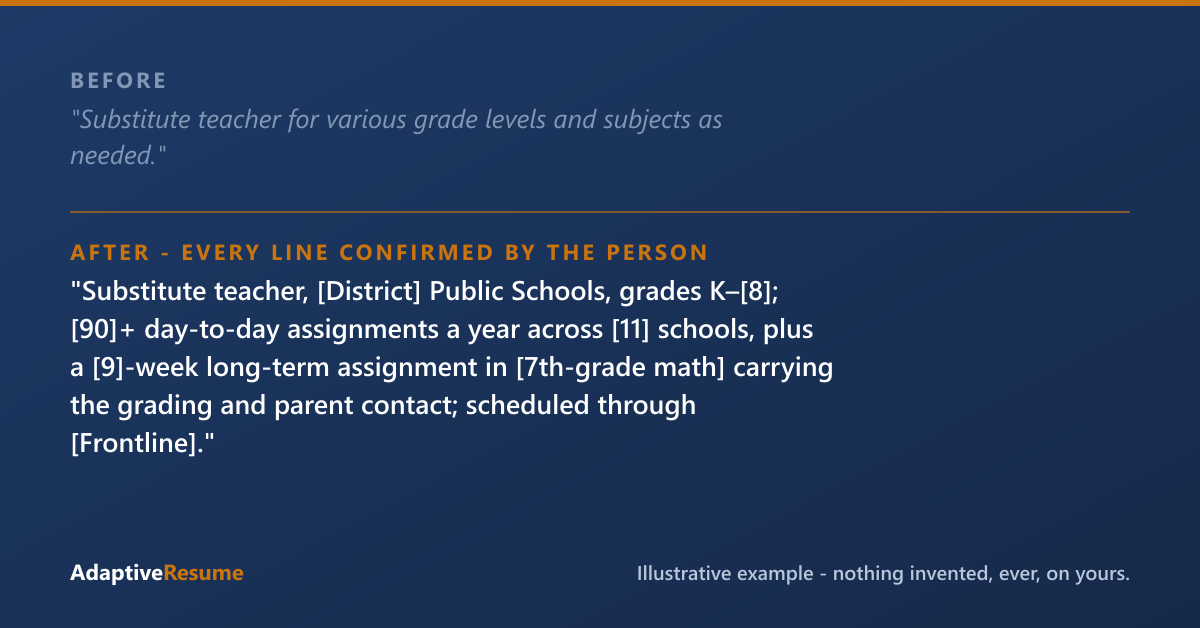
Illustrative example. On your resume, every line comes from your real history — proposed as a question, added only when you confirm it.
The second version is scannable in four seconds: the district, the grade bands, the volume, the long-term work, and the system you already know. The rewrite invents nothing. Fill the brackets with your real districts and numbers.
Credentials, exactly as your state grants them
There is no national substitute teaching credential. Every state sets its own rules for who can substitute — and some districts add their own on top. The requirements vary widely: some states require a bachelor’s degree, some a set amount of college coursework, some a high school diploma plus a training course. The names vary too: permit, license, certificate, authorization. So write the name your state uses, the year, and its true status, and put it near the top where it can be found in two seconds. Our guide on how to list certifications on a resume covers placement and format; here is what typically belongs in a substitute’s block:
- Your state substitute credential, named the way your state names it: “[State] substitute teaching permit, [year].”
- A full teaching certificate, if you hold one. This leads the block. Write the state, the area, and the grade band — “[State] Professional Teaching Certificate, Elementary Education K–6.” A retired or expired certificate still belongs on the page, labeled honestly with its status and year.
- Fingerprint and background clearance. Districts run this before they place you; the process is set by your state and district. Name where it was done and when: “Fingerprint background clearance, [state/district], [year].”
- CPR (cardiopulmonary resuscitation) and first aid, where districts ask for them, with the provider and current-through date.
- Your degree or program in progress. Education students: “Bachelor of Science, Secondary Education — expected [month/year].”
List exactly what you hold, with real status. Nothing “pending” unless it’s labeled that way — “[State] substitute permit, application submitted [month/year]” is honest and reads fine. Districts check credentials before placing you, so an overstated line is caught early.
The parts of the job that carry the most weight
Long-term assignments. Subject, grade, length in weeks, and what you carried: lesson planning (yours or the teacher’s), grading, parent contact, IEP (individualized education program) meetings. A [12]-week assignment where you planned and graded is teaching experience, and it should read like it.
Day-to-day frequency and range. How many assignments a year, how many schools, which grade bands and subjects. “Regularly requested by [N] schools” is worth writing if it’s true — it’s the substitute’s version of a reference.
Classroom management. Every principal reads for this. Say what you actually do: running the posted routines, keeping the day on schedule, documenting behavior incidents for the returning teacher. Concrete beats “strong classroom management skills.”
Lesson-plan execution. Following a teacher’s plan is the core of short-term work, and it takes judgment — adjusting pacing, keeping students working when the plan runs short, leaving clear notes on what got done.
Special education and inclusion support. Covering a resource room, co-teaching in an inclusion classroom, supporting students with IEPs or 504 plans (accommodation plans under Section 504 of the Rehabilitation Act), working alongside paraprofessionals. Name the setting and the support you gave. If many of your assignments land here, our special education teacher resume guide covers the vocabulary those postings use.
Platforms and staffing firms. Frontline (formerly Aesop) is the absence and substitute-scheduling system many districts run, and listing it shows you already know how placements work. If you sub through a staffing firm such as Kelly Education or ESS, list the firm as the employer and the districts you were placed in beneath it. Google Classroom and Canvas belong here too.
No experience yet: what goes on the page
If you’ve never held a classroom assignment, you are not starting from nothing. What a district needs to see is that you’re cleared to work and that you’ve run a group of young people before — and many people have, under a different name.
Lead with the credential block above: the permit, the clearance, the degree or program in progress.
Then write the experience that proves the room won’t fall apart. Tutoring, coaching a team, running a camp cabin or after-school program, teaching Sunday school, childcare, leading a scout troop, training new hires at a retail job. Each gets the same treatment a classroom would: the ages, the group size, how long, and what you were responsible for. “Head counselor, [camp], [3] summers; led a cabin of [12] boys ages [9–11] and ran the daily schedule” is real, nameable evidence of the job’s core skill.
Education students: your student-teaching and field placements are experience — list the school, the grade, the weeks, and whether you taught full lessons. Paraprofessionals moving up: your classroom years are the strongest thing you have; the paraprofessional resume guide covers how to write them.
Don’t pad. A single true line about coaching [15] kids beats three lines of “passionate about education.”
Format notes
Length follows your history, not a page rule. One page is right for many substitutes and for anyone building a first classroom resume. Two pages is normal once you have more than one substantive role to describe. Order matters more than length: credential block near the top in its own labeled section, then experience with an assignment line atop each district or firm.
One genuine exception worth knowing: federal applications through USAJOBS cap at two pages as of the September 2025 OPM change. That’s a hard requirement, not a style preference.
Otherwise: reverse chronological, single column, standard headings, real text rather than graphics or tables. District applicant systems parse plain layouts most reliably. Skip the graphics.
A bullet bank you can adapt — keep only what’s true
- “Substitute teacher, [District], grades [K–5]; [N] day-to-day assignments per year across [N] schools”
- “Long-term substitute, [subject], grade [N], [N] weeks; planned and taught [N] sections, carried grading and parent contact”
- “Followed teacher lesson plans across [subjects]; left end-of-day notes on coverage and student concerns for every assignment”
- “Covered [resource/inclusion] classrooms; supported students with IEPs alongside [N] paraprofessionals”
- “Regularly requested by [N] schools; accepted [N]% of offered assignments through [Frontline]”
- “Placed through [Kelly Education/ESS] in [N] districts; cleared in [state/district], [year]”
- “Tutored [N] students in [subject], ages [N–N], [N] hours per week for [N] months” (for first-time substitutes)
Each bullet is a frame, not a claim. If a line isn’t true of your work, it doesn’t go on your page — a principal’s first question on the phone will find it.
What screening software looks for on a substitute teacher resume
District applicant systems and staffing-firm filters read for the vocabulary of the job. The terms that typically matter: substitute teacher, substitute permit, long-term substitute, day-to-day, classroom management, lesson plans, the grade levels you name (elementary, middle school, high school, K–12), special education, inclusion, IEP, 504 plan, paraprofessional, fingerprint clearance, background check, CPR, first aid, Frontline, Aesop, Google Classroom, and the names of your districts.
One honesty note on job codes: O*NET profiles this work under Substitute Teachers, Short-Term (25-3031.00), and its task list — following the absent teacher’s lesson plan, taking attendance, enforcing class rules, supervising students outside the classroom — is a useful checklist for your day-to-day lines. Long-term work overlaps with the regular teaching occupations, which is exactly why those assignments need their own lines with subject, weeks, and what you carried. Our teacher resume skills guide covers the classroom skills a full-time teaching posting reads for.
The highest-risk lines are the ones that overstate scope — a long-term assignment written as if you planned it when you followed the teacher’s plans, a permit listed as held when it’s still pending, a clearance from a state you no longer work in. Districts check, and the substitute world in any region is small enough that they check informally too.
The Role Skills Checklist below helps you inventory what your classroom days actually prove, which is often considerably more than the resume currently says. Our build does it with you: we work backwards from your real districts, assignments, and credentials, propose the lines and scope that history supports — each one offered as a question, not a decision made for you — and ask you to confirm every item before it appears. We never add a permit, a district, or an assignment you didn’t tell us about.
Common questions
Do I need a teaching license to be a substitute teacher?
It depends on your state, and sometimes on the district. Substitute permits, licenses, and certificates are granted state by state, and the requirements vary widely — some states ask for a bachelor's degree, some for a set amount of college coursework, some for a high school diploma plus training. Check your state's education department and write exactly what you hold: '[State] substitute teaching permit, [year].' If you hold a full teaching certificate, lead with it.
How do I write a substitute teacher resume with no experience?
Lead with the permit and clearances you already hold, then show the work that proves you can run a room — tutoring, coaching, camp or after-school leadership, childcare, church or youth programs, training adults on the job. Name the ages, the group sizes, and how long you did it. Write the credential you're finishing honestly: 'Bachelor of Arts, Elementary Education — expected [month/year].' Don't pad it with a duty you never had.
How do I show a long-term substitute assignment?
Give it its own line, the way a teacher would. Subject, grade, the length in weeks, and what you actually carried: whether you wrote the lesson plans or followed the teacher's, whether you did the grading, whether you ran parent contact and attended IEP meetings. 'Long-term substitute, [7th-grade science], [12] weeks; planned and taught [5] sections, carried grading and parent contact' tells a principal what nine words of 'various duties' never could.
I'm a retired teacher. Do I list my whole career?
List it, but trim it. Your years of full-time teaching are the strongest thing on the page, so keep the schools, subjects, grade bands, and any leadership roles, and cut the older detail that no longer helps. Write your certificate exactly as it stands now — current, retired, or expired with the year — and put your substitute permit next to it if your state issues a separate one. Nothing on the page should read as more current than it is.
Role Skills Checklist
Pop your email in and the download unlocks right here — and being on the list before launch day locks in 25% off your first build. We'll also send the occasional useful note and tell you the moment AdaptiveResume goes live. No spam.
Download: Role Skills ChecklistThanks — you're on the launch list, your 25% is locked in, and your download is ready below.
That email didn't look right — mind trying it again?
Ready to do this on your own resume?
We'll find what you've left off and you approve every line — nothing made up.
Build your resume — $49Try the demo first — a sample review, no sign-up · See how the service works
Paid a resume service and got a template back? Start at Fix my resume.