Guides · For job seekers
Executive Chef Resume: Food Cost, Menus, Kitchen Teams, and Your Certifications
Owners and general managers hire an executive chef on numbers and leadership: food and labor cost, the menus you built, the volume your kitchen ran, and the team you developed. Here's how to write each one, plus your ACF certifications, exactly.
Published 10/28/2026
An executive chef is hired by an owner, a general manager, or a food and beverage director, and they read the resume for two things at once: can this chef cook at the level we need, and can this chef run the kitchen as a business? A resume that lists “menu development, staff supervision, inventory, and cost control” says yes to both without showing either.
The fix is to lead each job with the size and type of kitchen, then the numbers an owner reads every month, then the menus, the team, and the certifications behind them.
Lead with your kitchen and your numbers
Before: “Executive Chef responsible for menu development, staff supervision, ordering, and cost control.”
After: “Executive Chef, 220-seat restaurant with private dining: cut food cost from 34% to 29% of food sales in 9 months, rebuilt the menu four times a year with seasonal sourcing, led a kitchen team of 18, and held a 96 or better on every county health inspection.”
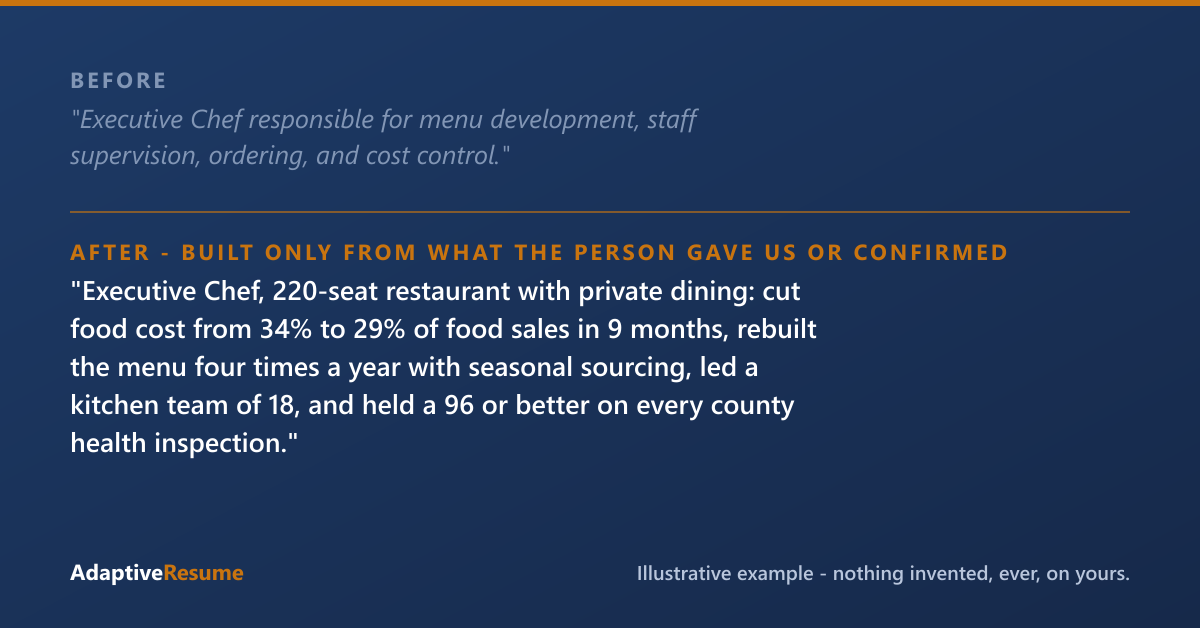
Illustrative example. Everything on your resume is yours: the experience you listed, plus the kitchens, certifications, and results your work already involved, each added only after you confirm it’s true.
The second version tells a reader the size and type of kitchen first, then shows cost, menus, team, and safety in numbers an owner recognizes from their own reports.
Summary example: “Executive Chef with 12 years in hotel and independent kitchens, ACF Certified Executive Chef. Run three outlets and banquets for up to 400, hold food cost near 29%, and have opened two kitchens.” Name your years, your settings, your scale, and the results you are known for.
The numbers an owner or general manager reads
- Food cost. Food cost as a percentage of food sales, where it started, and where you brought it. Owners and general managers often ask about it first.
- Labor cost. Kitchen labor as a percentage of sales, or the hours you scheduled against the budget. If your owner tracks prime cost (food plus labor as a share of sales), give that figure too.
- Volume. Covers per week, plates per banquet, or catering events per month, so a reader can picture the pace.
- Sales. Food sales or the kitchen’s share of revenue, if you saw the figures and had a part in them.
- Team. The number of cooks and staff you led, the sous chefs and leads you developed, and turnover, if you lowered it.
- Health and safety. Inspection scores or results, written the way your jurisdiction reports them.
- Openings and changes. Kitchens you opened, remodels you ran, or concepts you launched, with dates.
Write the part you drove. If food cost fell because the owner changed suppliers, say what you did with the change, such as rewriting specs and recosting the menu.
Menus, purchasing, and costing
Menu work is the creative half of the job, and it belongs on the page with specifics:
- how many menus you wrote or changed, and how often
- the cuisine and the price point
- recipe costing and plate costing, and the system you used
- purchasing: the vendors you managed, the bids you ran, the annual food and supply purchasing you controlled in dollars, such as “managed $1.2M in annual food purchasing,” and any savings from specs or ordering
- the systems you cost and order in, such as your point-of-sale system, an inventory or recipe-costing program, or a spreadsheet you built, named the way you used them, because postings often name one
- inventory: how often you counted, and how you cut waste
A line such as “costed every recipe on a 48-item menu and repriced 12 items to bring plate costs in line” shows both the cooking and the business.
Certifications, named exactly
American Culinary Federation (ACF). The ACF certifies chefs at several levels, and the two most relevant here are:
- Certified Executive Chef (CEC). The ACF’s CEC requirements include five years as a chef de cuisine, executive sous chef, or chef in charge of food production, supervising at least five full-time people, within the past ten years; an education path (such as a high school diploma or GED plus 150 continuing education hours, or an associate’s degree in culinary arts); 30-hour courses in nutrition, food safety and sanitation, supervisory management, beverage management, and cost control management; and written and practical exams.
- Certified Chef de Cuisine (CCC). The CCC requires supervising at least two full-time people, three years supervising a shift or stations, an education path, courses in nutrition, food safety and sanitation, and supervisory management, and written and practical exams.
Write each one with the issuer: “Certified Executive Chef (CEC), American Culinary Federation.” If you are working toward one, write what you have finished and when you expect the rest: “Certified Executive Chef (CEC), American Culinary Federation, in progress: courses complete, practical exam expected [month/year].”
ACF certifications renew every five years, with 80 continuing education hours for one certification level and more if you hold several, so write “current through [year]” and leave off a lapsed level or mark it expired.
Food safety. List your food protection manager certificate, such as the ServSafe Food Protection Manager Certification, with its expiration date. Our restaurant general manager resume guide covers how that certificate and allergen training are written.
Culinary education. Name the school, the program, and the year, or the apprenticeship and its sponsor.
The kitchen you ran
Executive chef jobs differ by setting, so name yours next to each employer:
- Independent and chef-driven restaurants: menu identity, sourcing, and the dining room’s reputation.
- Hotels and resorts: several outlets at once, room service, banquets, and a food and beverage director to report to.
- Country clubs: member events, a la carte dining, and seasonal swings.
- Catering and banquets: event counts, plates per event, and off-site logistics.
- Multi-unit groups: consistency across locations, recipe standards, and training programs.
- Hospitals, universities, and corporate dining: large daily volume, set budgets, and special diets.
If you are changing settings, say so in your summary, for example from hotel banquets to an independent restaurant, and name the numbers that carry over.
Moving up from sous chef
The jump to executive chef is a jump from running service to running the business of the kitchen. If you are making it, show the parts of the job you already do:
- writing or costing a menu, even one section of it
- placing orders and managing vendors
- building schedules against a labor budget
- hiring and training cooks
- running the kitchen when the executive chef is away
Give each one a number, such as the dishes you costed or the cooks you trained. Our line cook resume guide covers the earlier steps on the path.
Format notes
- Put the kitchen’s size and type next to each title, before the bullets.
- Keep awards and press in one short section, with the year and the source, and only the ones that were yours.
- Give earlier cook jobs one line each once you have several chef roles to show.
- Keep the layout plain, with standard headings and no tables, so screening software reads every line.
Executive chef resume bullets you can adapt — keep only what’s true
- “Led a kitchen team of [number] at a [number]-seat [format]; [covers or plates] per week.”
- “Cut food cost from [X]% to [Y]% of food sales in [period] by [your change].”
- “Wrote and costed [number] seasonal menus a year at a [price point] check average.”
- “Opened [concept or kitchen] in [month/year]; hired and trained a team of [number].”
- “Held [result] on [number] health inspections over [period].”
- “Developed [number] cooks into sous chef or lead roles.”
What screening software looks for on an executive chef resume
Filters commonly read for: executive chef, chef de cuisine, executive sous chef, sous chef, kitchen manager, culinary director, menu development, recipe costing, food cost, labor cost, purchasing, inventory, vendor management, banquets, catering, high volume, fine dining, food safety, ServSafe, health inspections, sanitation, hiring, training, scheduling, P&L, kitchen openings, ACF, CEC, and CCC. O*NET’s profile for chefs and head cooks has the full task list.
The lines an owner can check with one call are the ones most worth getting right: a food cost figure you never reached, a certification you have not earned, or an award that belonged to the restaurant before you arrived. Write what you actually did.
The Achievement-Quantification Worksheet below helps you find the real numbers behind your kitchens, such as food cost, covers, and team size, and mark honest estimates as estimates. Our build does it with you: we work backwards from the kitchens you ran and the roles you held, and we ask you about the numbers, the menus, and the certifications that work like yours normally involves. Nothing goes on your resume that you didn’t give us or confirm, so a number, a credential, or an award you never told us about stays off the page.
Common questions
What numbers belong on an executive chef resume?
Food cost as a percentage of food sales, kitchen labor cost, the covers or plates your kitchen produced on a typical week, banquet or catering volume, the size of the team you led, and your health inspection results. Add the menus you built and any openings you led. Use figures you know from your own work, such as the food cost the owner reviewed with you each month, and say which part you drove. Never copy reports out of an employer's systems.
Should I list ACF certification on my resume?
Yes, if you hold it, and write it exactly: for example, "Certified Executive Chef (CEC), American Culinary Federation." The CEC requires five years as a chef de cuisine, executive sous chef, or chef in charge of food production, supervising at least five full-time people, plus education, mandatory courses, and written and practical exams. If you are working toward it, write it as in progress.
How is an executive chef resume different from a sous chef resume?
A sous chef resume shows that you run the line and the team on a shift. An executive chef resume shows that you run the business of the kitchen: cost, menus, purchasing, hiring, training, and results the owner reads every month. If you are moving up, show the parts of the executive chef's job you already do.
Do awards and press belong on the resume?
Real ones do, briefly. Name the award, the year, and who gave it, or the publication and the year for press. Keep them in one short section so they support the numbers rather than replace them, and never list an award the restaurant won before you arrived as your own.
How long should an executive chef resume be?
Long enough to show your last ten to fifteen years of kitchens with real numbers, which often means two pages for a senior chef. Earlier cook jobs can be one line each. Cut generic duty lines before you cut a number.
Achievement-Quantification Worksheet
Pop your email in and the download unlocks right here. Joining our list also takes 25% off your first purchase within 30 days of joining, when you create your account with this same email. We'll also send the occasional useful note. No spam.
Download: Achievement-Quantification WorksheetThanks, you're on our list, and your download is ready just above. Your 25% off a first purchase is good for 30 days from the day this email joined our list.
That email didn't look right — mind trying it again?
Ready to do this on your own resume?
We'll find what you've left off, and nothing goes on your resume that you didn't give us or confirm.
Get your resume build — $29Every purchase is one payment, and nothing renews. A single resume build can be used any time within 12 months of buying it, and AR Pass builds you don't use end when its 90 days end.
Try the demo first — a sample review, no sign-up · See how the service works
Paid a resume service and got a template back? Start at Fix my resume.