Guides · For job seekers
Bookkeeper Resume: Systems, Close, and Real Scope
Bookkeeping hiring reads for trust and scope: which systems you ran, how many accounts you reconciled, how fast you closed the month, and what you filed. Here's how to write yours honestly — with or without a credential.
Published 09/08/2026
Bookkeeping hiring runs on trust and scope. The owner, controller, or firm partner reading your resume wants to know one thing: can they hand you the books and get clean, on-time numbers back without watching over your shoulder? Generic language (“responsible for all bookkeeping duties in a fast-paced office”) doesn’t answer that. The specifics do — the systems you ran by name, how many accounts you reconciled, how fast you closed the month, and what you filed.
The other thing that trips up bookkeeper resumes is scope vagueness. An AP (accounts payable) clerk, a staff bookkeeper, a full-charge bookkeeper, and a freelance bookkeeper carrying [N] client books are related but different jobs, and a resume that just says “bookkeeper” competes badly against one that names the cycle it owned. Say what your scope was, and what you did in it.
The scope line: your books in one sentence
Under each role, give one line a fellow bookkeeper recognizes instantly.
Before: “Responsible for bookkeeping duties including accounts payable, accounts receivable, and reconciliations for a small business.”
After: “Full-charge bookkeeper for [3] entities, [400] transactions per month in [QuickBooks Online]; reconciled [9] bank and credit card accounts, closed the books within [5] business days of month-end, and filed [1099s] and [state] sales tax.”
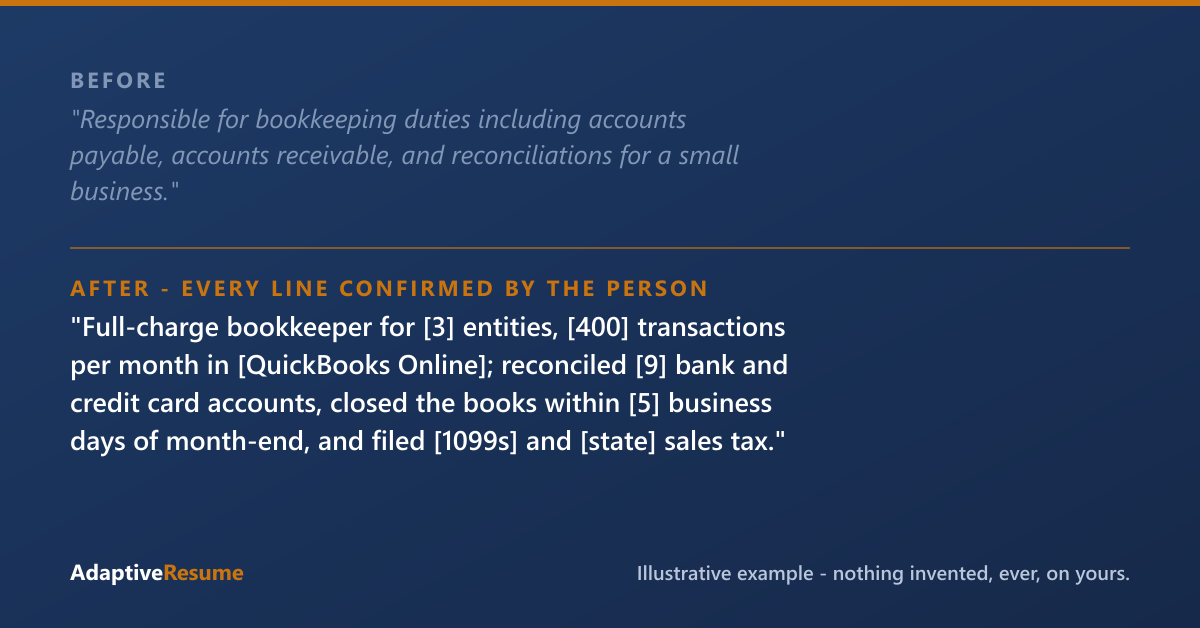
Illustrative example. On your resume, every line comes from your real history — proposed as a question, added only when you confirm it.
The second version is scannable in four seconds and answers what the first leaves a reader guessing at. Notice the rewrite invents nothing; it just says plainly what the vague version was hiding. Fill the brackets with your real numbers.
Credentials — optional in this field, so list them honestly
Bookkeeping has no state or government license. Bookkeepers are generally hired on experience and software skill, and a resume with no credential block is normal. The credentials below are real, checkable, and worth their own lines if you hold them. Our guide on how to list certifications on a resume covers placement and format; here is what typically belongs in a bookkeeper’s block:
- Certified Bookkeeper (CB) — from the AIPB (American Institute of Professional Bookkeepers). It requires passing a four-part national exam, and the AIPB also asks for evidence of at least two years of full-time bookkeeping experience or 3,000 hours part-time or freelance, which can be met before or after the exam. Because of that experience rule, a CB tells a reader you have been doing the work for a while.
- Certified Public Bookkeeper (CPB) — from the NACPB (National Association of Certified Public Bookkeepers). NACPB calls it a license; it is a private credential the NACPB issues on completing its program and agreeing to its code of conduct, and it renews yearly with 24 hours of CPE (continuing professional education). List the year and, if current, “active.”
- QuickBooks Online certification — Intuit offers QuickBooks Online Certification (Level 1 and Level 2) through its ProAdvisor Program, which is free to join with a QuickBooks Online Accountant account. Name the level and year; small-business postings filter for it constantly.
- Xero certification — Xero’s certification is free and runs in levels: Xero associate (Level 1), Xero professional (Level 2), and Xero specialist (Level 3), with add-on badges such as Payroll Specialist. Name the level you hold, not just “Xero certified.”
List exactly what you hold, with real status. “QuickBooks Online Certification Level 1, [2025]” is a line; “QuickBooks expert” is a claim. An accounting degree belongs under education, not here — but say it.
The parts of the job that carry the most weight
Systems, by name. QuickBooks Online, QuickBooks Desktop, Xero, Sage Intacct, and NetSuite are the general ledgers most postings filter for. Then the tools around them: Bill.com for AP, Expensify for expenses, Gusto or ADP for payroll, and Excel for everything else. Name each one you ran, not just “accounting software.”
Reconciliations. How many bank, credit card, and loan accounts you reconciled, how often, and whether you cleared the discrepancies yourself.
Month-end close. This is the center of the job for anyone above clerk level. Say what the close included — accruals, prepaid and depreciation entries, the financial statements you produced — and how many business days it took.
AP and AR. Vendor bill entry and payment runs, three-way matching (checking each bill against the purchase order and the receiving record) where you did it, AP aging you managed; on the AR (accounts receivable) side, invoicing volume, collections, and the AR aging you kept current. Each is real, nameable work with a number attached.
Payroll. Headcount, pay frequency, the system, and what you owned: hours, deductions, quarterly filings, year-end forms. “Processed biweekly payroll for [45] employees in [Gusto]” tells a reader everything.
Filings. Form 1099-NEC (Nonemployee Compensation) for contractors at year-end, state sales tax returns and their frequency, and anything else you filed on a deadline. Deadlines met on your own are proof of reliability.
Basis and standards. Say whether you kept books on a cash or accrual basis and, if accrual, that you worked to GAAP (Generally Accepted Accounting Principles). Don’t overstate it: a bookkeeper applies the basics of GAAP; the outside CPA (certified public accountant) signs off. For firm and freelance bookkeepers, add the number of client books you carried and the industries.
Format notes
Length follows your history, not a page rule. Two pages is normal and expected once you have more than one substantive bookkeeping role to describe; one page is right for people starting out or moving over from clerical or cash-handling work. Order matters more than length: a skills-and-systems block near the top in its own labeled section (screening software keys on it), certifications if you hold any, then experience with a scope line atop each role. If you moved up inside one company — clerk to staff bookkeeper to full-charge — show each step; our guide on how to list promotions on a resume covers the layout.
One genuine exception worth knowing: federal applications through USAJOBS cap at two pages as of the September 2025 OPM change. That’s a hard requirement, not a style preference.
Otherwise: reverse chronological, single column, standard headings, real text rather than graphics or tables — plain layouts parse most reliably. Skip the graphics and the skills-rating bars.
A bullet bank you can adapt — keep only what’s true
- “Full-charge bookkeeper for [N] entities; [N] transactions per month in [QuickBooks Online / Xero / Sage Intacct]”
- “Reconciled [N] bank, credit card, and loan accounts monthly; cleared discrepancies to zero unexplained variance”
- “Closed the books within [N] business days of month-end; prepared balance sheet, P&L (profit and loss), and cash flow statements for [owner / CPA]”
- “Processed [N] vendor bills per month through [Bill.com]; kept AP aging current and ran [weekly] payment batches”
- “Issued [N] customer invoices per month; followed up on collections and kept AR over 60 days under [N]%”
- “Processed [biweekly] payroll for [N] employees in [Gusto / ADP]; filed quarterly payroll returns on time”
- “Prepared and filed [N] Form 1099-NEC at year-end and [monthly / quarterly] [state] sales tax returns”
- “Maintained books on [cash / accrual] basis; posted accruals, prepaids, and depreciation entries for review by the outside CPA”
Each bullet is a frame, not a claim. If a line isn’t true of your work, it doesn’t go on your page — the first interview question about your close will find it.
Starting out: a bookkeeper resume with no experience
If you don’t have a bookkeeping title yet, lead with what you can prove today. The free vendor certifications above are the fastest honest signal — a QuickBooks Online or Xero certification says you can run the system before day one. Then name the adjacent work you have actually done: accounting coursework, a volunteer treasurer role, cash handling and daily deposits from a retail or bank teller job, invoicing or expense tracking from an office manager or admin role, with the system named beside each.
Don’t call yourself a bookkeeper for work that wasn’t bookkeeping, and don’t list “month-end close” from a textbook as if you had done it. A short, true resume beats a padded one.
What screening software looks for on a bookkeeper resume
Filters read for the vocabulary of the books, and a human reads for the same words minutes later. The terms that matter: bookkeeping, full-charge bookkeeper, accounts payable, AP, accounts receivable, AR, general ledger, journal entries, bank reconciliation, month-end close, financial statements, payroll, 1099, sales tax, accrual, cash basis, GAAP, QuickBooks Online, QuickBooks Desktop, Xero, Sage Intacct, NetSuite, Bill.com, Expensify, Gusto, ADP, Microsoft Excel, pivot tables, Certified Bookkeeper, CB, Certified Public Bookkeeper, and CPB.
One honesty note on job codes: O*NET profiles this work under Bookkeeping, Accounting, and Auditing Clerks (43-3031.00), and its listed technology skills open with accounting software, QuickBooks first, and include Excel. Full-charge, freelance, and AP-only work all sit inside that one occupation code — which is exactly why your scope line and named systems have to carry the message the code can’t.
The highest-risk lines are the ones that overstate scope — an AP role written as full-charge, a close you assisted with written as one you owned, or a certification listed at the wrong level. Bookkeeping is a trust job, and references get called.
The Role Skills Checklist below helps you inventory what your work with the books actually proves, which is often considerably more than the resume currently says. Our build does it with you: we work backwards from your real systems, volumes, and filings, propose the lines and credentials that history supports — each one offered as a question, not a decision made for you — and ask you to confirm every item before it appears. We never add a credential, a system, or a filing you didn’t tell us about.
Common questions
Do I need a certification to get a bookkeeping job?
No. Bookkeeping has no state or government license, and many employers hire on experience and software skill. Two national credentials exist and are worth listing if you hold them: the Certified Bookkeeper (CB) from the AIPB (American Institute of Professional Bookkeepers) and the Certified Public Bookkeeper (CPB) from the NACPB (National Association of Certified Public Bookkeepers). Vendor certifications — QuickBooks Online certification through Intuit's ProAdvisor Program, and Xero's certification levels — are free and carry real weight because they name the exact system a posting asks for.
How do I write a bookkeeper resume with no experience?
Lead with what you can prove. Free vendor certifications (QuickBooks Online, Xero) show you can run the software before day one. Coursework in accounting fundamentals, a volunteer treasurer role, cash handling, invoicing, or data entry from any job are all real bookkeeping-adjacent work — name them plainly with the systems you used. Don't title yourself 'Bookkeeper' for work you didn't do; 'Accounting coursework, QuickBooks Online certified, [N] months volunteer treasurer' is honest and reads well.
What's the difference between a bookkeeper and a full-charge bookkeeper?
Full-charge means you own the whole cycle for a business — AP and AR, payroll, reconciliations, journal entries, the month-end close, and the financial statements — usually reporting to an owner or an outside CPA (certified public accountant) rather than to a controller. If that's your work, say 'full-charge' on the page and back it with the close and the statements you produced. If you handled one piece, such as AP, say that; it's a real job and hiring managers filter for it.
Should I list Excel, or is that assumed?
List it, and say what you did with it. 'Microsoft Excel' alone is assumed; 'built reconciliation workbooks with lookups and pivot tables' is a skill. Screening software matches the word, and a person reads for the proof.
Role Skills Checklist
Pop your email in and the download unlocks right here — and being on the list before launch day locks in 25% off your first build. We'll also send the occasional useful note and tell you the moment AdaptiveResume goes live. No spam.
Download: Role Skills ChecklistThanks — you're on the launch list, your 25% is locked in, and your download is ready below.
That email didn't look right — mind trying it again?
Ready to do this on your own resume?
We'll find what you've left off and you approve every line — nothing made up.
Build your resume — $49Try the demo first — a sample review, no sign-up · See how the service works
Paid a resume service and got a template back? Start at Fix my resume.