Guides · For job seekers
Physical Therapist Assistant Resume: License, Caseload, and Setting Scope
PTA hiring reads for readiness under a plan of care: your license exactly as held, the settings and diagnoses you have actually treated, and a caseload line that shows real scope. Here's how to write yours honestly.
Published 09/08/2026
Physical therapist assistant (PTA) hiring runs on one question: can the supervising physical therapist (PT) hand you their caseload and trust you to carry the plan of care, progress it within the plan, and flag the patient who is not responding? Generic language (“provided quality patient care in a fast-paced rehabilitation setting”) doesn’t answer that. The specifics do — your settings, the diagnoses you have treated, the caseload you carried, your license exactly as your state issues it, and the charting system you documented in.
The other thing that trips up PTA resumes is scope blur in both directions. Some pages claim evaluation and diagnosis, which belong to the PT and read as a red flag. Others shrink the job to “assisted the physical therapist” and hide real, skilled treatment work. Say what your setting was, what you treated, and what you did under the plan of care — no more, no less.
The caseload line: your scope in one sentence
Under each role, give one line a fellow PTA or a rehab director would recognize instantly.
Before: “Physical therapist assistant responsible for treating patients and assisting the physical therapist with rehabilitation.”
After: “PTA, [outpatient orthopedic] clinic; [12–14] patients per day under PT plans of care — post-surgical knee and shoulder, low back, and balance cases; manual therapy, therapeutic exercise, and modalities; [WebPT] documentation.”
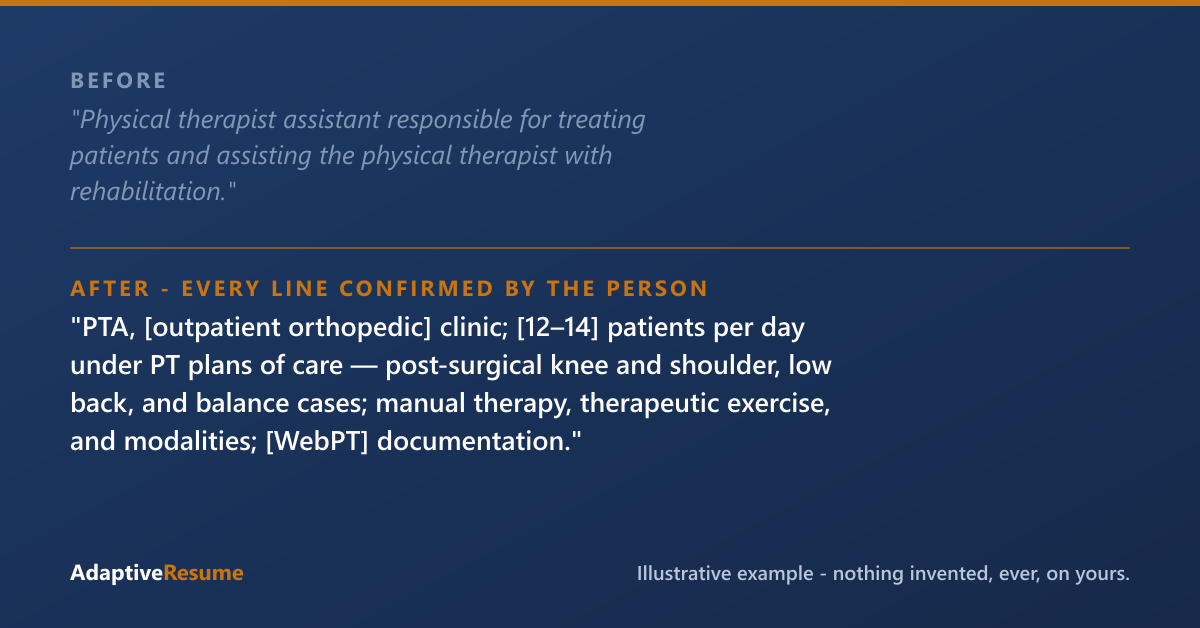
Illustrative example. On your resume, every line comes from your real history — proposed as a question, added only when you confirm it.
The second version is scannable in four seconds and answers what the first leaves a reader guessing at. Notice the rewrite invents nothing; it just says plainly what the vague version was hiding. Fill the brackets with your real setting, numbers, and system.
Credentials, exactly as held
Every item in this block gets checked against a state board lookup, so it has to be exactly right. Our guide on how to list certifications on a resume covers placement and format; here is what typically belongs in a PTA block:
- State PTA license or certification — issued by your state’s physical therapy board, with the state and license number. Every state and the District of Columbia licenses or certifies PTAs; the term and the requirements vary by state, so use your board’s exact wording.
- NPTE-PTA — the physical therapist assistant version of the National Physical Therapy Examination, developed and administered by FSBPT (Federation of State Boards of Physical Therapy). A short line with the month and year passed is enough.
- CAPTE-accredited program — graduation from a PTA program accredited by CAPTE (Commission on Accreditation in Physical Therapy Education). Name the school and the degree; boards and many employers look for the accreditation.
- BLS — Basic Life Support, typically through the American Heart Association, with current-through dates.
- PT Compact privilege — the Physical Therapy Compact lets PTAs and PTs who live in and hold a license from an active member state purchase a “compact privilege” to practice in other member states. If you hold privileges, list each state — home health and travel employers filter for this.
- APTA membership and PTA Advanced Proficiency Pathways — the APTA (American Physical Therapy Association) runs the PTA Advanced Proficiency Pathways program for its members, an assessment-based certificate in one of eight areas: acute care, cardiovascular and pulmonary, geriatrics, neurology, oncology, orthopedics, pediatrics, and wound management. If you have completed one, name the area and the year.
List exactly what you hold, with real status. Nothing you’re “about to take” unless it’s labeled that way — “NPTE-PTA, scheduled [month/year]; license application pending” is honest and reads fine. A misnamed credential is the fastest way to lose ground in a profession where every license is looked up before an offer.
The parts of the job that carry the most weight
Treatment under the plan of care. This is the center of the job. Say it plainly: delivered treatment under PT plans of care, progressed interventions within the plan, and reported status changes to the supervising PT. That wording shows you know the supervision line, which is the first thing a rehab director listens for.
Settings. Outpatient orthopedics, SNF (skilled nursing facility), acute care, inpatient rehabilitation, home health, pediatrics, and sports are different jobs with different caseloads, documentation, and pace. Name each setting you have worked and what the caseload looked like there.
Diagnoses and populations. Post-surgical joint replacement, rotator cuff repair, low back pain, stroke and other neurological cases, balance and fall-risk patients, pediatric developmental delay, cardiac and pulmonary patients. Write what you have actually treated, not what the clinic sees.
Interventions and modalities. Therapeutic exercise, gait training, transfer training, the manual therapy techniques you were trained in, and modalities (machine-based treatments) by name — electrical stimulation, ultrasound, moist heat and cold, mechanical traction. Screening software keys on the nouns.
Outcome measures. The tools you have administered and recorded: Timed Up and Go (TUG), Berg Balance Scale, Six-Minute Walk Test, Lower Extremity Functional Scale (LEFS), Oswestry Disability Index. Listing them shows you track progress, not just deliver sessions.
Documentation and Medicare. Daily notes and progress toward plan-of-care goals. Medicare requires the CQ modifier on outpatient physical therapy services furnished in whole or in part by a PTA, and since 01/01/2022 those claims are paid at 85 percent of the otherwise applicable Part B amount — so clinics care that PTAs document minutes accurately. If you handled that, say so.
Patient and family education. Home exercise programs, safe transfers, fall prevention, and equipment use.
Charting. WebPT, Net Health (which acquired Casamba), Epic, or Oracle Health (formerly Cerner) by name.
If you’re an occupational therapy assistant
The same rules apply to an occupational therapy assistant (OTA) resume, with the credentials swapped. The national credential is COTA (Certified Occupational Therapy Assistant) from NBCOT (National Board for Certification in Occupational Therapy), plus your state license or certification as the state issues it. Your caseload line names the setting, the populations, and the work under the OT’s plan of care: activities of daily living training, upper-extremity rehabilitation, splinting, and adaptive equipment. Medicare’s parallel to the CQ modifier is the CO modifier for services furnished in whole or in part by an OTA. Everything else on this page carries over as written.
Format notes
Length follows your history, not a page rule. Two pages is normal and expected once you have more than one substantive clinical role to describe; one page is right for new graduates listing clinical rotations. Order matters more than length: license and certification block near the top in its own labeled section (screening software keys on it), then experience with a caseload line atop each role. If you’re trimming to fit, cut older non-clinical detail before you cut a single treatment specific.
One genuine exception worth knowing: federal applications through USAJOBS cap at two pages as of the September 2025 OPM change. That’s a hard requirement, not a style preference.
Otherwise: reverse chronological, single column, standard headings, real text rather than graphics or tables — hospital and clinic systems parse plain layouts most reliably. Skip the graphics.
A bullet bank you can adapt — keep only what’s true
- “PTA, [setting]; [N] patients per day under PT plans of care; [diagnoses/populations treated]”
- “Progressed therapeutic exercise, gait, and transfer training within the plan of care; reported status changes to the supervising PT”
- “Delivered [modalities: electrical stimulation, ultrasound, moist heat] per plan of care in an [outpatient/SNF/acute] setting”
- “Administered and recorded [TUG, Berg Balance Scale, Six-Minute Walk Test] at [interval] to track progress toward goals”
- “Documented daily notes and progress in [system]; applied the CQ modifier and tracked treatment minutes for Medicare Part B claims”
- “Instructed patients and families in home exercise programs, safe transfers, and fall prevention”
- “Treated [N] home health visits per week across [county/area]; coordinated with the supervising PT on plan-of-care changes”
- “Mentored [N] PTA students through clinical rotations; oriented new hires to [system] documentation”
Each bullet is a frame, not a claim. If a line isn’t true of your practice, it doesn’t go on your page — an interviewer’s first follow-up question will find it.
What screening software looks for on a physical therapist assistant resume
Clinic and hospital filters read for the vocabulary of the profession, and a human reads for the same words minutes later. The terms that typically matter: physical therapist assistant, PTA, plan of care, therapeutic exercise, gait training, transfer training, manual therapy, modalities, electrical stimulation, ultrasound, outpatient orthopedics, skilled nursing facility, SNF, acute care, home health, pediatrics, home exercise program, CQ modifier, NPTE-PTA, CAPTE, BLS, PT Compact, WebPT, Net Health, and Epic.
The occupation has its own code: O*NET profiles this work under Physical Therapist Assistants (31-2021.00). Make sure your license line and caseload line hit that target. If you’re weighing other allied-health paths, our guides for respiratory therapists and radiologic technologists follow the same honest pattern.
The highest-risk lines are the ones that overstate scope — an evaluation you observed but did not perform, a modality you were never trained on, or a license status that isn’t quite current. Rehab is a small world, and employers check.
The Role Skills Checklist below helps you inventory what your treatment work actually proves, which is often considerably more than the resume currently says. Our build does it with you: we work backwards from your real settings, caseloads, and credentials, propose the lines and credentials that history supports — each one offered as a question, not a decision made for you — and ask you to confirm every item before it appears. We never add a credential, a setting, or an intervention you didn’t tell us about.
Common questions
How do I list my PTA license when my state calls it a certification?
Use your state's own word. Every state and the District of Columbia licenses or certifies physical therapist assistants, and the term is set by the state board, not by you. Write it the way the board issues it: 'Licensed Physical Therapist Assistant, [state], License #[N]' or 'Certified Physical Therapist Assistant, [state].' If you hold a PT Compact privilege in other member states, list each one on its own line.
Should I put the NPTE-PTA on my resume?
Yes, briefly, and especially early in your career. The NPTE-PTA (the physical therapist assistant version of the National Physical Therapy Examination) from FSBPT (Federation of State Boards of Physical Therapy) is the exam behind your license; every state's board requires it for licensure. A short line under education — 'NPTE-PTA, passed [month/year]' — reads fine. Once you have a few years of practice, the license line carries the message on its own.
I'm a new graduate with only clinical rotations. What goes on the page?
Your clinical rotations, written like jobs. Give each one the setting, the diagnoses you treated, the caseload you carried by the end, and the EMR (electronic medical record) you charted in. 'Clinical rotation, [outpatient orthopedic clinic], [N] weeks; treated [N] patients per day by final week under PT (physical therapist) plans of care; [WebPT] documentation' tells a hiring manager what you have actually done. Add your CAPTE-accredited program by name and your license or exam status honestly.
Can a PTA write 'evaluated' or 'diagnosed' on a resume?
No. Evaluation, plan-of-care design, and diagnosis belong to the physical therapist. A PTA delivers treatment under that plan and reports progress back. Write what you did: 'treated under PT plans of care,' 'progressed interventions within the plan,' 'reported status changes to the supervising PT.' That wording is not a smaller claim — it is the exact scope a clinic is hiring for, and it shows you know where the line is.
Role Skills Checklist
Pop your email in and the download unlocks right here — and being on the list before launch day locks in 25% off your first build. We'll also send the occasional useful note and tell you the moment AdaptiveResume goes live. No spam.
Download: Role Skills ChecklistThanks — you're on the launch list, your 25% is locked in, and your download is ready below.
That email didn't look right — mind trying it again?
Ready to do this on your own resume?
We'll find what you've left off and you approve every line — nothing made up.
Build your resume — $49Try the demo first — a sample review, no sign-up · See how the service works
Paid a resume service and got a template back? Start at Fix my resume.