Guides · For job seekers
Patient Care Technician Resume: Your Unit, Your Ratios, and the Skills a Floor Actually Uses
A hospital reads a patient care technician resume for three things: the certifications written exactly right, the unit and patient ratio you carried, and the technical skills your shifts prove — draws, EKGs, glucose checks, charting. Here's how to write yours honestly.
Published 09/26/2026 · Updated 10/30/2026
A hospital reads a patient care technician resume in a few seconds, and it reads for three things. Are your certifications current and written the way the issuers write them? What unit did you work, and what patient load did you carry? And do the technical skills on the page, the draws, the EKGs, the glucose checks, the charting, match what a charge nurse would confirm if someone called? “Compassionate patient care technician dedicated to quality care” answers none of that. The specifics do.
The other thing that sinks PCT resumes is leaving off the work. Techs do a great deal that never makes the page: vitals on a full assignment every four hours, blood draws and EKGs on a floor that used to call the lab for them, point-of-care glucose, Foley care, safety sitting, intake and output, charting every task in the hospital system, and the escalations that caught a patient going bad. Nearly all of it is what the next unit is screening for, and this guide is about getting it on the page without adding a single thing that did not happen.
The shift line: your scope in one sentence
Under each job, give one line another tech or a charge nurse would recognize instantly.
Before: “Patient care technician responsible for assisting nurses and providing patient care.”
After: “PCT, CPCT/A (NHA, active), BLS (American Heart Association); [8]-patient assignment on a [36]-bed telemetry unit, [night] shift; vitals, [12]-lead EKGs (electrocardiograms), blood draws ([4]-[6] per shift), point-of-care glucose, Foley care, 1:1 safety sitting; charted in [Epic].”
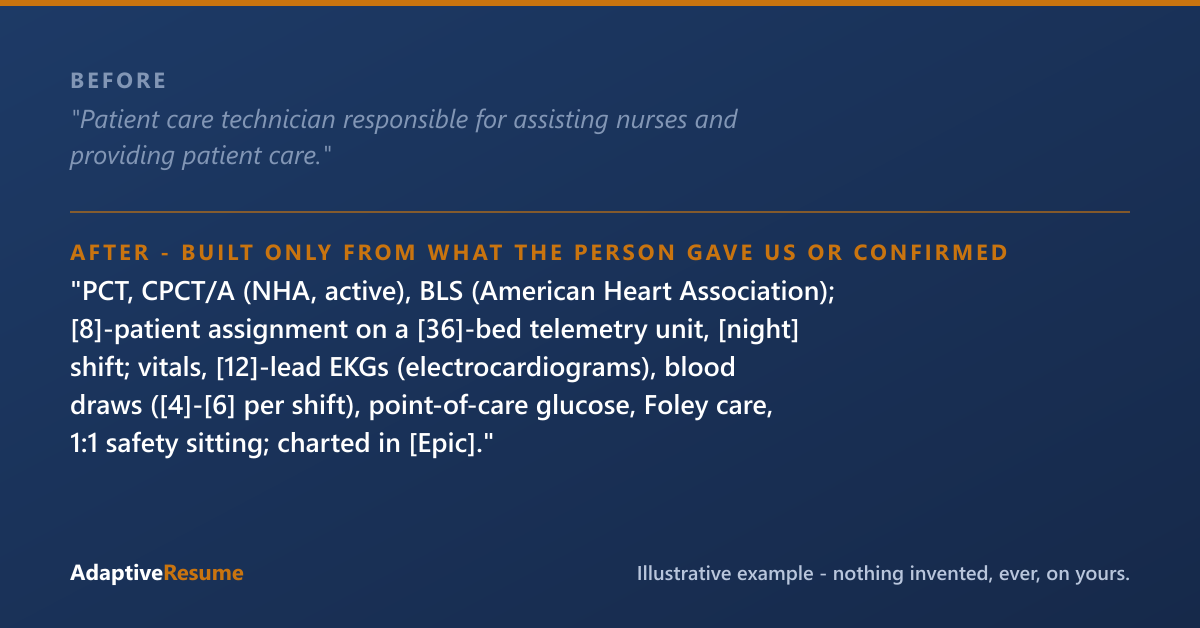
Illustrative example. Everything on your resume is yours: the experience you listed, plus the skills, tools, responsibilities, and credentials your work already involved, each added only after you confirm it’s true.
The second version answers, in one line, what the first leaves a reader guessing at: what you hold, what unit and shift, how many patients, what you actually did, and what system you documented it in. It invents nothing. Fill the brackets from your real assignments and the skills you were checked off on, not from what a “typical” tech does.
Credentials, exactly as held
A PCT’s credential block is usually three or four lines, and every one of them gets checked. Our guide on how to list certifications on a resume covers placement; here is what belongs in yours.
- CPCT/A, if you hold it. The NHA (National Healthcareer Association) Certified Patient Care Technician/Assistant credential requires a high school diploma or equivalent and one of two paths: a patient care technician training program completed within the last five years, or one year of supervised work in the field within the last three years (two years within the last five). Candidates then pass a 100-question exam. It renews every two years on 10 continuing education credits. Write it exactly: “CPCT/A, NHA, current through [month year].” If you completed a PCT program but haven’t tested, write the program and the hours, not the credential.
- BLS, by issuer. Hospitals typically require BLS (Basic Life Support), most often the American Heart Association course, before or within the first weeks of hire. Write the card as it reads: “BLS Provider, American Heart Association, current through [month year].” Don’t write CPR when you hold BLS, or BLS when you hold a general CPR course.
- CNA (certified nursing assistant), if you hold it. Your state nurse aide registry listing is a separate credential from any PCT certificate, and some hospitals require it. Write it as the registry shows it: “[State] Nurse Aide Registry, active, [year].” Our CNA resume guide covers the aide side of the page in detail.
- Phlebotomy and EKG certifications, if separate. A CPT (Certified Phlebotomy Technician) or CET (Certified EKG Technician) from the NHA, or a phlebotomy credential from another national body, each on its own line by issuer. If your draws and EKGs came from a hospital competency checkoff instead, they go in experience as skills, not here as certifications.
- Dialysis, if that’s your unit. A dialysis patient care technician works under a federal rule of its own, 42 CFR (Code of Federal Regulations) 494.140(e). It requires a high school diploma or equivalent and a training program approved by the facility’s medical director and governing body, run under the direction of a registered nurse. It also requires certification under a state or national program within 18 months of hire. The national credentials are the CCHT (Certified Clinical Hemodialysis Technician) from the Nephrology Nursing Certification Commission and the CHT (Certified Hemodialysis Technologist/Technician) from BONENT (Board of Nephrology Examiners Nursing and Technology). The CCHT is a 150-question exam that renews every three years on 3,000 work hours and 30 contact hours of continuing education, 10 of them in nephrology. Write the one you hold, with status; if you’re inside the 18-month window, write “CCHT eligible, testing [month year],” not the credential.
- Hospital competencies. Telemetry monitor training, safe patient handling, restraint documentation, point-of-care testing, and any unit-specific checkoff, each with the hospital and the year. These are training, not certifications, and they read best in a short line under the credentials.
List exactly what you hold, with real status. A lapsed BLS card written as current is the first thing a hospital’s onboarding checklist catches.
The parts of the job that carry the most weight
Unit, ratio, and shift. The number means nothing without the unit. “[8]-patient assignment, [36]-bed telemetry, nights” and “[12]-patient assignment, med-surg, days” are both honest and both tell a nurse manager what pace you’ve handled. Emergency department techs give the setting differently: “[Level II] trauma center ED, [N]-bed, [evening] shift.”
Vital signs and escalation. Full sets on schedule, plus what you did with the abnormal ones. “Vitals every [4] hours on a full assignment; escalated [N] changes in condition to the RN (registered nurse), including [two] rapid responses” is a line that shows judgment, not just task completion.
Phlebotomy. Draws per shift, the population, and the training behind it. “Venipuncture, [4] to [6] draws per shift on a telemetry population; trained and checked off by [hospital] lab services.” Say if you drew on a hard-stick population, pediatric or oncology, because that’s a different skill.
EKGs and telemetry. “[12]-lead EKGs, [N] per shift” plus, if you did it, the monitor side: “telemetry monitor tech [two] shifts a week for [24] patients; recognized and reported rhythm changes to the RN.” Rhythm recognition is a trained skill; write it only if you were trained and checked off.
Point-of-care testing. Glucose checks, and anything else your hospital delegated to techs: “point-of-care glucose, [N] per shift, results charted and criticals reported within [policy].”
ADL care and mobility. ADLs (activities of daily living), transfers with lifts and gait belts, ambulation, turning schedules, and skin checks. This is aide work and it’s still the core of the job; write which ones you handled and at what level.
Catheters, specimens, and I&O (intake and output). Foley care and, where your hospital’s policy allowed it after checkoff, insertion and removal; specimen collection; intake and output tracking. Write it precisely and within policy, and only if your hospital delegated it to techs: “Foley insertion and removal per [hospital] policy after checkoff, [year].”
Safety sitting and behavioral care. 1:1 observation for fall-risk, suicide-precaution, or confused patients; restraint monitoring and documentation; de-escalation. “1:1 safety sitter on [N] shifts; restraint checks and documentation every [15] minutes per policy” is exactly what a manager staffing a sitter pool looks for.
Charting. Name the system. In hospitals that’s usually Epic, Oracle Health (formerly Cerner), or Meditech. “Charted vitals, I&O, ADLs, and point-of-care results in [Epic]” matches a filter; “documented patient care accurately” matches nothing.
Dialysis, if that’s your unit. Machine setup and priming, cannulation where your training and facility allowed it, monitoring during treatment, and post-treatment care, with the patient count per shift and the equipment named.
Three things stay off the list: assessments, medication administration, and any task your hospital never delegated to techs. Everything a tech does happens under a nurse’s delegation, so write it in those terms. If you are a tech headed for the license, our med-surg nurse resume guide and the rest of our nursing resume guides are for that page; this one is for the job you hold now. If your work was mostly draws, our phlebotomist resume guide goes deeper on that side.
Patient care technician resume skills: the list, and how to make it true
Put a skill on a PCT resume only if you did it on a real shift and could walk a charge nurse through it. Here are the ones postings name most, in their own words: vital signs, phlebotomy and venipuncture, 12-lead EKG, telemetry monitoring, point-of-care glucose testing, specimen collection, Foley catheter care, intake and output, ADL care, safe patient handling and transfers, fall prevention, 1:1 safety observation, restraint monitoring, wound care assistance, isolation precautions and PPE (personal protective equipment), BLS, and charting in your hospital’s system.
Two rules keep it honest. First, list only what you’ve done, not what your program covered; a skills lab is not a shift. Second, put the unit next to the skill where it changes the meaning: EKGs in an emergency department and EKGs on a med-surg floor are the same words in very different hours.
Format notes
Length follows your history, not a page rule. One page is right for a new PCT or for a couple of years on one unit. Two pages is normal once you have more than one substantive role to describe, a telemetry floor and a dialysis clinic, say, each with its own ratio and skills. Order matters more than length: CPCT/A, BLS, and CNA near the top in their own labeled section, because screening software keys on them, then experience with a shift line atop each role.
There is one hard exception. Since the Office of Personnel Management (OPM) change that took effect on September 27, 2025, USAJOBS accepts resumes of two pages or fewer. Department of Veterans Affairs health technician and nursing assistant postings run through USAJOBS, so if that is where you are headed, two pages is the limit.
Otherwise: reverse chronological, single column, standard headings, real text rather than graphics or tables; applicant systems parse plain layouts most reliably.
Patient care technician resume examples: a bullet bank you can adapt — keep only what’s true
- “PCT, CPCT/A (NHA, current through [month year]), BLS (AHA); [N]-patient assignment on a [N]-bed [telemetry / med-surg / ED] unit, [shift]”
- “Took and charted vitals every [4] hours on a full assignment; escalated [N] changes in condition to the RN, including [N] rapid responses”
- “Performed venipuncture, [N] draws per shift, and [12]-lead EKGs, [N] per shift; trained and checked off by [hospital] [year]”
- “Ran point-of-care glucose checks, [N] per shift; reported critical values within [policy] and charted in [Epic]”
- “Provided full ADL care and transfers with [lift / gait belt] for [N] patients; [zero] falls on my assignments in [year]”
- “Served as 1:1 safety sitter on [N] shifts; completed restraint checks and documentation every [15] minutes per policy”
- “Dialysis PCT: set up and primed [N] machines per shift, monitored [N] patients per treatment, cannulated per facility training; CCHT current”
- “Completed [PCT program], [school], [N] hours, [year]; [N] clinical hours at [hospital]”
Each bullet is a frame, not a claim. If a line isn’t true of your shifts, it doesn’t go on the page; your former charge nurse is the reference.
What screening software looks for on a patient care technician resume
Hospital filters read for the vocabulary of tech work, and a nurse manager reads for the same words minutes later. The terms that typically matter: patient care technician, PCT, nurse tech, CPCT/A, BLS, CNA, phlebotomy, venipuncture, EKG, 12-lead, telemetry, point-of-care, glucose, vital signs, Foley, specimen collection, intake and output, ADL, safe patient handling, 1:1 sitter, restraints, isolation precautions, Epic, Cerner, Meditech, med-surg, telemetry unit, emergency department, and dialysis.
One honesty note on job codes: O*NET has no separate profile for patient care technicians; it groups the work under Nursing Assistants (31-1131.00), whose sample titles include Patient Care Assistant (PCA) but not PCT. Hospital postings use “patient care technician,” “nurse tech,” “clinical technician,” and “PCT” for the same job, which is exactly why writing your hospital’s title plus “patient care technician” once covers you on every posting.
The highest-risk lines overstate standing or scope: a lapsed BLS written as current, a CNA listing you don’t hold, a nursing-school clinical skill written as tech work, or a procedure your hospital never delegated to techs. Every one of those is a registry lookup or a one-minute call to a charge nurse away from being caught.
The Role Skills Checklist below helps you inventory what your training and your shifts actually prove, which is often considerably more than the resume currently says; our skills you forgot, by trade guide is built around exactly that problem. Our build does it with you: we work backwards from your real units, ratios, systems, and credentials, propose the lines that history supports, each one offered as a question rather than a decision made for you, and ask you to confirm every item before it appears. We never add a credential, a number, or a skill you didn’t tell us about.
Common questions
What's the difference between a PCT and a CNA on a resume?
The certification and the skill set. A CNA is a state registry credential earned through a state-approved nurse aide program. A PCT is a hospital job title that usually adds phlebotomy, EKGs, and point-of-care testing on top of aide work, and the credential behind it is usually the NHA's CPCT/A, a hospital's own training, or both. Many PCTs are also CNAs, and some hospitals require it. Write each credential you hold on its own line, by its issuer, and let the title on the page be the one your hospital used.
I'm in nursing school and working as a PCT. How do I show both?
The PCT job goes in experience, written like any job, with the unit, the ratio, and the skills. The nursing program goes in education with the expected graduation date and, if you've completed them, the clinical rotations by unit and hours. Don't write nursing skills from clinicals as PCT work; a manager reading 'medication administration' on a tech resume will ask which license that was under. Keep the two sections honest and separate, and the resume shows exactly what a nurse manager likes to see: a tech who will be an RN on the floor.
How do I write my phlebotomy and EKG experience if I don't have a separate certification for them?
As skills from work, with the volume and the training behind them. 'Venipuncture, [4] to [6] draws per shift, trained and checked off by [hospital] lab services' and '[12]-lead EKGs, [N] per shift' are honest lines without a separate certificate. If you do hold a phlebotomy or EKG certification, write it by issuer in the credentials block. What a manager wants to know is whether you can do it on their floor tomorrow, and a competency checkoff from a real hospital answers that.
Should I put my patient ratio on the resume? It was high.
Put the real one, with the unit. '[12]-patient assignment on a [36]-bed med-surg unit, nights' tells a manager exactly what pace you handled. A high ratio isn't a mark against you; it's the setting. What hurts is a number with no unit next to it, or a number rounded down that a reference call corrects.
Role Skills Checklist
Pop your email in and the download unlocks right here. Joining our list also takes 25% off your first purchase within 30 days of joining, when you create your account with this same email. We'll also send the occasional useful note. No spam.
Download: Role Skills ChecklistThanks, you're on our list, and your download is ready just above. Your 25% off a first purchase is good for 30 days from the day this email joined our list.
That email didn't look right — mind trying it again?
Ready to do this on your own resume?
We'll find what you've left off, and nothing goes on your resume that you didn't give us or confirm.
Get your resume build — $29Every purchase is one payment, and nothing renews. A single resume build can be used any time within 12 months of buying it, and AR Pass builds you don't use end when its 90 days end.
Try the demo first — a sample review, no sign-up · See how the service works
Paid a resume service and got a template back? Start at Fix my resume.